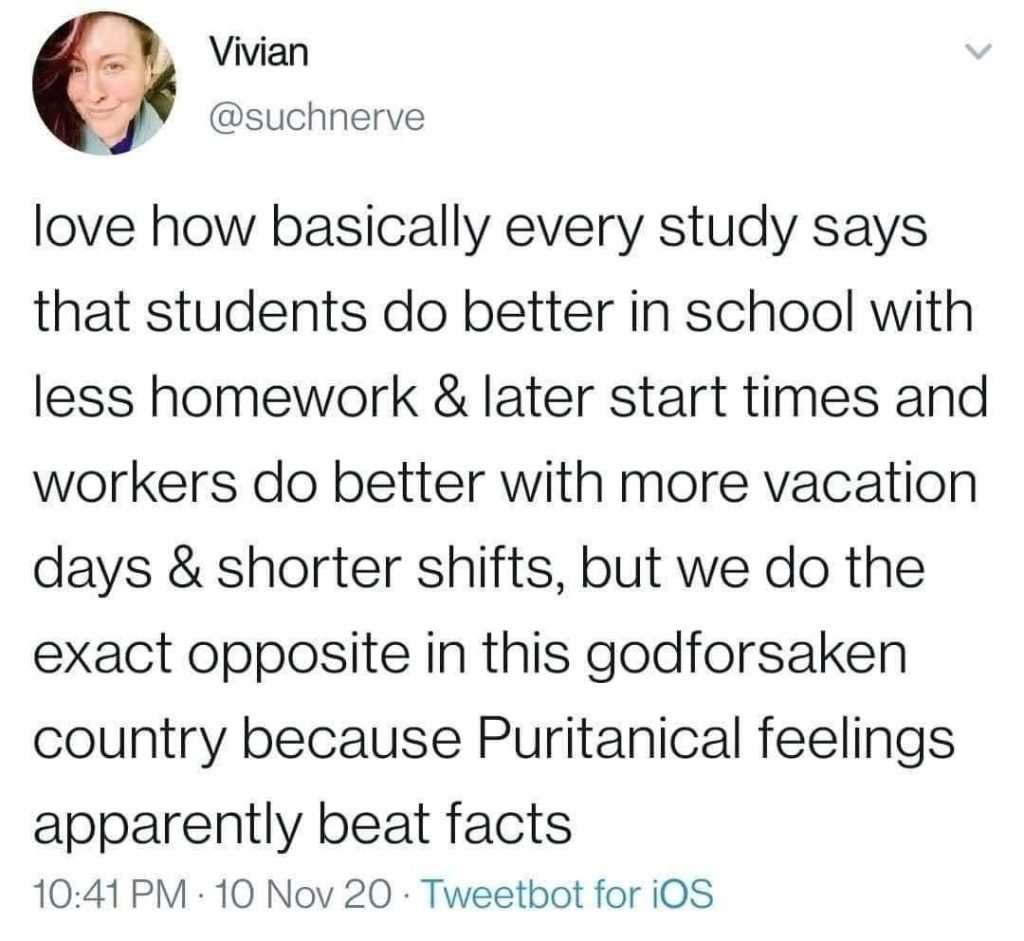
Yes, politics is about gaining power, not following scientists and research.
There is no lack of examples of where many politicians go one way while scientists and research show us a better way.
Why? It’s likely a range of different reasons or combination of reasons. Sometimes, it’s because of puritanical feelings, as the quote suggests. They know what will appeal to their likely voters. They are aligned with money interests that want something else. Most political systems reward immediate results and not long-term or big-picture projects and planning. In our system, there is not much in place to (a) encourage policies grounded in research, (b) encourage long-term and big-picture thinking, and (c) reward what actually gives results. The system is set up so effective or grounded policies are not necessarily rewarded with votes.
The problem is not with the politicians. It’s with the system, and it’s with the people voting for these politicians.
A FEW EXAMPLES AND LOW-HANGING FRUITS
What are some examples of politicians being out of tune with the science community and research?
The two examples in the quote are a good place to start.
Work. Innumerable studies have, for decades, shown that a four-day workweek helps people be more productive, reduces sick leave, improves well-being, and so on. People get as much done in four days as they do in five when they have a four-day workweek. The same with vacations and shorter shifts. So why do we not implement a shorter work week when research and real-life examples show us it’s effective?
Schools. The same goes for schools. Homework is shown to not be a very effective way to help students learn. Also, teenagers especially benefit from a later start on the school day. It’s more aligned with their biological rhythms which helps them learn more effectively and improves well-being.
Drug policies I. Innumerable studies have for decades mapped out the dangers of different drugs. Marijuana is among the least dangerous and least addictive drugs, while, for instance, alcohol is both dangerous (people injure themselves and others when intoxicated) and highly addictive. So why is alcohol still allowed in most countries while the far less dangerous marijuana is not? (Several states in the US have followed the research and decriminalized marijuana.)
Drug policies II: Research and real-life examples show that harm-reduction strategies, like needle exchange programs and supervised injection sites, reduce crime while not increasing drug use. Why isn’t there widespread use of safe zones for drug addicts – or even decriminalization of most or all drugs – so it can be better regulated and addicts can receive better help?
Drug policies III: Research and real-life examples show that some drugs are effective for therapeutic use. For instance, patients who cannot be helped with pharmaceuticals or therapy show a significant improvement from using some of these in a supervised and therapeutic setting. So why are they not more universally decriminalized for therapeutic use?
Health-care. Almost all developed countries have universal healthcare and decades of experience show it has innumerable benefits, including reduced spending. Why does one country – the US – not have it yet? Likely because the current system is hugely inefficient, and that inefficiency lines the pockets of health insurance companies, private hospitals, and others.
Criminal justice. Research and real-life examples show that focusing on rehabilitation is more effective and less expensive than a punitive approach with longer prison sentences. Again, to take the US as an example: Why are so many in prison there compared to other developed countries? Why do some receive long prison sentences for relatively minor infractions? Here too, it’s because the inefficiency in the system is highly profitable to the prison industry, and money dictates policies more than research, especially when they can also tap into the puritanical feelings of the public combined with their relative lack of education.
GLOBAL ECOLOGICAL OVERSHOOT
There is also one that’s far more important than any of these:
We are in a global ecological overshoot. Our collective ecological footprint is so large that we need more than one planet Earth to support it, and we don’t have a second planet. We are spending more from our metaphorical ecological savings account than comes in. We are using more resources than Earth can replenish, especially with the massive loss of healthy ecosystems. Just like spending from our savings account, it looks fine for a while until we reach the bottom, our lifestyle cannot be supported anymore, and it all comes crashing down.
This too has been known for decades, at least since the 70s. It’s well-documented. So why don’t most politicians take this seriously? Why do the ones who appear to take it seriously mostly focus on peripheral issues and solutions?
It’s likely because it requires long-term and big-picture planning, a thorough transformation of all aspects of society, and the support of the public. Our current political system rewards short-term projects and discourages long-term and big-picture projects. Similarly, most people are focused on their day-to-day life.
Mainly, any system tries to stay in equilibrium and so also our current civilization. There are innumerable mechanisms in place aimed at ensuring a dynamic status quo.
Our civilization is embedded in our larger ecological systems, and they provide the massive encouragement for change that we need. They are unraveling. They are full of toxins that also go into us. They bring about massive shifts in our climate and ocean currents.
Their unraveling is our unraveling, and that is what can bring us to our senses.
Our civilization is causing this massive ecological destruction, we are receiving feedback since we are embedded in these ecological systems, and we may or may not be receptive enough to make the necessary changes in time.
WHAT CAN I DO?
What can we do about all of this?
I make some effort to stay up-to-date with real-life examples and studies on these and other topics.
I also look at which political parties seem to have policies most grounded in research, and which ones are most grounded on the issues that seem most important. (For me, in Norway, it’s the Green Party. They recently suggested decriminalizing marijuana which was met with scorn and ridicule from other parties less grounded in science.)
It’s important to set aside superficial personal preferences here. I may have voted for another party in the past. I may have family and friends who vote for other parties. My conscious identity may be more aligned with another party. All of that is less important. (In my case, I did vote for another party in the past since the Green Party was so small, although that party does have similar policies. My family are all far more conservative than me. My friends are probably all over the place, with few of them prioritizing reducing our global ecological footprint. My conscious identity fits nicely with the Green Party, although they are more conservative than me on social issues. A similar party with a more integral orientation could fit even better.)
I have educated myself on our ecological footprint, why we are in our current situation, and what we can collectively and individually do about it. I sometimes bring it up in conversation with others, to plant a seed. I eat local and organic when I can. I limit driving and flying to essentials. (Although what’s essential is always something I question.) I am a member of and vote for the Green Party. I am involved in a reforestation and regeneration project in the Andes. And so on.
I do what I can to provide little nudges for the larger system.
ECOLOGICAL FOOTPRINT ESSENTIALS
What are the essentials of our ecological footprint?
More than one Earth. The essence is that we would need two Earths to support our current global ecological footprint, and several Earths if everyone lived as we do in industrialized countries.
Systems. We are in this situation because of our economic and other human-made systems. These systems came in place at a time when Earth, for all practical purposes, was infinite so we didn’t take ecological limits into account. Over the last few decades, with a huge increase in population and far more effective technology, we have quickly run up against these ecological limits.
Systems change. The solution is a thorough system change. We need to change our economic and other systems (transportation, energy, water, waste, education) to take ecological realities into account. We need to create systems where what’s easy and attractive to do, collectively and individually, is also what’s good for our ecological systems.
It’s possible. That’s more than possible. There is no lack of solutions, good small-scale examples, and brilliant people working in this field. We can have a civilization that operates within the limits of our ecological systems, and where people live full, rich, and rewarding lives.
Collective will. To make those changes, we need to find our collective will. Enough of us need to realize that these changes are required – not only for our survival but for having a thriving civilization.
A NOTE ON SCIENCE
Science has two aspects: the methods and the findings.
The methods are mainly common sense put in a system. They reflect methods we all use to figure out how the world works.
The content changes over time, as does how it’s understood and the worldview it is understood within.
Some content of science has been thoroughly researched by many scientists over decades and sometimes centuries. The findings are solid, although the finer points may be open for discussion.
Some content of science has a less rigorous history, and – as they say – we need more research.
In general, the findings of science are far more solid and far more likely to be aligned with reality than the opinion of you or me or anyone else.
In the absence of something better, like the science in one or two hundred years, we have to settle for the best we have which is the science of today.
Synchronicity: After posting this article, I received an email from the Green Party asking for my signature in support of a four-day workweek in Norway. Specifically, to test it out with some among a couple of groups of workers that have an especially hard workload, like nurses. I signed, of course.