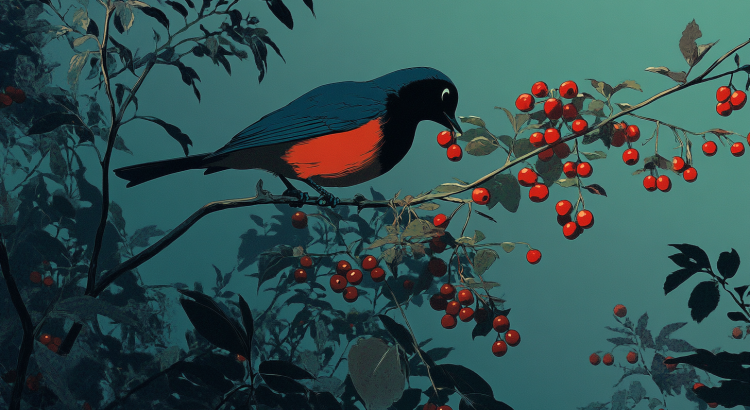
I grew up in a house with a moderately large garden in a small town South of Oslo. My parents have always had a lawn with some fruit trees and flower areas, as you were supposed to do it when I grew up, and the yard had some wild edges as well. These days, most gardens in this area of Norway seem to be overly manicured with grass and little else. They are sterile monocultures maintained by robot lawn movers and noisy edge cutters on a Saturday morning.
My father loves birds and wildlife so he always had a couple of birdfeeders and put out food for the birds daily.
STERILE MONOCULTURE VERSUS FULL OF LIFE
To me, this has always seemed a bit weird. Why such an overly manicured garden? Why so much lawn?
Why create an environment where you need birdfeeders?
Why not have a nature garden, a garden full of food-producing trees and bushes, and native trees, bushes, and flowers? That is a garden full of life and it creates habitat and food for birds, insects and other wildlife. It may require a little more effort to establish, but after a while, it mostly takes care of itself. In general, it seems far more sensible and enjoyable.
WHAT I LIKELY WOULD DO
If I had a house and garden in Norway, what would I do? I would create a small food forest with ample food for birds and other wildlife.
I would start with fruit trees and berry bushes. Maybe apple (eple), pear (pære), plum (plomme), cherry (kirsebær), hazelnut (hasselnøtt), walnut (valnøtt), and raspberry (bringebær), blackberry (bjørnebær), gooseberry (stikkelsbær), and red currants (rips).
I would include some perennial food-producing shrubs like strawberries (jordbær), clover (klover), comfrey (kynge), and chives (gressløk).
I would include some native trees like rowan (rogn), silver birch (sølvbjørk), Norway maple (norsk lønn), common oak (eik), black alder (svartor), and aspen (osp).
I would encourage edible mushrooms in the shady and now humid areas.
I would also have some more open areas with wildflowers. For instance, buttercup (smørblomst), oxeye daisy (geitrams), common knapweed (knoppurt), red clover (rødkløver), field scabious (hestehov), meadowsweet (marihånd), yarrow (ryllik), and purple loosestrife (liljekonvall).
As I plant these, I would remove grass to make space. It can be done one small portion at the time.
All of this can be done in a regular garden, and although it requires some effort in the beginning, it soon largely takes care of itself and it has multiple benefits – food, enjoyment, nature close by, habitat and food for birds and wildlife, and more.
WHY DON’T MORE PEOPLE DO THIS?
Why is this still quite rare? Why do the vast majority of people maintain a sterile garden?
Some of it is likely inertia. They already have a lawn so it may seem easier to just keep it going and not make changes.
They may have other priorities than creating a thriving ecosystem around their house.
They may be concerned about going against expectations and norms. What will the neighbors say if I get rid of the lawn and instead create a natural garden and garden forest?
They may be concerned they won’t know what to do or how to do it.
These things often have to do with identity. Does it fit my identity or not?
ONE VISION
How can we remedy this?
I imagine local governments providing information and support to convert lawns into natural gardens and food forests. They can provide brochures, classes, practical guidance, and perhaps even a rebate on the plants in cooperation with nurseries or a tax rebate.
WHAT AM I DOING?
I don’t have a garden in Norway, but I am the steward of land in the Andes and we are reforesting, regenerating, and creating a food forest here.
Illustration by me and Midjourney