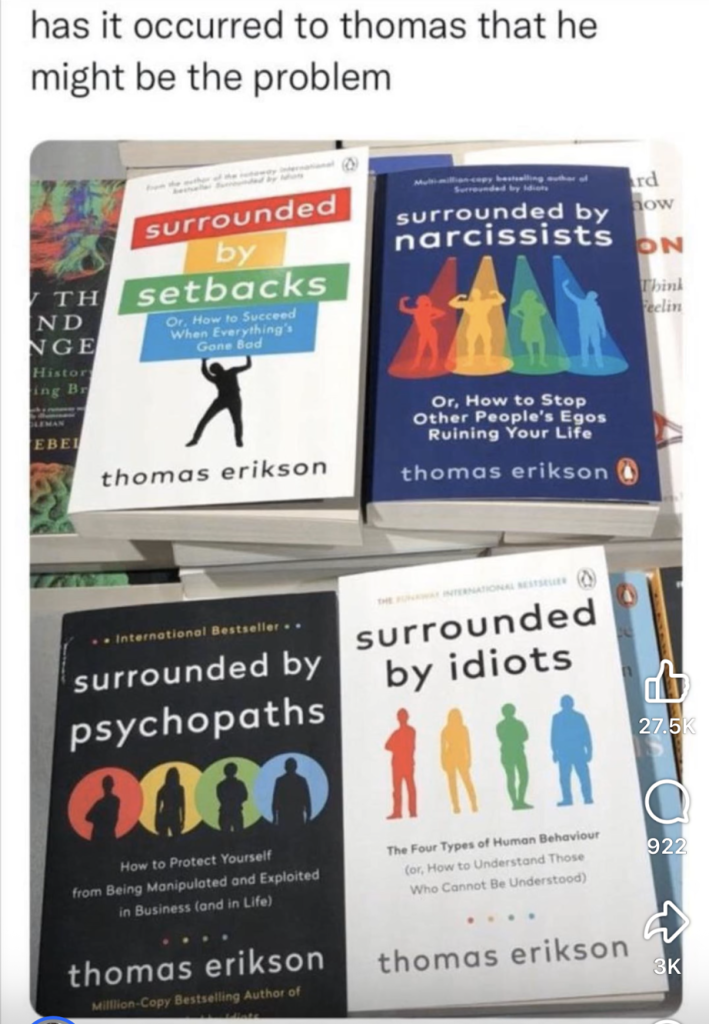
I have seen these books in bookstores and have no idea what they are about. I assume the title is a hook and the content is either pragmatic pointers for how to deal with challenging situations, noticing and owning that we are what we see in others, or both.
SUSTAINABILITY AS AN EXAMPLE
I am what I see in the world. For instance, I have been passionate about sustainability since my mid-teens and also exploring projections, so I am very aware that I am doing what I see in others – whether it’s the topic of sustainability or anything else. I also seek out and use worldviews that are inclusive of this.
A SYSTEMS VIEW ON OUR ECOLOGICAL CRISIS
Our ecological crisis is created by the system we all live within. We live in a civilization that assumes that nature is infinite, which is ecocidal and suicidal considering that we are more than 8 billion people and have advanced and efficient technology.
That means that I live a life that’s as destructive to our planet as anyone. It’s almost inevitable considering the systems we all live within. My life is very likely more destructive than most since I live a Western lifestyle with flying long distances, owning not only one but two cars (one in the Andes and one in Norway), and consumption of things I don’t need. Most people in the world don’t have the resources to have such a large ecological footprint. In that context, that I eat organic and local food when I can, take public transportation when I can, have a tiny reforestation and food forest project in the Andes, and so on, is a drop in the bucket. In the bigger picture, my life is more destructive to the planet than that of the vast majority of the world’s population.
When I see people who don’t seem to care much about sustainability, I see myself. It’s a reminder that we live in a system that’s inherently destructive to our planet. It’s a reminder that I too live in this system and are part of the problem, whether I want to or not, and whether I do tiny things here and there to try to counter it.
This perspective makes it all far less personal. It’s about the system. Our current system was developed at a time when our numbers were small and our technology less powerful, so we could assume an infinite nature. We just happen to still operate with that system even if our situation is dramatically different. In that context, it’s all far more innocent – although the destruction is no less real.
ORDINARY PROJECTIONS
Then there is the ordinary and more universal way to explore projections.
I can take any story about the world – in this case, people who live and act in a way that’s harmful to our planet – turn it to myself, and find genuine and specific examples of how I am doing the same. It’s not difficult to find these examples. (The Work of Byron Katie.)
It’s a relief to find these examples, take it in, and allow my images of myself, others, and the world to align with this information. It removes any strong sense of me vs others, or me vs the world. We are all in the same boat. What I see in others and the world is also what I have in myself. It’s what I am living too.
There are many other ways to explore projections, of course, including tonglen which is another of my favorites.
This type of projection is the conventional psychological projection. Whatever characteristics and dynamics I see in the world mirror the same in me and in my life. It may take another form, and it may look and be expressed quite differently, but the essence here and there is the same.
A MORE ESSENTIAL PROJECTION
There is a more essential projection: My mental field creates an overlay on the world. It interprets everything and has stories about everything. Even simple labels – man, woman, sustainability – are assumptions in themselves and typically have a large number of other stories and assumptions connected with them. Even the idea of a world with a mental field overlay is, in itself, created by the mental field. It’s all made up of mental images and words.
My world of images and words is projected onto the world, and it’s projected onto a world that is itself a projection.
THE WORLD IS WHAT I AM
Even more essentially, it’s all happening within and as what I am. The world, to me, happens within and as what I am. The consciousness I am forms itself into all content of experience, including this human self, others, situations, the wider world, states, emotions, ideas, and so on.
What I see in the world not only mirrors what’s in me, at a human level. It’s not only created by my mental field trying to make sense of the world. It is – in a very direct and literal sense – what I am.
The world, as it appears to me, is what I am. The consciousness I am forms itself into it, and it’s inherently ephemeral and always changing.
ALL TOGETHER
It’s all valid in its own way.
Yes, some are more focused on sustainability than others and that’s important and part of the deep systemic change that’s required for us to create a more sustainable civilization.
Since I live within this system, and since I have a Western lifestyle, I am not doing much better than anyone else. In reality, I am very likely in the worst few percent since most in the world involuntarily have a much smaller ecological footprint.
Whatever story I have about anyone in terms of sustainability – or anything else – is a story I can turn to myself and find genuine and specific examples of how it’s true. I do and live what I see in others.
My mental field creates my stories about the world, down to the most basic labels and assumptions.
The world, as it appears to me, happens within and as what I am. The consciousness I am forms itself into all of it. I am – directly and literally – it.
All of this together is a relief. It’s a relief because it’s a bit closer to reality than assuming I am somehow better than others, or blaming myself or others for something that’s an inevitable feature of our current system, or pretending that my stories about the world somehow reflect some final, full, or absolute truth, or pretending that my perception of the world is the world itself.
This frees me up to do more for the Earth. It frees me up to focus more on this reforestation and food forest project which is immensely important for all the beings that live their lives here and will live their lives here.
THE BOOKS
Back to the books by Thomas Eriksson: If they really are about how to deal with people we label idiots etc., I assume they have some practical approaches to deal with them. What I write about here is an addition to and a different context for that.
We can use different pragmatic approaches to deal with challenging situations. We can understand it in a context that’s more real, and kind, and makes it all a little more universal and impersonal. We can work on noticing and owning projections. We can notice how our stories are created by our mental field. And we can notice how the world, to us, happens within and as the consciousness we are.
I should also mention that if the title of the books is to be taken literally – if we think we are surrounded by idiots, narcissists, etc. without seeing it also in ourselves – it’s very likely that others see us as an idiot, narcissist, or whatever it is. We inevitably live out what we don’t recognize in ourselves, and others pick up on it.