


Where does the new organic matter in our young food forest come from?
THE FOOD FOREST ON MILAGROS
As I have written about in other articles, we are growing a food forest on our land in the Andes.
It’s in two distinct sections, although I suspect the distinction will get more blurred over time. One is the wilderness area where an organization is planting a diversity of natives that include some food-producing plants. The other is around the houses with an emphasis on native and non-native food-producing plants, with other natives mixed in.
WHERE DOES THE ORGANIC MATTER COME FROM?
The soil around the houses was very poor, mostly sand and clay with little to no organic content. It still is this way in the areas we have not planted yet.
So where does the new organic matter come from?
Imported from neighbors and the region: very little in terms of mass
Some are imported from neighbors close by and in the region. We get organic goat manure from Paul down the road. We get worm compost from Marlon a little ways away. Earlier, we collected leaves along the road and brought them here and used them as mulch. We are buying microorganisms from people in the area. We have also bought rice husk, which I assume comes from further away. All of this is vital for improving soil health.
Most of the plants in the food forest are imported as well, as seeds or small and smallish saplings. This is obviously essential for creating the food forest.
As important as this is, in terms of mass or volume, it’s not much.
Pruned material: recycling what’s already here
We regularly prune some pioneers already growing here and use the pruned material as mulch. In terms of mass, this is a little more substantial although it’s a recycling of the organic material already here. As the food forest grows, we will prune a greater diversity of plants and this pruning will help improve the soil health and create a thicker layer of mulch.
Air, soil, and water
The vast majority of the new organic matter here comes from the air. Carbon, hydrogen, and oxygen collected from the air make up roughly 96% of a plant’s dry weight.
Soil nutrients are important although make up just 3-5% of the dry weight.
Of the wet weight, about 70-90% is water.
THE MIRACLE OF LIFE
This is one aspect of the miracle of life.
We start with severely degraded land and soil. The soil is mostly inorganic matter – sand, silt, and clay.
There are some hardy pioneers here and they do the vital work of beginning to improve the soil. When we prune these plants and give them back to the soil, that process is sped up slightly.
We have imported some manure, compost, and mulch, although not much in terms of mass.
We are importing seeds and saplings to start the food forest, and this is obviously essential for creating this food forest. This too is not much in terms of mass.
From this humble beginning, nature takes over. The plants create organic matter mostly from the air, and it’s an exponential process. As there are more plants growing, the soil health improves, and the plants grow better and create the conditions for new plants.
Over time, the forest becomes more and more diverse, healthy, and self-sustaining.
It never needed us, of course, to evolve into a more diverse and healthy ecosystem. It just needed humans to stop interfering. Since we are here too and we wish to have food and perhaps income from the forest, we steered the regrowth in the direction of becoming a food forest.
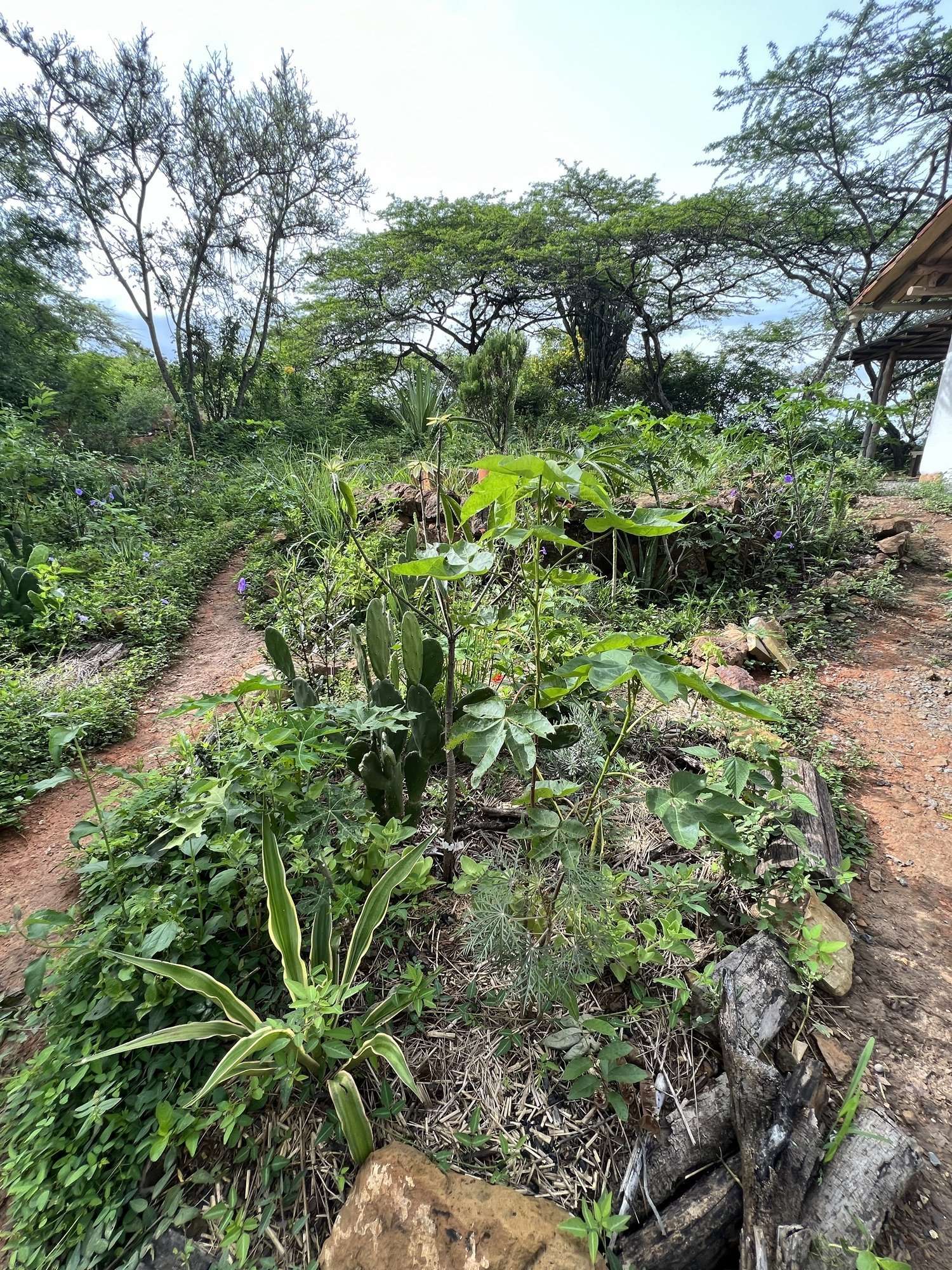
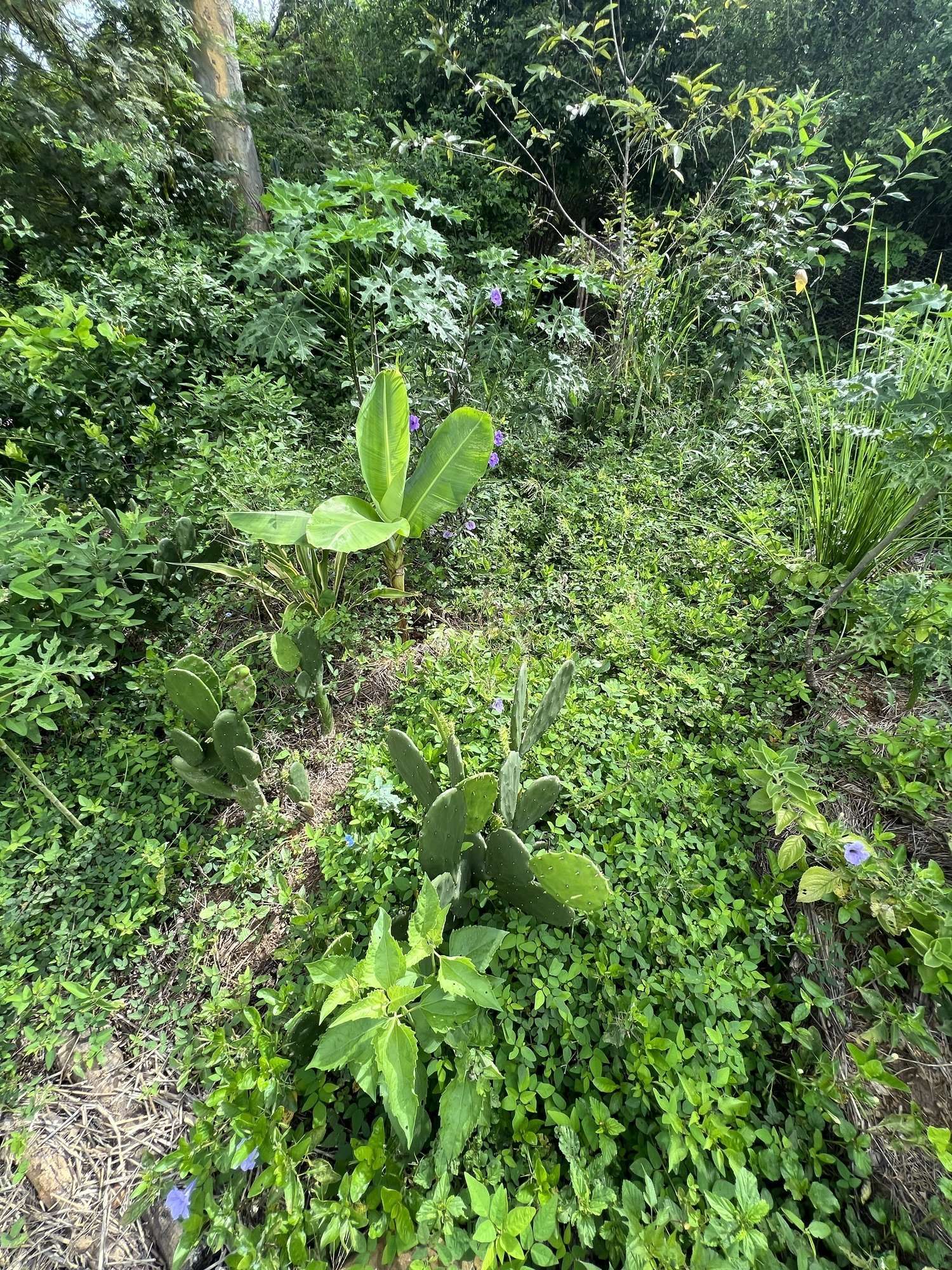
The images are from the area around the first small house. We started last year so it’s all new still, and we started with very poor soil so a lot of the emphasis so far has been on building soil and improving soil health. That is, literally, the foundation of healthy plants and a healthy forest ecosystem. The second image is a section of our nursery. The last shows that the microclimate has already improved so we are having a lot of fungi here now – where we used to have barren and dry soil.
Read on for more info on these topics.
MORE INFO
I asked ChatGPT 4o for some input on this topic. See below.
Where does the dry matter of plants come from?
The matter that makes up a plant primarily comes from four main sources: carbon dioxide (CO?), water (H?O), sunlight (for energy), and minerals from the soil. Below is a breakdown with rough percentages based on the origin of the plant’s biomass:
- Carbon (from CO? in the air) – ~45-50%
- The largest portion of a plant’s dry mass is carbon, which comes from the carbon dioxide absorbed through photosynthesis. This carbon forms the backbone of carbohydrates, cellulose, and other organic molecules.
- Oxygen (from CO? and water) – ~40-45%
- Oxygen is a major component in organic molecules like carbohydrates, proteins, and fats. While it also comes from carbon dioxide and water, most of the oxygen absorbed is later released back into the air through photosynthesis or respiration.
- Hydrogen (from water) – ~6%
- Water absorbed by roots supplies hydrogen, essential for building carbohydrates and other organic compounds in the plant.
- Minerals and nutrients (from the soil) – ~3-5%
- These include nitrogen, phosphorus, potassium, magnesium, calcium, sulfur, and trace elements. These nutrients are critical for cellular functions like protein synthesis and photosynthesis, but they make up only a small fraction of the plant’s mass.
Example of Dry Weight Composition in a Plant:
- Carbon, Oxygen, Hydrogen: ~96%
- Nitrogen, Phosphorus, Potassium, Calcium, Magnesium, etc.: ~3-5%
This breakdown shows that most of the plant’s mass comes from the air (CO?) and water, with soil nutrients playing an essential but smaller role in structure and metabolism.
Dry and wet weight of plants
Here’s a breakdown of the composition of a plant in terms of wet weight and dry weight, along with the sources of the matter:
1. Wet Weight Composition (Fresh Plant)
A large part of a fresh plant’s weight comes from water.
- Water: ~70-90%
(Absorbed through roots and necessary for photosynthesis, nutrient transport, and turgor pressure.) - Dry Mass: ~10-30%
(This is what remains when all water is removed. The dry mass consists of organic compounds and minerals.)
2. Dry Weight Composition (Without Water)
The dry mass consists of elements mostly derived from air, water, and soil minerals.
- Carbon (from CO? in the air): ~45-50%
- Oxygen (from CO? and water): ~40-45%
- Hydrogen (from water): ~6%
- Minerals and nutrients (from the soil): ~3-5%
- Includes essential elements like nitrogen, phosphorus, potassium, calcium, magnesium, and trace minerals.
Summary: Sources and Contributions
- Wet Weight (100% of the fresh plant weight):
- Water: ~70-90%
- Dry Mass: ~10-30%
- Dry Weight (100% of the plant’s dry mass):
- Carbon (from air): ~45-50%
- Oxygen (from air and water): ~40-45%
- Hydrogen (from water): ~6%
- Minerals and nutrients (from soil): ~3-5%
Explanation
- Air (CO?) contributes the majority of a plant’s dry mass. Carbon, hydrogen, and oxygen make up most of the plant’s biomass (96% of dry weight).
- Water makes up the bulk of the plant’s wet weight (70-90%).
- Soil nutrients are essential but represent only a small fraction (3-5%) of the total dry weight.
This balance between water and biomass helps explain why plants lose so much weight when dried: only about 10-30% of their total mass remains after the water evaporates.
How Plants Build Organic Matter in Soil and Evolve Ecosystems
When a landscape starts out with poor soil, devoid of organic matter—like degraded land, deserts, or rocky terrain—plants play a key role in kickstarting ecological succession. Through their roots, decaying matter, and symbiotic relationships, plants slowly transform barren soil into a thriving ecosystem. Here’s a breakdown of how this process works and evolves over time.
1. Pioneer Plants: Breaking Ground
In the earliest stages, pioneer species—plants adapted to harsh conditions—are the first to colonize bare soil. These species include weeds, grasses, lichens, and nitrogen-fixing plants.
- Root systems penetrate compacted soil and create cracks, allowing air and water to infiltrate.
- Leaf litter and decaying roots introduce the first layers of organic matter, improving the soil structure.
- Nitrogen-fixing plants (like lupine or legumes) form symbiotic relationships with bacteria, introducing nitrogen to the soil.
At this stage, organic matter is limited, but plants create the first pulse of life by introducing dead plant material, root exudates (sugars released into the soil), and microbial communities.
2. Accumulation of Organic Matter: Soil Building Begins
As more plants grow and die, they leave behind dead leaves, stems, roots, and other organic material, which microbes, fungi, and invertebrates break down into humus.
- Decomposing organic matter becomes a food source for bacteria, fungi, and soil organisms like earthworms, which further improve soil structure.
- Humus builds up, increasing the soil’s ability to retain water and store nutrients, creating a positive feedback loop for plant growth.
- Fungal networks begin to develop, helping plants exchange nutrients through mycorrhizal associations.
At this stage, the soil becomes richer, and more plant species—including shrubs and small trees—can now establish themselves.
3. Intermediate Ecosystem: Greater Plant and Animal Diversity
As the organic content of the soil increases, the ecosystem begins to support a greater diversity of life. A variety of plants, including grasses, shrubs, and fast-growing trees (like acacias and willows), become established. These plants:
- Produce more biomass, which decomposes into organic matter.
- Support a broader range of insects, birds, and animals, contributing further to nutrient cycling (e.g., through droppings and carcasses).
- Create microclimates that retain moisture and shelter life, allowing new species to thrive.
Over time, organic matter accumulates deep within the soil, and nutrient cycles become more efficient.
4. Mature Ecosystem: Self-Sustaining Forest or Food Forest
In the final stages, the ecosystem reaches maturity with a diverse mix of trees, shrubs, groundcovers, fungi, and animals. The soil at this stage is rich in organic matter, well-structured, and teeming with life.
- Perennial plants and deep-rooted trees cycle nutrients from deep in the soil to the surface, enriching the upper layers.
- Leaf litter and fallen branches build thick layers of mulch, preventing erosion and maintaining moisture.
- Decomposers (bacteria, fungi, and detritivores) keep nutrient cycles functioning efficiently.
- The soil becomes a stable, living ecosystem, capable of withstanding drought, floods, and other environmental challenges.
At this stage, the ecosystem is self-sustaining and resilient. Plants, animals, and microorganisms work together to maintain the system, ensuring a continuous cycle of growth, decay, and regeneration.
Summary: How Ecosystems Evolve with Organic Matter
- Pioneer stage: Hardy plants introduce organic matter to lifeless soil.
- Soil-building stage: More plants and microbial life increase organic content.
- Intermediate stage: Greater plant and animal diversity enhances nutrient cycling and water retention.
- Mature stage: A stable, diverse ecosystem emerges, with efficient nutrient and water management.
This process demonstrates the power of plants to regenerate ecosystems, even in the most degraded conditions. Over time, their ability to build organic matter, create habitat, and foster biodiversity transforms lifeless soil into a thriving, balanced environment.