One of the penalties of an ecological education is that one lives alone in a world of wounds. Much of the damage inflicted on land is quite invisible to laymen. An ecologist must either harden his shell and make believe that the consequences of science are none of his business, or he must be the doctor who sees the marks of death in a community that believes itself well and does not want to be told otherwise.
– Aldo Leopold
He wrote this decades ago, and it’s more true today than ever.
There is very little true wilderness left, and very few examples of untouched nature like old-growth forests.
What people take for nature and wilderness is typically heavily impacted by human behavior and civilization. It’s degraded, tamed, and a shadow of its former self.
I am not an ecologist, but I know enough to see this everywhere. Yes, it may still be beautiful in its own way since nature is beautiful. And I always bring with me an image of how it could be if it was allowed to be more diverse, vibrant, and mature.
Knowing a bit of ecology means seeing with deep time eyes, with an overlay of how nature used to be here before human civilization. It means having a mental overlay that shows us the contrast between how nature can be and is when it’s allowed to come to maturity, and how it is because of human intervention.
How would it be if this was one of the essential topics of any formal education? If all children learned to see with deep time and ecological eyes? I think it would change not only how many grow up to see the world, but how they live, at least to some extent.
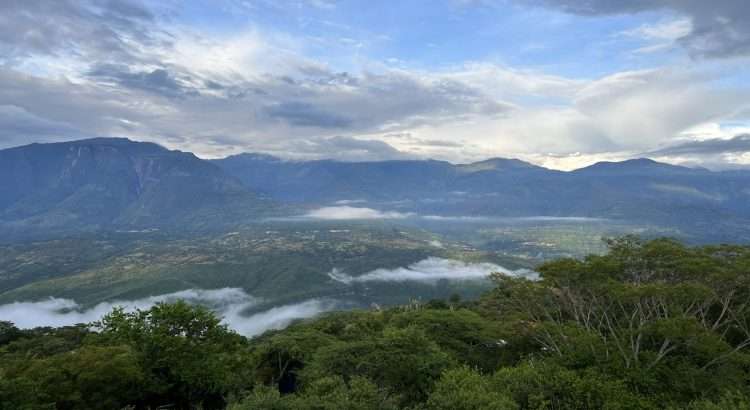
The photo is one of the current views from Milagros. It’s amazingly beautiful. And when I look, I also see all the impacts on the other side of the canyon from human activity. I see the patches of land that suggest different ownership, or at least different use. I see land more heavily degraded from grazing. I see areas with a few more trees but still far from a mature forest. I see erosion. I imagine how it may be in a few years or decades. Will some areas be more developed? Will some areas be actively supported to become more diverse, mature, and vibrant?
The remedy to what Aldo Leopold writes about is to find, develop, and nourish communities of like-minded people. Globally, there are many of us. (And, in my case, many who know far more about this than me.)
Another remedy is to actively support nature – wherever we are, and in whatever ways we can – in regenerating. How can I, in my own small ways, help restore ecosystems to a more diverse, vibrant, and mature state? How can I do it in my own garden? In my own community?
We are doing it here on Finca Milagros, through the reforestation with native trees and through developing a food forest closer to the houses.