
I saved a few images that came through my social media feed this morning and thought I would say a few words about them.
The cartoon above captures the general views I have seen among those concerned about ecosystems and nature and how these have changed over the last few decades.
Since my teens, I have been into systems views and knew that we needed a thorough transformation of our whole civilization to survive. Then and for a while, I had optimism. I thought we would collectively understand and make the changes necessary.
These days, I am not so sure anymore. I am not sure if we’ll ever find that collective will. It seems more likely that life will make the changes necessary – with or without the collaboration of whatever is left of humanity.
In our individual lives, life will decide for us if we wait too long. The same may very well be the case with Earth and us. We are waiting for too long, and Earth will make decisions for us. Whether that leads to a world inhabitable by humans or not is something we’ll see.

Science is amazing. It’s baffling how much we know about the world through science, considering how young modern science is, and considering that we are just beginning to scratch the surface in terms of understanding.
Something we know from science is that (a) we are in a global ecological overshoot, (b) this will lead to the unraveling and collapse of our current ecosystems, and (c) since we are part of and depend on Earth’s living systems, what happens with Earth happens with us.
This is by far the major issue today. It’s the one overarching issue.
Everyone we care about and everything we care about – whether it’s celebrities, sports, politics, human rights, or whatever it is – depends on these living systems we are part of.
So why is it not the main issue in our public discourse? Why is it not the main issue in our everyday conversations? (It is for some of us, including me.) Why is it not our main priority in any and all decisions we make, including who we vote for? Why is it not the context for any and every discussion about any other topic?
I have written about some of the likely reasons in other articles: We mistakenly think… we still have time, others will take care of it, it’s a problem for future generations, it will happen to others, we are insulated by our privilege, we’ll find a technological solution, we just need to tweak a few things here and there, it will involve too much sacrifice, it will go against my cherished identity, I am just one so can’t do anything, it’s easier to pretend it’s not happening, and so on.

Yes, colonialism indeed rewrote the story of nature for the colonized, at least to some extent depending on how much of what they had was lost due to genocide, cultural eradication, laws against speaking their languages and following their traditions, and so on.
I would go further back in time, to the agricultural revolution. Before the agricultural revolution, we were all indigenous. We likely saw the sacred in everyone and everything, and generally had more of a partnership orientation with ourselves, others, and the world. With the agricultural revolution, some amassed wealth and others did not, so to justify the more dominant relationship with nature and other people, the ones with wealth images ideologies than then were adopted by just about everyone.
These are imaginations of separation: Humans are separate from nature. Nature is here for our use. Nature is infinite in its resources and capacity to absorb waste from human activities. If you are lower in the hierarchy, it’s your fault. (Lack of character, wrong ethnicity, bad karma, or something else.) You’ll reap your rewards in the afterlife. (So don’t rock the boat now.) Pretend to believe absurdities told to your secondhand, and you’ll be saved. We understand something by taking it apart to its smallest parts. A thought can be true, and exclusively true so alternate views are wrong. Non-human beings don’t have cognition, emotions, and so on, or – at least – it’s so different from ours that we can still justify imprisoning, torturing, and eating them, or destroying their habitat. If we win, someone or something else must lose. And much more.
Colonialism inflicted this domination culture onto the colonized, that’s true. But the colonizers inflicted this on themselves millennia earlier, at some point after the agricultural revolution. We inflicted it on ourselves, and it’s time to heal and find a more healthy relationship with ourselves, others, and the web of life.
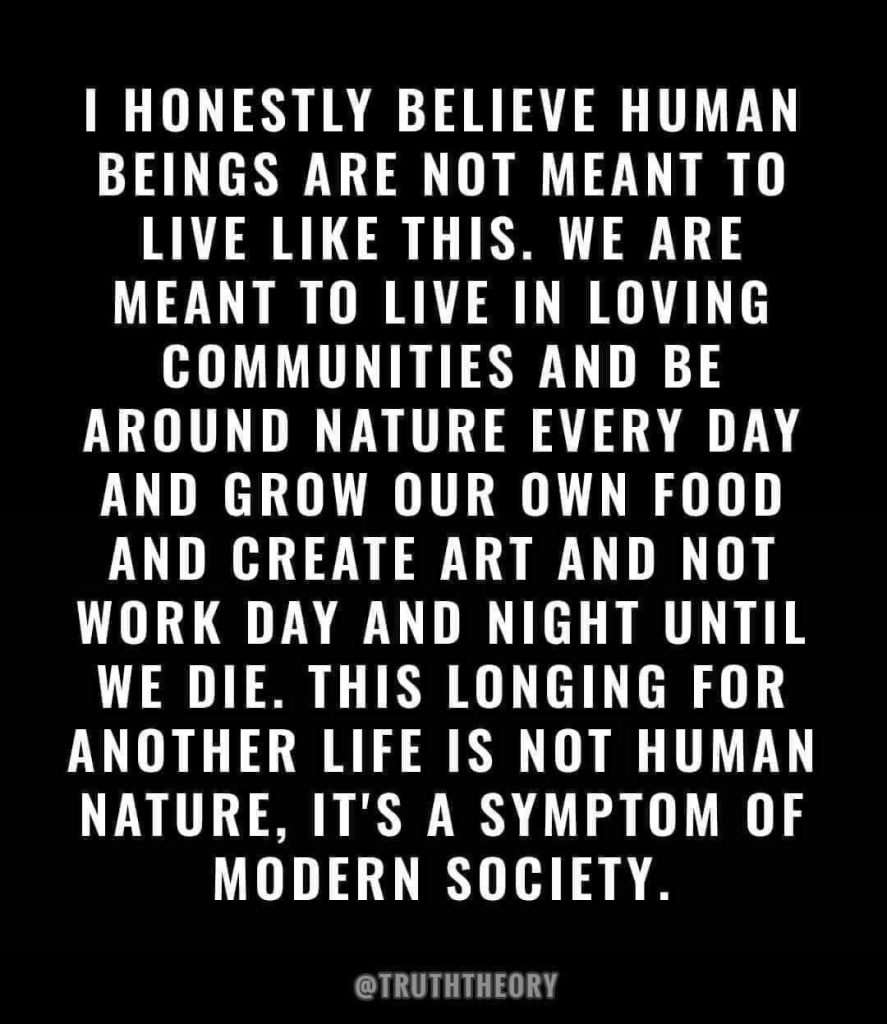
Yes, that’s true. We evolved to live as our indigenous ancestors. We evolved to live in small and mostly egalitarian groups. We evolved to live in and as nature. We evolved to see ourselves as nature. (Since that’s obviously what we are.)
With our food forest and regeneration project in the Andes, I feel I am coming closer to this. I work in partnership with nature. I live in nature. I am nature helping itself regenerate.
We can have this world. At the very least, it’s easy to imagine it. It’s easy to imagine a world where most of us live in a partnership culture, where we have good social safety nets, where people have access to education and health care, where our economic system takes ecological realities into account, where we grow food in partnership with nature in ways that heal the soil and our ecosystems and provides habitat for wildlife. We can have a world of abundance. We know how to do all that. It’s within our reach.
The only question is our collective will. Are we collectively smart enough to choose this world?