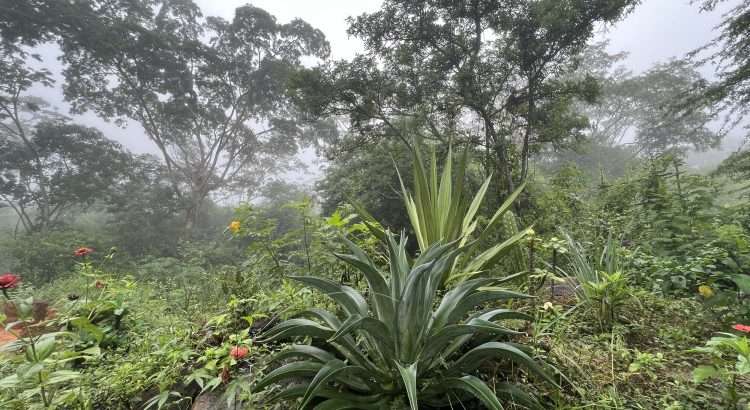
When I am working with the food forest here on Milagros, I am aware of the connection with past and future generations.
WHAT IS A FOOD FOREST?
First, what is a food forest?
It’s a forest that produces food for wildlife and humans, and have some degree of human intervention.
That intervention can be minimal or extensive.
In some cases, we have an existing mature forest and we just encouarge certain types of plants, for instance by planting seeds or taking cuttings. This is what most of our ancestors did, to different extents.
In other cases, we have severely degraded land and create a food forest nearly from scratch, as we are doing in some areas here in Finca Milagros. Around the first house, the ground was barren apart from some trees. We left the trees and have improved the soil and planted in the barren areas.
Mostly, there is a combination of existing vegetation and intentional planting with the intention of mimicking – and creating – a healthy multi-layered forest ecosystem.
THE ANCIENT HISTORY OF FOOD FORESTS
It’s a good guess that our ancestors around the world often supported and encouraged forest plants that provided benfit for them, including food. If they found fruits, berries, and edible roots in the forest, why not plant the seeds and get more of them? Why not take some cuttings and plant them nearby?
Many if not most of the forests in the Americas were food forests, intentionally enhanced by humans encouraging the growth and spread of especially useful plants. It’s possible, or likely, that much of the biodiversity of the Amazon was encouraged and supported by humans.
In Europe, people planted fruit and nut trees and berry bushes in the forests and the edges of forests. (There are still examples of this in the forest I grew up next to in Norway, even if it’s largely a plantation forest now.)
In Asia and Africa, they have traditional multi-layered gardens and groves producing food for the community.
It makes sense to work in partnership with nature in this way. It’s relatively low effort and can yield an abundance of food. So it’s not surprising if it’s what people have been doing for thousands of years around the world.
DOMINATION & PARTNERSHIP CULTURES
With the agricultural revolution came the ability to own land, animals, things, money, and even people.
This needed to be justified and some developed a worldview and set of assumptions to do just that. This created a domination culture. Here are some of the essential assumptions: We are separate from nature. Nature is here for our use. Nature is inifinite. We are more important than other species and ecosystems.The sacred is “out there” in a sky god or the afterlife. Nature is “out there” and an appendix and source of resources.
One expression of domination culture is modern agriculture. It’s typically a monoculture which creates an ecological desert. It’s highly resource intensive and requires input of chemical fertilizers, toxins, gasoline, and so on. It depletes and destroys the soil. It causes erosion and loss of soil. It takes away habitt for wildlife. It poisons the soil, water, air, and the bodies of all living beings.
Before the agricultural revolution, we were all indigenous and we had more of a partnership orientation: We are nature. Everyone and everything is sacred. We are part of the web of life. We share the resources of life with all life. What happens with the web of life happens to us.
One expression of a partnership orientation is food forests. In a food forest, we work in partnership with nature. We mimick, create, and support a healthy multi-layered forest ecosystem. It provides an abundance of food for us and the wildlife. It creates habitat for wildlife. We use organic compost and manure. The diversity and health of the ecosystem limits insect and disease problems.
This is a obviously a simplification but there is something to it.
ECOLOGICAL OVERSHOOT
Through the last few centuries of Western domination culture, we have been very successful in taking natural resources from the commons of life and using them for our own benefit. We have developed science and technology, and refined our worldviews and assumptions to do just that.
This has led to global ecological overshoot. We are collectively using far more resources than Earth can replenish. That’s similar to living off a savings account that goes in minus every day. Eventually, it all comes crashing down, and we are seeing the signs of that all around us these days.
To deal with this, we need a profound transformation of our civilization. We need an economic system that takes ecological realitites into account. We need systems of production, transportation, and so on that do the same. We need a shift in focus for our public discourse, media, education, and more. We need a shift in our worldview from domination and in the direction of partnership.
That’s a tall order and there is no guarantee that we collectively will make this shift.
What we can do is to support and emobody aspects of this shift in our own life and in our communities.
A PARTNERSHIP APPROACH
There is a deep partnership orientation behind developing a food forest.
It’s a partnership with nature. We mimic healthy forest ecosystems and work in partnership with the processes and ecological wisdom of nature.
It’s a partnership with the community here and around the world. Locally, we are inspired by what others do, learn from them, and even receive seeds and seedlings from them. Globally, I am learning a lot from the experiences of others shared in videos, podcasts, and books. I hope we can give back in time, as this food forest matures and we learn more.
It’s a partnership with modern science and knowledge. We take whatever knowledge, insights, methods, and practices from modern science and agricultural practices that makes sense.
More to the point in this context…
It’s a partnership with our ancestors from around the world who developed and benefited from food forests. Their knowledge is passed on and helps our project, and they are with me, at the very least in my imagination and in my inner community, and I feel inspired and supported by them.
It’s a partnership with future generations of humans, non-humans, and ecosystems. I hope that this food forest can benefit this community and the local wildlife for generations to come. I hope that it can, in its own small way, inspire others to do the same. I hope it can be a small part of creating a more life-centered civilization for future generations.
A VISION FOR THE FUTURE
Food forests have ancient roots, and they also show the way to an abundant and life-centered future.
I have a vision of a future that’s more partnership oriented and that has a focus on regeneration, polycultures, and food forests.
In this world…
Our systems take ecological realities into account. They are set up so what’s easy and attractive to do also supports regeneration. This goes for all our systems, including economy, production, transportation, food, energy, water, and so on.
There is a focus on regeneration everywhere – in gardens, parks, forests, agriculture, oceans.
We mostly use a partnership orientation – a partnership with nature, our community, science, technology, indigenous perspectives, and, in its own way, with ancestors and future generations.
Food is produced in ecosystems that support life, in polycultures, food forests, and similar.
There is a much stronger focus on bioregions, the bioregion we live within, and largely living within our bioregion in terms of travel, food, and products.
We are aware that what’s produced by life is for life. It’s all part of a commons we share with all life.
Ecosystems are becoming more lush, diverse and full of life. Some areas are set aside as wilderness areas with limited human presence and intervention. Other areas are used for food production, in a way that supports wildlife.
Houses are built with natural, local or other ecologically sound materials. There is an emphasis on quality of life, walkable communities, shared spaces, tools and vehicles, and public transporation. Food, energy, and much of what’s needed for daily living is produced locally and in the bioregion.
There is an awareness that our population needs to be small enough to be easily sustained by Earth alongside all other life.
Ecology is the context for everything – education, media, economy, business, and so on. We understand that we are all part of a much larger web of life, and what happens with this web of life happens to us.
Education has a stronger emphasis on ecological literacy, hands-on experience and learning, and so on.
Spirituality is more ecologically informed. Ecospirituality has become a far more important and prominent strain within the different religions, and spirituality informed by ecology and science outside of religions is also more common, along with earth- and life-centered rituals.
It’s important to have these kinds of visions to remind ourselves of what’s possible, what direction we want to move in, and what we want to live in our own life. We can all bring some of this into our own life and live some of the solutions.
THE ACTUAL FUTURE?
That’s one of many possible visions, and a very general one at that.
When it comes to the actual future, we know that we cannot know for certain and that we will be surprised.
Judging from the inaction we see today, it’s very likely that our ecological crisis will become far more severe and acute and will strongly impact just about everyone. It’s likely that many will die as a consequence drought, floods, wildfire, hunger, lack of clean water, resource-related wars, and so on. It’s also likely that the polarization we see in the world today will continue or worsen.
No matter what happens, it makes sense for us as individuals and communities to live the solutions to the extent we are able. It’s the only sane way to live.
WHAT WE CAN DO
So what can we do? What am I doing?
I am educating myself, seek out solutions, and I am in the fortunate situation where we are developing a food forest on our land in the Andes.
If we don’t have a large piece of land, there is still a lot we can do. We can develop our own small food forest in our garden, maybe starting with one small section. We can grow food on our balcony and plant flowers for insects and birds. We can join regeneration or food forest community projects. We can join political parties working for this, which in most places would be the Green Party. We can join online communities. We can educate ourselves.
All of this makes us part of the solution.
By doing this, we are changing a small part of the world and we never know the ripple effects. Without knowing it, we may inspire someone who inspires someone… and that’s how the world changes. (I know I have been profoundly inspired by people who never knew.)
As an individual, we may not significantly change the world, but we can change our world, and that makes it more than worth it.
MORE INFO
I asked ChatGPT 4o for input on this topic. See below.
HISTORY & APPROACHES
The History of Food Forests
Modern Food Forests and the Modern Food Forest Movement
Approaches to Food Forests
The History of the Modern Food Forest, Forest Garden, and Agroforestry Movement
The Importance of Food Forests in Today’s World
PARTNERSHIP ORIENTATION & VISION FOR THE FUTURE
The Partnership Orientation Behind Food Forests
A Vision for the Future Centered on Regeneration and Food Forests
A Vision for a Regenerative and Life-Centered Future
The Transition to a Life-Centered, Partnership-Oriented Civilization
What Individuals and Communities Can Do to Support the Transition to a Life-Centered Civilization
The Ancient Roots of Food Forests and Their Connection to the Future
The History of Food Forests
Early Pre-Agricultural Food Forests
Before the rise of formal agriculture, humans relied on naturally occurring ecosystems to meet their food needs. Early foragers observed and nurtured wild plants, promoting those that provided edible fruits, nuts, seeds, and roots. This interaction created proto-food forests, where humans subtly influenced ecosystems without large-scale cultivation. For example, in the Amazon Rainforest, patches of high biodiversity were often deliberately planted and tended by Indigenous peoples, leading to the enrichment of the forest with useful species like Brazil nuts, cacao, and açaí palms. These ancient agroforestry systems date back thousands of years and are still visible in the landscape today.
Indigenous Food Forests
Indigenous communities around the world have long cultivated food forests that reflect deep ecological knowledge and spiritual connection to the land. In the Pacific Northwest of North America, Coast Salish peoples maintained “forest gardens,” integrating hazelnuts, camas, and berry-producing shrubs like salmonberry and huckleberry. These food forests not only provided sustenance but also supported ecological balance by mimicking natural ecosystems.
In Southeast Asia, the Khasi people of Meghalaya, India, developed multi-layered food forests that combined fruit trees, medicinal plants, and spices like cardamom and turmeric. These forests were sustainable and diverse, providing food, medicine, and economic resources for generations.
Traditional European Agroforestry
Although less well-known, traditional European landscapes also incorporated food forest principles. In medieval England, “wood pastures” combined tree crops like apples, chestnuts, and walnuts with grazing animals. These systems were sustainable and biodiverse, supporting both agricultural needs and natural habitats.
In southern Europe, dehesa systems in Spain and montado systems in Portugal integrated cork oaks, olive trees, and grazing animals, creating a food forest-like mosaic. These practices, rooted in pre-modern land management, continue to provide food, fuel, and shelter for both humans and wildlife.
Asian Examples of Food Forests
In tropical Asia, the home gardens of Indonesia, Sri Lanka, and Kerala, India, have long exemplified food forest principles. These gardens are dense, multi-layered systems with fruit trees like jackfruit, banana, and coconut, interspersed with spices, vegetables, and medicinal plants. They not only meet household needs but also enhance soil fertility and support local biodiversity.
African Food Forests and Sacred Groves
In Africa, Indigenous agroforestry systems have sustained communities for millennia. The Mesoamerican cacao-based agroforests in Central America evolved alongside African examples like the Sahelian parklands, where species like baobab, shea, and tamarind were nurtured in a savanna-like setting. These systems supported resilience in semi-arid climates, providing food security and cultural continuity.
Sacred groves, often found in West Africa, are another example of food forests. These groves protect valuable food and medicinal species while serving as cultural and spiritual hubs. They represent a balance between human needs and ecological preservation.
The Spread of Agroforestry Practices
Food forest techniques spread through cultural exchanges, colonization, and trade. For example, Polynesian voyagers carried breadfruit, taro, and bananas to new islands, creating agroforestry systems that sustained entire societies. Similarly, enslaved Africans brought seeds and agricultural knowledge to the Americas, contributing to the establishment of food forests in plantation economies.
Revival and Modern Applications
The food forest tradition has experienced a resurgence in recent decades as a sustainable solution to food production. Inspired by Indigenous practices, permaculture food forests have been established worldwide, combining ancient wisdom with contemporary ecological science. Examples include Geoff Lawton’s food forests in Jordan and the Beacon Food Forest in Seattle, USA, which integrate community engagement with ecological restoration.
The history of food forests demonstrates humanity’s capacity to live harmoniously with nature while meeting essential needs. From the Amazon to the Himalayas, these systems offer timeless models of sustainability and resilience for future generations.
Modern Food Forests and the Modern Food Forest Movement
The Revival of Food Forests
In recent decades, food forests have experienced a resurgence as a sustainable approach to food production that aligns with ecological principles. This movement combines ancient wisdom with contemporary design techniques to create productive, diverse, and resilient ecosystems. By mimicking natural forests, modern food forests provide food, enhance biodiversity, improve soil health, and support local climates, offering a regenerative alternative to industrial agriculture.
Community-Led Food Forests
Across the world, communities are coming together to establish food forests as hubs for local engagement and sustainable living. The Beacon Food Forest in Seattle, USA, is a prime example. Covering seven acres, this urban food forest integrates fruit trees, berry bushes, herbs, and vegetables, providing free food to the community. It also serves as an educational space, teaching visitors about permaculture, biodiversity, and sustainable food systems.
In Canada, the Edible Forest Garden Project in Ontario transforms public spaces into edible landscapes. By incorporating native plants alongside food-bearing species, the project creates accessible food sources while enhancing local ecosystems. These efforts demonstrate how food forests can be both productive and educational, fostering community resilience.
Regenerative Agriculture and Food Forests
Modern food forests are also a cornerstone of regenerative agriculture, emphasizing soil health and ecosystem restoration. In India, the Aranya Agricultural Alternatives project uses food forest techniques to combat soil degradation and water scarcity. Their designs integrate diverse crops like moringa, tamarind, and pigeon pea, alongside medicinal and nitrogen-fixing plants, creating systems that regenerate the land while supporting farmers’ livelihoods.
In Jordan, Geoff Lawton’s Greening the Desert Project demonstrates the potential of food forests in arid environments. By capturing water, building soil, and planting drought-tolerant species, this project transforms barren land into productive oases, providing a model for food production in challenging climates.
Urban Food Forests and Climate Adaptation
Cities around the world are turning to food forests to address food insecurity, urban heat islands, and loss of green spaces. The Atlanta Food Forest at Browns Mill, located in Atlanta, Georgia, is one of the largest urban food forests in the United States. Spanning 7.1 acres, it includes fruit and nut trees, medicinal plants, and educational gardens, offering fresh food and environmental benefits to the surrounding community.
Similarly, in Melbourne, Australia, the CERES Community Environment Park integrates food forest principles into urban landscapes. By incorporating fruit trees, native plants, and vegetable beds, CERES demonstrates how food forests can thrive in cities, creating green spaces that improve air quality and reduce urban temperatures.
Private Food Forests and Homestead Projects
The modern food forest movement is not limited to public initiatives; many individuals and families are creating food forests on private land. In Costa Rica, Finca Luna Nueva integrates food forest techniques with organic farming, cultivating cacao, bananas, turmeric, and other crops in a biodiverse setting. This approach not only supports self-sufficiency but also fosters ecological restoration.
In the United States, the Ridge to Reef Farm in the Virgin Islands combines food forests with permaculture practices to grow tropical fruits, vegetables, and medicinal plants. These efforts illustrate the versatility of food forests in both tropical and temperate climates.
Education and the Food Forest Movement
Modern food forests are often tied to education, spreading awareness of sustainable practices. Organizations like Project Food Forest in South Dakota promote food forests by providing resources, training, and community support. Their work helps individuals and communities establish food forests that enhance food security and ecological health.
Globally, permaculture courses integrate food forest design into their curricula, empowering people to create regenerative landscapes. This blend of hands-on practice and theoretical learning ensures that food forest knowledge continues to evolve and spread.
The Future of Food Forests
The modern food forest movement exemplifies a growing recognition of the need for sustainable and regenerative food systems. From urban centers to rural homesteads, these systems provide food, improve biodiversity, and restore ecosystems. As climate challenges intensify, food forests offer a pathway to resilience, demonstrating how human systems can harmonize with the natural world to create abundance for generations to come.
Approaches to Food Forests
The modern food forest movement draws from diverse approaches, each emphasizing the integration of ecological principles with food production. These methods, shaped by pioneering individuals, organizations, and resources, provide various frameworks for designing and managing food forests. From permaculture to syntropic agriculture and beyond, these approaches align human activity with natural processes.
Permaculture and Food Forests
Permaculture, a design philosophy developed by Bill Mollison and David Holmgren in the 1970s, is one of the most widely known approaches to food forests. It focuses on creating sustainable human habitats by mimicking the patterns and relationships found in natural ecosystems. In permaculture, food forests are designed as multi-layered systems incorporating canopy trees, understory plants, shrubs, herbs, ground covers, root crops, and climbers.
- Key Figures and Organizations:
- Bill Mollison: Known as the “father of permaculture,” Mollison’s teachings and books, such as Permaculture: A Designers’ Manual, laid the foundation for permaculture design.
- Geoff Lawton: A prominent permaculture educator, Lawton’s work includes projects like the Greening the Desert initiative in Jordan, showcasing how food forests can thrive in arid environments. His online courses and videos are widely used resources for aspiring permaculturists.
- Permaculture Research Institute: Founded by Geoff Lawton, this organization provides training and research on sustainable systems, including food forests.
- Resources:
- Introduction to Permaculture by Bill Mollison
- The Permaculture Handbook by Peter Bane
- Geoff Lawton’s online permaculture design courses
Syntropic Agriculture
Syntropic agriculture, developed by Ernst Götsch in Brazil, focuses on creating dynamic agroforestry systems that mimic natural succession. This method emphasizes planting diverse species in dense arrangements, with regular pruning to mimic natural disturbance and recycle nutrients. Syntropic systems prioritize ecosystem restoration alongside food production, making them particularly suitable for degraded landscapes.
- Key Figures and Organizations:
- Ernst Götsch: A Swiss farmer and scientist based in Brazil, Götsch’s work has transformed degraded land into thriving forests. His approach is documented in videos and workshops.
- Agenda Gotsch: This platform shares resources and case studies on syntropic farming.
- Resources:
- Videos on syntropic agriculture by Agenda Gotsch (available online for free)
- Workshops and field courses offered by practitioners in Brazil, Australia, and beyond
Agroforestry and Silvopasture
Agroforestry integrates trees with crops and livestock to create multifunctional landscapes. Silvopasture, a subset of agroforestry, combines trees with grazing systems. These approaches enhance biodiversity, sequester carbon, and improve soil health while producing food and other resources.
- Key Figures and Organizations:
- World Agroforestry Centre (ICRAF): Based in Kenya, this organization conducts research and promotes agroforestry practices worldwide.
- Mark Shepard: Author of Restoration Agriculture, Shepard advocates for agroforestry systems in temperate climates, emphasizing perennials like hazelnuts, chestnuts, and apples.
- Resources:
- Restoration Agriculture by Mark Shepard
- ICRAF’s online library of agroforestry case studies
Natural Farming and Forest Gardening
Natural farming, popularized by Masanobu Fukuoka in Japan, emphasizes working with natural processes rather than against them. His “do-nothing farming” philosophy minimizes human intervention, allowing ecosystems to flourish. Forest gardening, as developed by Robert Hart in the UK, builds on similar principles, focusing on creating perennial polycultures.
- Key Figures and Organizations:
- Masanobu Fukuoka: Author of The One-Straw Revolution, Fukuoka’s philosophy influenced natural and organic farming movements.
- Robert Hart: A pioneer of forest gardening in temperate climates, Hart’s work emphasized small-scale, sustainable food production systems.
- Resources:
- The One-Straw Revolution by Masanobu Fukuoka
- Forest Gardening by Robert Hart
Tropical and Indigenous Approaches
Indigenous communities have cultivated food forests for millennia, drawing on deep ecological knowledge. These systems are often regionally specific, blending native species with traditional practices.
- Key Figures and Organizations:
- Dr. Nalini Nadkarni: Known for her research on tropical forest canopies, her work underscores the ecological significance of diverse, multi-layered systems.
- Forest Peoples Programme: This organization supports Indigenous communities in protecting and revitalizing traditional agroforestry practices.
- Resources:
- Case studies and publications from the Forest Peoples Programme
- Research papers on Amazonian and Asian traditional food forests
Integrated Modern Approaches
Modern food forest designs often combine elements from multiple systems, integrating scientific research with traditional knowledge.
- Key Figures and Organizations:
- Martin Crawford: Based in the UK, Crawford’s work focuses on temperate food forests. His books and the Agroforestry Research Trust offer resources for designing diverse ecosystems.
- David Holmgren: Co-originator of permaculture, Holmgren’s emphasis on resilience and future scenarios informs many contemporary approaches.
- Resources:
- Creating a Forest Garden by Martin Crawford
- Permaculture: Principles and Pathways Beyond Sustainability by David Holmgren
The Role of Technology and Collaboration
Modern food forest practitioners often leverage technology and networks to share knowledge and scale projects. Platforms like Open Food Network and Global Agroforestry Network connect practitioners worldwide, enabling collaboration and innovation.
The Path Forward
The diverse approaches to food forests illustrate the adaptability and potential of these systems to meet global challenges. By integrating traditional practices with contemporary insights, the food forest movement continues to evolve, offering solutions for resilient and sustainable food systems that align with the natural world.
The History of the Modern Food Forest, Forest Garden, and Agroforestry Movement
Early Foundations in Traditional Practices
The roots of modern food forests, forest gardens, and agroforestry can be traced to traditional practices across the globe. Indigenous communities in the Amazon, Asia, Africa, and beyond have long cultivated landscapes that integrate food-producing plants with natural ecosystems. These ancient systems inspired the modern movement, showcasing the effectiveness of working with nature rather than against it.
In the Amazon, ancient agroforests enriched biodiversity, while in Southeast Asia, home gardens created densely productive systems. In Africa, parkland agroforestry integrated species like baobab and shea into agricultural systems, combining ecological resilience with food security.
The Emergence of Agroforestry as a Discipline
The formal study of agroforestry began in the mid-20th century, as scientists recognized the ecological and agricultural value of combining trees with crops and livestock.
- 1950s–1970s: Early research highlighted the benefits of integrating trees into farming systems, particularly in tropical regions where soil erosion and land degradation were growing concerns. Organizations like the International Crops Research Institute for the Semi-Arid Tropics (ICRISAT) began studying agroforestry systems in the Global South.
- 1978: The establishment of the World Agroforestry Centre (ICRAF) in Kenya marked a turning point, providing a global hub for research, advocacy, and the promotion of agroforestry practices.
The Forest Garden Movement in the West
The concept of forest gardening gained attention in temperate climates during the 20th century. Influenced by traditional practices and ecological science, pioneers in Europe and North America adapted the concept to smaller-scale systems.
- Robert Hart (UK): In the 1970s, Robert Hart developed one of the first modern forest gardens on his smallholding in Shropshire, England. Inspired by the multi-layered structure of tropical forests, Hart’s work demonstrated how perennial plants could create sustainable, low-maintenance food systems in temperate regions. His book Forest Gardening remains a foundational text.
- Bill Mollison and Permaculture (Australia): In the 1970s, Bill Mollison and David Holmgren introduced permaculture as a design philosophy for sustainable living. Food forests became a central element of permaculture, blending ancient knowledge with modern ecological design. Mollison’s Permaculture: A Designer’s Manual and Holmgren’s Permaculture Principles were instrumental in spreading the idea of forest gardens globally.
Expanding Agroforestry in the Global South
Throughout the late 20th century, agroforestry gained prominence as a tool for ecological restoration and rural development.
- 1980s–1990s: Projects across Africa, Asia, and Latin America demonstrated the potential of agroforestry to combat deforestation, desertification, and food insecurity. The International Centre for Research in Agroforestry (ICRAF) played a key role in advancing these efforts, conducting research and sharing knowledge.
- Notable Initiatives: India’s Aranya Agricultural Alternatives introduced agroforestry to combat land degradation, while Brazil’s syntropic farming, pioneered by Ernst Götsch, restored degraded lands through innovative agroforestry systems.
Integration with Climate and Conservation Movements
The late 20th and early 21st centuries saw a growing recognition of the role of agroforestry and food forests in addressing global environmental challenges.
- Climate Change Mitigation: Agroforestry became a key strategy for carbon sequestration, with trees absorbing atmospheric CO2 while supporting biodiversity and local livelihoods.
- Biodiversity Conservation: Food forests and agroforestry systems were increasingly seen as tools for protecting habitats and fostering wildlife corridors in fragmented landscapes.
Urban Food Forests and Grassroots Movements
As the movement expanded, food forests began appearing in urban areas, driven by grassroots initiatives and community efforts.
- Incredible Edible Todmorden (UK): This grassroots project, launched in the early 2000s, turned public spaces into edible landscapes, including food forests, inspiring communities worldwide.
- Beacon Food Forest (USA): Established in Seattle in the 2010s, this urban food forest became a flagship example of how permaculture and community engagement could transform cities.
Educational and Institutional Growth
By the 21st century, educational initiatives and institutions dedicated to food forests and agroforestry emerged worldwide.
- Permaculture Research Institute (Australia): Founded by Geoff Lawton, this institute popularized food forest techniques through training programs and online courses.
- Agroforestry Research Trust (UK): Martin Crawford’s work in temperate forest gardening provided a model for researchers and practitioners in cooler climates.
Modern Innovations and Global Momentum
The modern movement continues to evolve, incorporating advanced research and innovative practices.
- Syntropic Agriculture: Ernst Götsch’s syntropic farming gained international attention for its ability to restore degraded ecosystems and create highly productive systems.
- Technology and Networks: Platforms like the Open Food Network and Global Agroforestry Network connect practitioners, enabling knowledge-sharing and collaboration on a global scale.
A Continuing Legacy of Regeneration
The modern food forest, forest garden, and agroforestry movement draws from the wisdom of the past while addressing the urgent challenges of the present. From the grassroots to the global stage, this movement exemplifies how humanity can live in harmony with nature, regenerating ecosystems while meeting human needs. Its history is a testament to the enduring power of collaboration, innovation, and a shared vision for a sustainable future.
The Importance of Food Forests in Today’s World
Responding to Ecological Overshoot
As humanity faces the reality of ecological overshoot—where resource consumption exceeds Earth’s capacity to regenerate—food forests offer a way to restore balance. Conventional agriculture, with its reliance on monocultures, synthetic inputs, and resource-heavy practices, is a significant driver of soil degradation, deforestation, and biodiversity loss. In contrast, food forests work with natural systems, regenerating ecosystems while producing food.
By mimicking the resilience and diversity of natural forests, food forests can sequester carbon, enhance soil fertility, and support biodiversity. They offer a regenerative solution that addresses ecological limits while meeting human needs, embodying a shift from extractive to restorative practices.
Building Resilience to Climate Change
The climate crisis is intensifying, bringing more extreme weather, shifting growing seasons, and threatening food security. Food forests are uniquely suited to adapt to these changes. Their diverse, multi-layered structure buffers against climatic extremes, with deep-rooted trees stabilizing soils, providing shade, and conserving moisture. They also act as carbon sinks, mitigating the impacts of greenhouse gas emissions.
In drought-prone regions, food forests like those in the Sahel demonstrate how integrating native species with water-harvesting techniques can combat desertification. Similarly, food forests in flood-prone areas reduce runoff and erosion, protecting both ecosystems and human communities.
Restoring Ecosystems and Biodiversity
Modern industrial practices have fragmented ecosystems and driven species extinction at an alarming rate. Food forests provide a lifeline for biodiversity, offering habitats for pollinators, birds, and other wildlife. They also reconnect fragmented landscapes, creating corridors that support ecological health.
The restoration of degraded lands through food forests has been demonstrated globally. Projects like Geoff Lawton’s Greening the Desert in Jordan and reforestation efforts in the Amazon show how food forests can transform barren areas into thriving ecosystems, fostering a partnership between humanity and nature.
A Model for Food Security and Equity
Food forests address not only ecological but also social challenges. In a world where hunger and malnutrition persist alongside food waste and overproduction, these systems offer a localized, equitable approach to food security. They provide nutrient-dense food while reducing dependency on global supply chains, which are increasingly vulnerable to disruption.
In urban areas, food forests like the Atlanta Food Forest empower communities by providing free, accessible food and educational opportunities. They foster resilience at a local level, ensuring that basic needs can be met even in times of crisis.
Living in Harmony with Natural Systems
The dominant narrative of humanity as separate from and above nature has driven many of our current crises. Food forests embody a different story—one where humans are integral to the ecosystems they inhabit. By designing systems that align with natural processes, food forests cultivate a deeper sense of interconnection and responsibility.
This perspective is seen in Indigenous practices worldwide, which recognize that caring for the land is caring for future generations. Modern food forest movements, drawing on these principles, represent a reawakening of this wisdom, integrated with contemporary understanding.
Reimagining Land Use for the Future
As cities expand and agricultural land becomes scarcer, the need for innovative land use is critical. Food forests offer a model that can be scaled to urban, suburban, and rural contexts. In cities, they transform underutilized spaces into green, productive landscapes. In rural areas, they regenerate degraded lands and support sustainable livelihoods.
The global food forest movement, encompassing projects from small home gardens to large-scale initiatives, demonstrates that we can meet human needs while regenerating the Earth. It provides a hopeful vision of how we might navigate the challenges of the Anthropocene—working with, rather than against, the natural world.
A Path Forward in Uncertain Times
The urgency of global challenges—ecological overshoot, climate change, biodiversity loss, and food insecurity—requires solutions that address root causes rather than symptoms. Food forests embody such a solution, fostering resilience, regeneration, and a harmonious relationship with the Earth.
In embracing food forests, we are not merely planting trees or producing food. We are cultivating a new paradigm—one that recognizes our place within a living, interconnected planet. As stewards of this Earth, food forests invite us to participate in the co-creation of systems that nurture life, balance, and abundance for generations to come.
The Partnership Orientation Behind Food Forests
A Holistic Vision of Partnership
Food forests embody a profound orientation toward partnership—an approach that acknowledges the interconnectedness of life and the mutual relationships that sustain it. Rooted in a recognition that no part of life exists in isolation, food forests reflect a collaborative relationship with nature, communities, modern science, and the wisdom of ancestors. They are living examples of how humanity can align with the cycles of life to co-create systems that nourish all beings.
Partnership with Nature
Food forests thrive by embracing nature as a collaborator, not as a resource to be dominated. Their design mirrors the complexity and resilience of natural ecosystems, leveraging biodiversity to create abundance.
- Emulating Natural Systems: Food forests mimic the structure of natural forests, integrating canopy trees, understory shrubs, groundcovers, vines, and root crops. This diversity creates self-sustaining systems where plants, soil, water, and wildlife interact harmoniously.
- Respecting Ecological Wisdom: Instead of imposing rigid systems, food forests work with natural processes like nutrient cycling, pollination, and water filtration. These partnerships regenerate the land, heal degraded ecosystems, and restore balance.
- Giving Back to the Earth: Food forests embody reciprocity, enriching the soil, sequestering carbon, and providing habitats for countless species. They reflect a commitment to leave the Earth healthier than we found it.
Partnership with Community
Food forests bring people together, fostering connection and cooperation. They are inherently communal systems, designed to share abundance and strengthen relationships.
- Community Engagement: Urban food forests like the Beacon Food Forest in Seattle and the Atlanta Food Forest at Browns Mill create spaces where neighbors work together, share harvests, and learn from one another. These projects foster a sense of belonging and shared responsibility.
- Equity and Accessibility: Food forests challenge inequities by providing free, nutritious food to underserved communities. They empower people to take control of their food systems, reducing dependency on industrial agriculture.
- Cultural Resilience: By integrating traditional foods and practices, food forests celebrate cultural heritage and diversity, creating spaces where traditions can be preserved and shared.
Partnership with Modern Science
While food forests draw deeply from traditional and Indigenous wisdom, they also benefit from the insights of modern science.
- Integrating Knowledge Systems: Scientific research enhances understanding of soil microbiomes, carbon sequestration, and ecosystem dynamics, enriching food forest design. Tools like GIS mapping and climate modeling help optimize food forests for resilience in a changing world.
- Bridging Past and Future: Modern science validates many ancient practices, such as polycultures and intercropping, while offering new insights into regenerative techniques. This integration of old and new fosters innovation rooted in respect for natural principles.
- Expanding the Vision: Agroforestry research organizations like the World Agroforestry Centre (ICRAF) and the Permaculture Research Institute combine scientific rigor with practical application, advancing food forests as a global solution.
Partnership with Ancestors
Food forests honor the wisdom of those who came before us, recognizing that many of the principles they embody have deep historical roots.
- Continuing Ancient Practices: Indigenous and traditional peoples cultivated food forests long before modern agriculture. From the Amazon’s agroforests to the Khasi people’s layered gardens in India, these systems reflect ancestral knowledge of working with nature to sustain life.
- Learning from the Past: By studying historical food forests, modern practitioners gain insights into plant selection, ecosystem management, and resilience. These lessons are essential for adapting to contemporary challenges.
- A Legacy of Reciprocity: Food forests connect us to ancestors who understood the value of giving back to the land. They remind us that we are part of an ongoing lineage of caretakers, responsible for passing on a healthy planet to future generations.
A Vision of Partnership in Action
10 Years Into the Future: Food forests flourish in urban and rural areas, fostering partnerships between neighbors, scientists, and local governments. Communities embrace these systems as spaces for learning, sharing, and regeneration.
50 Years Into the Future: The principles of partnership embodied by food forests shape broader societal structures. Governance, education, and economies align with ecological realities, prioritizing collaboration and interconnection.
100 Years Into the Future: Humanity’s partnership with nature, community, and ancestral wisdom becomes the foundation of a regenerative civilization. Food forests are ubiquitous, nourishing people and ecosystems while preserving cultural and ecological diversity.
500 Years Into the Future: Civilization thrives as an integral part of the Earth’s living systems. Food forests are sacred spaces, celebrated as embodiments of humanity’s partnership with the planet. This orientation extends beyond Earth, guiding humanity’s stewardship of new worlds.
The Spirit of Partnership
Food forests reflect a way of being that transcends separation, embracing the interconnectedness of life. They are not just systems of food production but symbols of how humanity can live in harmony with the Earth, fostering relationships that sustain and enrich all life. By partnering with nature, community, modern science, and the wisdom of our ancestors, food forests offer a pathway to a civilization that is regenerative, resilient, and profoundly life-centered.
A Vision for the Future Centered on Regeneration and Food Forests
A Regenerative Future Rooted in Harmony
The future calls for a fundamental shift in how humanity interacts with the Earth, moving from extractive practices to regenerative systems. Food forests and agroforestry provide a tangible pathway to achieve this transformation, offering solutions to global challenges such as climate change, food insecurity, and biodiversity loss. By integrating natural processes with human systems, these approaches envision a thriving world where ecosystems and societies co-evolve sustainably.
10 Years Into the Future: Localized Food Systems and Education
Over the next decade, food forests and agroforestry could become foundational elements of local food systems. Urban centers, rural communities, and individual households would embrace these systems to create resilience in the face of economic and environmental instability.
- Urban Integration: Cities like Melbourne, Seattle, and Nairobi expand urban food forests, incorporating them into parks, schools, and public spaces. Projects like the Atlanta Food Forest at Browns Mill inspire global replication, providing accessible, nutrient-dense food to millions.
- Educational Expansion: Permaculture and agroforestry design courses become standard offerings in schools and universities, equipping the next generation with skills to restore ecosystems. Community-driven initiatives teach people to design food forests in their own backyards.
- Policy Support: Governments begin to incentivize agroforestry on farms through subsidies, recognizing its role in carbon sequestration, biodiversity restoration, and soil health.
50 Years Into the Future: A Global Network of Regeneration
In 50 years, food forests and agroforestry systems could transform landscapes on a regional and global scale.
- Reforestation and Land Restoration: Large-scale projects like the Great Green Wall in Africa are completed, creating vast agroforestry corridors that combat desertification and provide livelihoods for millions. Similar initiatives spread to other regions, restoring degraded lands and sequestering carbon.
- Integrated Farming Systems: Monoculture farms are largely replaced by diversified agroforestry systems. Farmers grow a mix of perennial crops, fruit trees, and livestock in harmony with local ecosystems, supported by advanced knowledge-sharing networks.
- Food Sovereignty: Communities worldwide reclaim control over their food systems. Local food forests reduce dependency on global supply chains, ensuring food security amid climate disruptions.
- Global Collaboration: Platforms like the Global Agroforestry Network connect practitioners across continents, facilitating the exchange of knowledge, seeds, and technology.
100 Years Into the Future: Regenerative Cities and Rural Landscapes
By the next century, regeneration becomes the cornerstone of how societies function. Food forests and agroforestry systems are fully integrated into daily life, from urban environments to vast rural landscapes.
- Regenerative Cities: Urban centers resemble living ecosystems, with rooftop food forests, vertical agroforestry systems, and edible public spaces. Waste is composted and cycled back into the soil, supporting local food production.
- Ecosystem Restoration: Degraded areas, from tropical rainforests to arid deserts, are transformed into biodiverse, productive landscapes. Agroforestry corridors connect ecosystems, allowing wildlife to thrive alongside human settlements.
- Cultural Shifts: A deep cultural understanding of humanity’s role as stewards of the Earth emerges. Regenerative practices are celebrated, and food forests become central to festivals, education, and community life.
500 Years Into the Future: A Planet of Abundance
In 500 years, humanity’s relationship with the Earth is fully regenerative, creating a planet of abundance for all life.
- Harmonized Landscapes: The distinction between human settlements and wild ecosystems blurs. Agroforestry and food forests seamlessly integrate with forests, rivers, and grasslands, creating a balanced mosaic of human and natural systems.
- Resilient Ecosystems: The Earth’s biosphere recovers, with thriving biodiversity supported by vast interconnected regenerative systems. Food forests are central to maintaining ecological stability, cycling nutrients, water, and carbon through the planet’s systems.
- Interstellar Lessons: Humanity’s regenerative knowledge extends beyond Earth. Space colonization efforts prioritize agroforestry and food forest principles to create sustainable ecosystems on other planets, ensuring survival and resilience in new environments.
Examples of the Vision in Action
- Regenerative Agriculture in the Sahel: Agroforestry projects transform arid regions into productive, green landscapes that sustain millions.
- Urban Food Hubs in Asia: Cities like Tokyo and Jakarta become global leaders in urban food forests, integrating them into transportation corridors and residential developments.
- Global Biodiversity Corridors: Food forests and agroforestry systems create wildlife corridors that connect continents, restoring migratory pathways and preserving endangered species.
The Path Forward
This vision for the future reflects humanity’s potential to live in balance with the Earth, cultivating systems that regenerate rather than deplete. Food forests and agroforestry provide a practical and inspiring framework for achieving this transformation, weaving human needs into the fabric of thriving ecosystems. By embracing these principles today, we can ensure a legacy of abundance and harmony for generations to come.
A Vision for a Regenerative and Life-Centered Future
A Civilization Aligned with Life
In this future, humanity undergoes a profound transformation, shifting from extraction and exploitation to regeneration and reciprocity. The very fabric of civilization becomes life-centered, rooted in an understanding of the interconnectedness of all beings and the planet itself. Regeneration and food forests are not just tools but symbols of this transformation, embodying humanity’s commitment to nurturing the Earth and all who live upon it.
The Regenerative Economy
The economy is fundamentally restructured to prioritize ecological health, social equity, and long-term resilience.
- Ecological Accounting: Every economic decision considers its impact on ecosystems, biodiversity, and climate. True cost accounting integrates the value of clean water, fertile soil, and healthy ecosystems into all transactions.
- Circular Systems: Waste is eliminated as materials flow in closed loops, cycling nutrients and resources back into ecosystems and production systems. Food forests and agroforestry play a central role, transforming organic waste into soil and food.
- Community-Centered Trade: Localized economies flourish, rooted in the regeneration of the land and the well-being of communities. Food forest cooperatives, regenerative farming collectives, and agroforestry enterprises form the backbone of this economy.
Regeneration as the Heart of Food Systems
Food systems are entirely regenerative, centered around food forests and agroforestry.
- Universal Access to Abundance: Every community is surrounded by thriving food forests, providing diverse, nutrient-dense food for all. Hunger and malnutrition are relics of the past.
- Biodiverse Landscapes: The global landscape is a mosaic of interconnected food forests, wetlands, grasslands, and wild ecosystems, all thriving in harmony. Agroforestry corridors ensure resilience, while urban food forests bring nature into cities.
- Perennial Agriculture: Annual monocultures give way to perennial systems, where tree crops, shrubs, and groundcovers sustain the land and people. Traditional knowledge and modern science work hand in hand to enhance soil health, water cycles, and biodiversity.
Governance That Honors Life
Governance systems reflect humanity’s commitment to supporting the living planet.
- Representation for Nature: Ecosystems have legal rights, with representatives advocating for forests, rivers, and non-human species in decision-making processes.
- Deep Democracy: Communities engage in participatory governance, guided by principles of equity, reciprocity, and long-term ecological health.
- Global Collaboration: Nations collaborate on planetary restoration projects, prioritizing the regeneration of critical ecosystems such as rainforests, coral reefs, and wetlands.
Education Rooted in Regeneration
Education systems are transformed to cultivate ecological literacy, creativity, and interconnected thinking.
- Regenerative Curricula: Students of all ages learn how to design food forests, restore ecosystems, and live in alignment with natural cycles.
- Embodied Learning: Schools become living laboratories, surrounded by food forests and regenerative landscapes where students gain hands-on experience.
- Cultural Renewal: The arts, storytelling, and rituals celebrate humanity’s place within the web of life, fostering a culture of care and reverence for the Earth.
Technological Harmony with Nature
Technology serves life rather than exploiting it, designed to enhance regeneration and resilience.
- Earth-Centric Innovations: Renewable energy systems are decentralized and integrated with natural systems, minimizing disruption to ecosystems. Technologies that enhance soil health, restore biodiversity, and monitor ecosystem health are widely adopted.
- Digital Stewardship: Global networks connect communities, sharing knowledge, seeds, and resources to accelerate regeneration. AI and digital tools are used to model ecological dynamics and inform regenerative practices.
Interwoven Human and Natural Systems
Human settlements are designed to integrate seamlessly with natural ecosystems.
- Regenerative Cities: Cities become living systems, covered in food forests, green roofs, and urban wetlands that clean air, filter water, and provide food.
- Ecological Villages: Communities are designed around regenerative principles, blending food forests, agroforestry systems, and habitat corridors for wildlife.
- Rewilding the Planet: Vast areas of the Earth are rewilded, with humans actively stewarding these spaces to enhance biodiversity and ecological balance.
Generational Perspectives
10 Years Into the Future: Regeneration becomes a global priority. Governments, organizations, and communities embrace food forests and agroforestry as central to addressing food security, climate change, and biodiversity loss. Early adopters showcase the potential of these systems, inspiring widespread adoption.
50 Years Into the Future: The global economy is fully regenerative. Food forests surround every community, providing security and abundance. Ecosystem restoration projects have transformed degraded lands, and agroforestry systems are the foundation of sustainable agriculture.
100 Years Into the Future: Civilization operates as a living system, in harmony with the Earth’s cycles. Cities, farms, and wilderness areas are interconnected, fostering ecological and cultural resilience. Humanity’s role as a steward of life is fully realized.
500 Years Into the Future: The planet thrives as an abundant, living organism. Regenerative systems sustain all life forms, and humanity’s partnership with the Earth inspires a deep sense of belonging and purpose. Technological and ecological harmony allows both Earth and humanity to flourish, extending these principles to planetary exploration.
A Legacy of Regeneration
This vision for a regenerative, life-centered future is more than a possibility—it is an imperative. It represents a profound transformation of human civilization, one that aligns with the rhythms and needs of a living planet. By embracing food forests, agroforestry, and regeneration at every level, humanity can ensure a thriving Earth for generations to come. This is the promise of a world where life, in all its diversity, is celebrated and nurtured.
The Transition to a Life-Centered, Partnership-Oriented Civilization
A Civilization in Crisis
We live in a time of profound ecological and social crisis. Humanity has exceeded the planet’s carrying capacity, plunging into ecological overshoot. Climate change accelerates, biodiversity loss reaches catastrophic levels, soil and water systems degrade, and extreme weather events devastate communities. These crises are not isolated; they are interconnected symptoms of a civilization built on extraction, exploitation, and short-term thinking.
This era is defined by stark contradictions: the potential for regenerative transformation exists alongside the collapse of life-support systems. The path ahead is fraught with challenges, and the journey to a life-centered, partnership-oriented civilization will demand resilience, ingenuity, and courage.
The Challenges of Transformation
Massive Losses and Uncertainty
The transition will not be painless. Before the shift takes hold, many will suffer and die from climate disasters, food and water shortages, pandemics, and social upheaval. Vulnerable populations—those already living on the edges of survival—will bear the brunt of these challenges. This loss is a tragic reminder of the urgency of action and the necessity of transforming our systems.
Entrenched Systems of Power
Our current systems are deeply entrenched. Economies prioritize profit over life, governments are influenced by short-term interests, and cultural narratives often reinforce separation and domination. Transitioning to a life-centered civilization means confronting these structures and shifting toward systems that prioritize ecological health and collective well-being.
Psychological and Cultural Resistance
Changing civilization requires not only systemic transformation but also a shift in consciousness. Many people struggle to see beyond the current paradigm, clinging to familiar ways of living, thinking, and being. Fear, denial, and resistance are natural responses to uncertainty, but they are obstacles to meaningful change.
The Path of Transformation
1. Facing the Crisis
Acknowledging the scale of the crisis is the first step. Denial and minimization must give way to collective recognition of the existential threats we face. This involves educating people about the interconnectedness of ecological, social, and economic challenges and fostering a shared understanding of the stakes.
2. Vision and Leadership
To navigate this transition, we need compelling visions of a regenerative, life-centered future. Leaders at all levels—community organizers, educators, policymakers, and cultural influencers—must articulate pathways forward that inspire hope and action. These visions must be grounded in ecological realities, equity, and the wisdom of Indigenous and regenerative practices.
3. Building Resilience in the Midst of Collapse
While large-scale transformation takes root, communities must adapt to the realities of ecological and social collapse. This includes developing localized food systems like food forests and agroforestry, transitioning to renewable energy, and building networks of mutual aid. Resilience is not just about survival; it is about maintaining the seeds of regeneration even as old systems crumble.
4. Systemic Overhaul
The transformation requires dismantling extractive systems and replacing them with regenerative ones. This involves:
- Economic Restructuring: Transitioning to economies that value ecosystem services, prioritize regeneration, and distribute resources equitably.
- Policy Change: Enforcing strong environmental protections, supporting renewable energy and sustainable agriculture, and granting legal rights to ecosystems.
- Cultural Shifts: Replacing narratives of separation and dominance with ones of partnership, interconnection, and stewardship.
5. Shifting Consciousness
At the heart of this transformation is a shift in consciousness. This involves cultivating a deep awareness of humanity’s interdependence with the Earth and fostering values of care, reciprocity, and humility. Spiritual practices, education, and art play essential roles in awakening this consciousness and embedding it into culture.
6. Bridging the Divide
As humanity polarizes under stress, finding ways to bridge divides becomes critical. Dialogue, empathy, and shared projects can help rebuild trust and foster collaboration. Transitioning to a life-centered civilization requires collective effort and cannot succeed in a fractured world.
The Promise of Regeneration
Near-Term Transformation (10–30 Years)
In the coming decades, ecological restoration and regenerative practices begin to reshape landscapes and communities. Food forests and agroforestry become central to food systems, and cities integrate green infrastructure to adapt to climate realities. Renewable energy systems replace fossil fuels, and localized economies gain traction. Even amid continued ecological disruptions, seeds of regeneration spread.
Mid-Term Flourishing (50–100 Years)
As regenerative systems take root, humanity begins to recover from the crises of the past. Ecosystem restoration projects heal degraded lands, biodiversity rebounds, and food and water security improve. Education and culture are oriented around partnership and interconnection, fostering a generation that lives in harmony with the Earth. The regenerative economy flourishes, supporting equitable well-being.
Long-Term Harmony (500 Years and Beyond)
Over centuries, humanity evolves into a species that views itself as a conscious participant in Earth’s ecosystems. Civilization becomes a living system, co-evolving with the biosphere. Regenerative practices sustain thriving human and non-human communities, and the scars of the Anthropocene fade as the planet heals.
Holding Hope Amid Crisis
The journey to a life-centered civilization is not linear or guaranteed. It requires navigating immense challenges, mourning losses, and enduring uncertainty. Yet, the possibility of transformation offers hope. The regenerative potential of humanity and the Earth is vast, and even in the midst of collapse, there is space for growth and renewal.
By embracing this vision, we honor those who will suffer and die in the transition. Their struggles remind us of the urgency of action and the responsibility to create a future where life is cherished and sustained. This is not just a vision for survival—it is a vision for thriving, for co-creating a civilization that celebrates and supports the living planet we call home.
What Individuals and Communities Can Do to Support the Transition to a Life-Centered Civilization
Recognizing Our Role in the Transition
The shift toward a regenerative, life-centered civilization requires collective effort, but the seeds of transformation are planted by individuals and communities. Each action, no matter how small, contributes to a broader movement toward harmony with the Earth. By aligning our lives, choices, and communities with principles of regeneration, we become active participants in shaping a thriving future.
Individual Actions: Living in Alignment with Life
1. Cultivate Personal Awareness and Connection
Change begins with recognizing our interdependence with the Earth and all living beings.
- Deepen Understanding: Learn about the ecological and social systems that sustain life. Read books, watch documentaries, and engage in conversations that expand awareness of global challenges and solutions.
- Foster Connection: Spend time in nature, observing its rhythms and cycles. Developing a relationship with the land and its ecosystems nurtures care and stewardship.
- Shift Perspectives: Challenge narratives of separation and dominance by embracing stories of interconnection, reciprocity, and partnership with the Earth.
2. Take Regenerative Action at Home
Our homes and immediate surroundings are powerful places to start creating change.
- Grow Food: Start a food forest, forest garden, or edible landscape, even on a small scale. Balcony gardens, backyard orchards, and community plots are all meaningful contributions.
- Compost and Recycle: Turn organic waste into nutrient-rich soil and reduce reliance on landfills.
- Conserve Resources: Minimize water, energy, and material use. Install rainwater harvesting systems, adopt renewable energy, and reduce consumption of non-renewable materials.
3. Support Regenerative Economies
How we spend money reflects the world we want to create.
- Buy Local and Regenerative: Support farmers and businesses practicing agroforestry, permaculture, and sustainable production.
- Reduce Waste: Prioritize products that are durable, repairable, and recyclable. Avoid disposable and single-use items.
- Invest Wisely: Advocate for and invest in renewable energy, sustainable technologies, and organizations that prioritize regeneration.
Community Actions: Building Resilient Networks
1. Create Spaces for Regeneration
Communities are hubs for collaborative action and shared learning.
- Establish Food Forests: Work with neighbors to create community food forests, urban gardens, or agroforestry systems. These spaces provide food, restore ecosystems, and bring people together.
- Green Public Spaces: Advocate for converting vacant lots, parks, and schools into regenerative landscapes that benefit the community.
- Support Local Ecosystems: Plant native species, restore habitats, and protect water sources in your area.
2. Foster Education and Awareness
Communities thrive when they share knowledge and skills.
- Host Workshops and Events: Organize events to teach food forest design, composting, and regenerative agriculture. Bring in local experts and share practical knowledge.
- Collaborate with Schools: Partner with educational institutions to integrate ecological literacy and hands-on regeneration projects into curricula.
- Share Stories: Celebrate successes and highlight the value of regenerative practices through social media, local newspapers, and community events.
3. Build Resilient Networks
Strong communities are essential for navigating challenges and creating change.
- Form Mutual Aid Groups: Build networks to share resources, skills, and support during times of need.
- Support Policy Change: Advocate for policies that promote agroforestry, renewable energy, ecosystem restoration, and equitable access to resources.
- Collaborate with Local Leaders: Partner with local governments, nonprofits, and businesses to expand the impact of regenerative initiatives.
Collective Efforts: Shaping a Global Transition
1. Connect with Broader Movements
The shift to a life-centered civilization is a global effort.
- Join Regenerative Organizations: Engage with groups like the Permaculture Research Institute, the World Agroforestry Centre (ICRAF), and local environmental organizations.
- Share Knowledge Across Borders: Participate in global networks that exchange seeds, techniques, and insights to accelerate regeneration worldwide.
- Amplify Voices: Support Indigenous communities and others who have long practiced regenerative living, ensuring their wisdom guides the transition.
2. Advocate for Systemic Change
Individual and community actions are powerful, but systemic transformation is essential.
- Support Green Policies: Vote for leaders and policies that prioritize regeneration, conservation, and equitable resource distribution.
- Hold Industries Accountable: Advocate for corporate responsibility, transparency, and a shift from extractive to regenerative business practices.
- Invest in Research and Innovation: Encourage funding and support for regenerative technologies, ecological restoration projects, and sustainable energy systems.
The Future We Build Together
10 Years Into the Future: Communities across the world embrace food forests, local economies, and renewable energy systems. Regeneration becomes a household concept, and grassroots efforts inspire broader systemic change.
50 Years Into the Future: Collaborative networks link communities, regions, and nations in a shared commitment to restoring ecosystems and creating resilient food systems. Food forests and regenerative practices are embedded in daily life.
100 Years Into the Future: Humanity functions as a global community aligned with the Earth’s rhythms. Regenerative systems thrive, nurturing both local ecosystems and global networks of cooperation.
500 Years Into the Future: The living planet and human civilization are deeply interconnected. Food forests, regenerative agriculture, and renewable technologies sustain a harmonious relationship between humanity and the Earth.
Becoming Stewards of the Future
The transition to a regenerative, life-centered civilization begins with each of us. By cultivating partnerships with nature, community, and the broader world, we weave ourselves into the fabric of regeneration. Every garden planted, every resource shared, and every system transformed brings us closer to a thriving future. Together, individuals and communities can co-create a world where life flourishes in abundance and harmony.
The Ancient Roots of Food Forests and Their Connection to the Future
Timeless Wisdom in the Landscape
Food forests are not a modern invention. Their roots stretch deep into human history, shaped by the knowledge, ingenuity, and resilience of ancient cultures. These systems reflect humanity’s enduring relationship with the Earth, a partnership based on reciprocity and respect for life. As we face global ecological crises, food forests offer a powerful way to honor the past and create a thriving future, weaving the wisdom of our ancestors with the aspirations of future generations.
The Origins of Food Forests
Long before industrial agriculture, humans cultivated landscapes that blurred the line between nature and cultivation. These food-producing ecosystems thrived by aligning with natural patterns, sustaining communities for millennia.
- Amazonian Agroforests: In the Amazon, Indigenous peoples enriched the rainforest with edible and medicinal plants such as cacao, açaí, and Brazil nuts. These “managed forests” demonstrate how humans can enhance biodiversity while meeting their needs.
- Pacific Northwest Forest Gardens: In North America, the Coast Salish and other Indigenous groups cultivated “forest gardens” that included hazelnuts, camas, and berry-producing shrubs. These systems balanced ecological health with human sustenance.
- African Parklands: Across Africa, agroforestry systems incorporated trees like baobab, shea, and tamarind into savanna landscapes. These parklands provided food, medicine, and resilience against drought.
- Asian Home Gardens: In Southeast Asia and India, home gardens functioned as small-scale food forests, blending fruit trees, spices, vegetables, and medicinal plants. These biodiverse systems sustained families while enriching the land.
Lessons from the Past
1. Reciprocity with the Earth
Ancient food forests embody a relationship of give-and-take. They demonstrate that humans thrive when they nurture the land, enhancing its capacity to sustain life. This principle is a guiding light for modern regeneration efforts, reminding us that sustainable abundance is rooted in reciprocity.
2. Resilience through Diversity
By integrating multiple layers of plants—trees, shrubs, vines, and groundcovers—ancient food forests created resilient ecosystems. This diversity buffered against pests, diseases, and climatic shifts, offering a blueprint for building food systems in a changing world.
3. Cultural and Ecological Interconnection
For ancient cultures, food forests were more than practical systems; they were deeply intertwined with cultural identity, spirituality, and community. Reviving these systems today reconnects us to the land and fosters a sense of belonging and purpose.
Food Forests as Bridges Between Generations
Honoring the Past
Reviving food forests is a way to honor our ancestors and their enduring wisdom. It acknowledges the ingenuity of Indigenous and traditional peoples who cultivated thriving ecosystems without depleting them. By restoring and expanding these systems, we give credit to those who lived in harmony with the Earth and pass their legacy forward.
- Restoration of Indigenous Practices: Projects like the revival of Amazonian agroforests and the preservation of Khasi forest gardens in India celebrate and protect ancient knowledge systems.
- Cultural Preservation: Food forests provide a space to grow traditional crops, preserve heritage seeds, and keep cultural practices alive, ensuring that future generations can connect with their roots.
Creating a Legacy for the Future
Food forests are also a profound gift to future generations. They embody a vision of abundance, resilience, and ecological harmony, ensuring that those who come after us inherit a thriving planet.
- Long-Term Sustainability: Unlike extractive systems, food forests regenerate the land, improving soil health, sequestering carbon, and fostering biodiversity. Their benefits grow over time, creating a living legacy.
- Future Resilience: In the face of climate change and resource scarcity, food forests offer a resilient foundation for food security and ecological stability. They provide tools for navigating an uncertain future.
- Inspiring New Generations: Food forests invite future generations to participate in a partnership with the Earth, fostering a sense of stewardship and responsibility.
A Vision of Continuity
Food forests are not just systems of the past or tools for the present; they are bridges connecting humanity’s ancient roots with its potential future. They remind us that we are part of a continuum, inheriting the Earth from those who came before us and shaping it for those who will follow.
- 10 Years Into the Future: Communities across the world revive ancient food forest techniques, integrating them into modern landscapes. Indigenous voices lead efforts to restore and protect traditional knowledge.
- 50 Years Into the Future: Food forests become central to global food systems, blending ancient practices with modern science to address ecological and social challenges.
- 100 Years Into the Future: Humanity fully integrates the wisdom of the past into a regenerative civilization. Food forests thrive as symbols of reciprocity, resilience, and intergenerational care.
A Legacy of Partnership and Care
By embracing food forests, we honor the wisdom of our ancestors while creating a foundation for future generations to thrive. These systems invite us to live in partnership with the Earth, cultivating abundance for all life. In reviving and expanding food forests, we step into a lineage of caretakers, contributing to a world that celebrates and sustains the interconnected web of life. This is the gift we inherit from the past and pass forward to the future.