
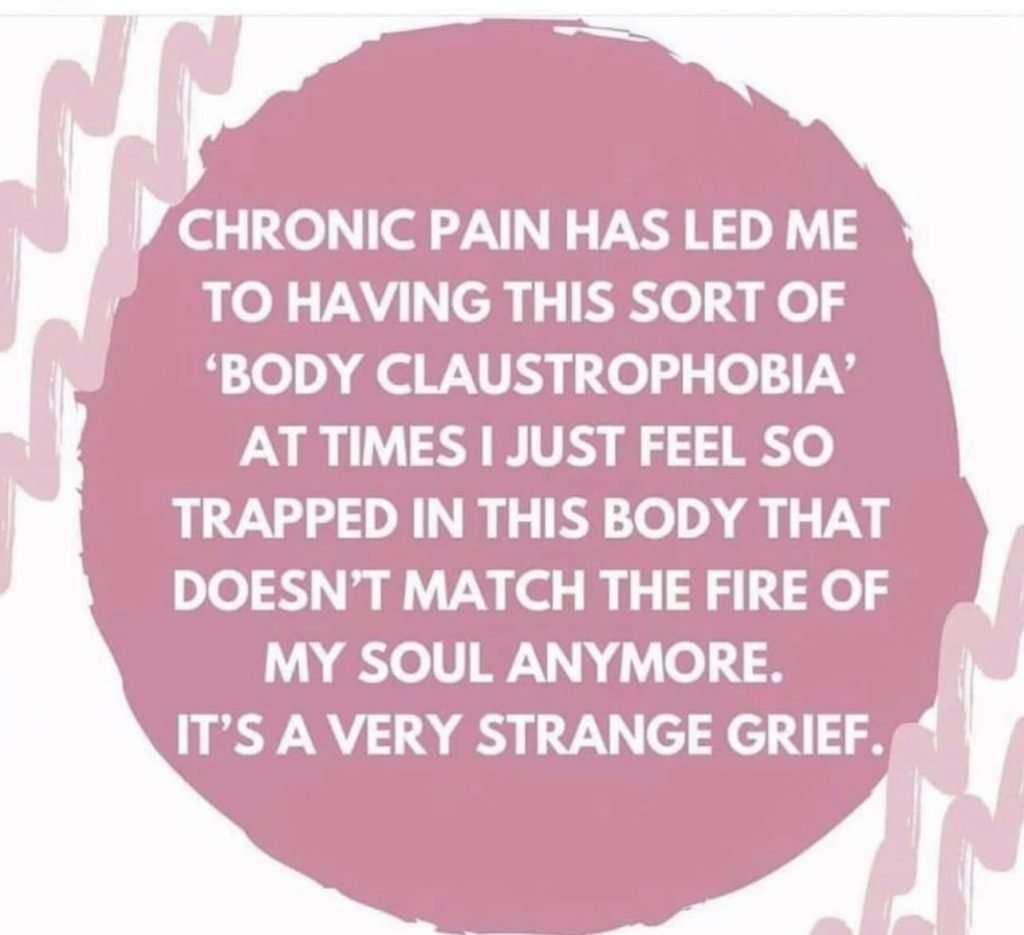
Someone posted this in a social media group for Chronic Fatigue Syndrome (CFS), and some responded saying their body has become their enemy and their prison.
I understand. It’s natural to see it that way, especially in our culture.
I see it and viscerally experience it differently.
COMPASSION AND GRATITUDE
I find a deep compassion for my body dealing with all that’s going on related to the CFS. It’s doing its best. It’s innocent and hard-working.
I have a deep gratitude for this body, for the same reason. It’s here. It’s doing its best. It’s supporting this life. It’s allowing me this life in the world.
I find that my body is my friend. It’s my best friend (one of many!). It’s here for me. It’s whole existence is devoted to me.
AM I IN THE BODY OR IS THE BODY IN ME?
I also find it useful to ask myself this question: Am I in the body, or is the body in me?
I find that I am space for this body and whatever it’s experiencing and the symptoms related to the CFS. It’s all happening within this awake space and as this awake space. (This awakeness is the ordinary awakeness I assume is here for all “conscious beings”, it’s nothing special.)
I also find that the symptoms, like everything else, are ephemeral. They come and go and are always new and fresh and different.
EXPLORING
How did I find this? Through many years of processing, inquiry, and explorations to find what’s genuinely true for me. I have identified and explored innumerable stressful thoughts about my body and its symptoms and found genuine and specific examples of how the reversals are as or more true. The Work of Byron Katie has been very helpful here, as has the Big Mind process, basic mediation, Headless experiments, sense field explorations (Kiloby Inquiries), and mainly curiosity and noticing.
I also know that many parts of me are not on board with this, and come up to be seen, felt, understood, included, loved, and so on. I also know that with different symptoms and in different circumstances, different things may come up in me.
There is always further to go, and there is always what I am invited to explore and notice here and now.
CULTURE AND BODY
These views always happen within a culture, and one way to understand cultures is to see where they fall on the partnership and domination spectrum.
In short, before the agricultural revolution around 10,000 years ago, we were all indigenous. We lived in cultures largely on the partnership side of the spectrum. We saw ourselves as nature, as part of the web of life, as the web of life giving us life, as ephemeral expressions of this web of life, of all life as sacred, and so on.
With the agricultural revolution, we had the opportunity to amass wealth and “own” land, animals, and even people. This had to be justified, and that’s where a stronger domination orientation came in. We see ourselves as separate from nature, we are superior to nature, nature is suspicious, we need to control in order to find safety, the mind comes from and lives inside of the body, the sacred is removed to a sky god and the afterlife, and so on.
If we have that worldview, it’s no surprise if we see the body as a burden, or even an enemy or prison, as soon as it’s not healthy. If it’s not doing what we think it should be doing, we try to control it and we find ways to struggle with it.
On the other hand, if we have more of a partnership orientation, it looks different.
With that worldview, it’s natural to see the body as doing its best. If it’s sick, it’s often because the larger systems – social and ecological – are sick, as they are today. We live in a culture of imagined alienation and separation and consequently lives that feel, to some extent, empty. We live in an ecosystem that’s severely impacted by and degraded because of this culture.
No wonder we get sick. Our individual illnesses are often a symptom of what’s happening in the larger social and ecological systems, and it’s ultimately a symptom of our domination culture.
If our body is not healthy, we look (among other things) at the larger systems for reasons and we seek solutions in partnership with the body. For instance, we may seek to support our body by changing our diet, reducing stress, moving to a better climate, and so on, along with whatever approaches make sense from mainstream medicine.
The image is by me and Midjourney
MORE INFO
After writing this, I used the text above as a prompt for ChatGPT 4o. See below.
Body, Culture, and the Struggle: A Reflection on Chronic Fatigue Syndrome and Cultural Narratives
The Body as Enemy and Prison
In many contemporary cultures, particularly within Western frameworks, the body is often viewed through a lens of struggle and domination. This is especially evident in contexts like Chronic Fatigue Syndrome (CFS), where individuals suffering from the condition may refer to their bodies as “enemies” or “prisons.” The body, in these perspectives, becomes something to overcome, something that betrays or limits the individual. This perception is rooted in larger cultural narratives that associate strength, control, and productivity with success, while weakness, vulnerability, and illness are viewed as failures. In this context, the body is often seen as an adversary, something to be conquered rather than cared for, respected, or even loved.
The Cultural Influence of Domination and Separation
The roots of this view are deep and trace back to the rise of domination culture, which emphasizes separation, control, and hierarchy. In such a culture, the body is often relegated to a lower status, seen as a machine to be managed, dominated, or fixed. This perspective fosters an environment where we view the body as something distinct from the “real” self—an object to be improved, perfect, or subdued. The body becomes separate from the mind, the spirit, or the true essence of the self, perpetuating the idea that we are not truly whole unless we “conquer” our bodily limitations.
This separation is also reflected in how society values external achievements—productivity, efficiency, and success—over inner well-being, rest, or healing. The dominant narrative in many Western cultures stresses the need to “push through” pain, exhaustion, or illness, which reinforces the idea that we must transcend the body’s limitations rather than understand or empathize with its needs. The dominant view of the body as something to be controlled is echoed in various spheres, including medicine, which often focuses on “fixing” the body rather than working with it or honoring its innate wisdom.
Body as Friend: A Reclamation of Wholeness
An alternative to this view—one that has been explored by individuals who challenge cultural norms—is to reframe the body as a companion rather than an adversary. This perspective invites us to shift from domination and separation toward a more integrative, compassionate view of the body. The idea of the body as a friend, one that is working tirelessly and innocently to support life, is not only an act of personal healing but also a reclamation of a deeper, more holistic relationship with the self.
This shift is profound. It requires us to step outside the norms of a culture that often disconnects the body from the mind and spirit. It asks us to remember that our bodies, regardless of their ailments or weaknesses, are intricately tied to the experience of being alive. They are vessels of experience, not just burdens to bear or obstacles to overcome. When we embrace the body with compassion and gratitude, we begin to see it not as something that is failing us but as a wise and resilient force that deserves love, care, and respect.
The Cultural Context of Chronic Illness
The perspective that the body is a prison or an enemy is not universal; it is shaped by the larger cultural values we inherit. In contrast to the Western model, many indigenous cultures see the body as an integral part of the environment, interconnected with the land, the community, and the cosmos. These cultures emphasize the interconnectedness of all things, where the body is not a separate entity to be controlled, but a sacred part of a larger, cyclical process. The emphasis in these traditions is on healing, balance, and harmony, not on domination or transcendence.
In these cultures, there is often a more profound acceptance of the body’s needs and limits, without the need to label it as “weak” or “broken.” This worldview can offer insights into how we might approach illness and suffering, not as punishments, but as invitations for deeper connection, understanding, and integration with the natural world and our own bodies.
Regeneration and Compassionate Inquiry
At its core, the journey of understanding the body through the lens of compassion and gratitude is one of regeneration—a regeneration not just of the body, but also of our relationship with it. Through practices like Byron Katie’s inquiry process, mindfulness, meditation, or simply exploring our thoughts and feelings, we begin to uncover how much of our suffering comes from the judgments we place on our bodies. When we explore these thoughts, we often find that the beliefs we hold about illness and weakness are not as solid as they first appeared. They are cultural imprints that can be questioned and released.
In the case of CFS, this process of inquiry can be particularly transformative. Chronic fatigue, though deeply challenging, offers an opportunity to re-examine our assumptions about productivity, strength, and worth. It invites us to ask whether we are willing to live in a world that values stillness, rest, and presence as much as it values doing and achieving. It challenges the very foundation of how we relate to both our bodies and our culture.
The Role of Culture in Healing and Understanding
Healing, then, is not just a physical process, but a cultural one. It is about questioning the dominant narratives that shape our relationship with the body and finding new ways to relate to ourselves and others. In this process, curiosity, acceptance, and compassion become essential tools. By shifting away from the mindset of the body as a machine to be fixed and instead embracing it as a companion and ally, individuals can create a deeper, more nurturing relationship with their physical selves.
This also requires a collective shift in how we view health, well-being, and illness in our culture. It involves moving away from individualism and toward a more holistic view of health that recognizes the interplay between mind, body, spirit, and culture. The conversation around chronic illnesses like CFS needs to evolve from one of isolation and judgment to one of community, understanding, and compassion. When we see the body as a friend and an integral part of our lived experience, we open ourselves to deeper healing—both for ourselves and for the collective.
Conclusion
The dominant cultural view of the body as an enemy and a prison is a reflection of deeper societal values rooted in domination, separation, and control. But there are alternative ways of thinking about the body—ways that emphasize interconnectedness, compassion, and gratitude. By embracing the body as an ally, rather than an adversary, we can begin to shift our personal and collective relationships with it. In doing so, we reclaim the wisdom of the body and its role in the larger web of life. This perspective invites healing not just at the level of the individual, but at the cultural level as well, encouraging a more compassionate, interconnected way of being in the world.