
The old left–right political map grew out of 18th-century France and no longer captures the challenges of our time. Today, two dimensions matter more: whether policies are green, aligning with ecological realities in the face of global overshoot, and whether they are inclusive, expanding the circle of who is cared for and who has a voice, from marginalized people to non-human beings and future generations. These axes reveal four broad orientations — inclusive but extractive, exclusive and extractive, exclusive but green, and inclusive and green — with the last offering the only truly sustainable, win-win path forward. By adopting this updated map, we can better see through superficial politics, focus on what matters, and orient ourselves toward futures where both people and the Earth can thrive.
We all use mental maps to think about political parties and their policies.
I like to ask myself some important questions about these maps.
ESSENTIAL QUESTIONS
What mental models do I use to organize political parties and their policies?
What do these mental maps say about me? How do they shape my views and behavior? What do I see because of them? What do they hide?
Are they aligned with what I really value? Are there models that better fit what’s important to me?
THE LEFT-RIGHT AXIS
For a couple of hundred years now, we have used a left-right axis to understand politics.
This comes from the seating arrangement in the French National Assembly after the 1789 storming of the Bastille at the beginning of the French Revolution. Those who defended the monarchy, church, and aristocracy sat on the right. Those who wanted radical change sat on the left.
This was more broadly adopted in Europe in the 1800s, when right came to mean defense of privilege, and left meant reform, redistribution, and often a more inclusive democracy.
THE SHORTCOMINGS OF THE LEFT-RIGHT AXIS
As with any map, the left-right axis has shortcomings.
It reflects the political situation of France in the late 1700s where the focus was on tradition versus revolution, and the social distribution of money and resources.
That’s why others have used other axes, often in addition to the left-right one. For instance, progressive-conservative (more about openness to change), urban-rural, secular-religious, globalist-nationalist, libertarian-authoritarian (the Political Compass), and so on.
So the question is: What’s different today from revolutionary France? What’s important to us in our world?
GLOBAL ECOLOGICAL OVERSHOOT
These days, our overarching crisis comes from global ecological overshoot. We are spending far more natural resources than this living planet can replenish. Our collective ecological footprint is larger than this planet. That means unraveling of ecological systems and eventual ecological collapse, and with it, civilizational collapse. We are on a path that’s ecocidal and suicidal.
So shouldn’t our political maps reflect that urgency?
THE GREEN AXIS
In my mental maps, the green axis is essential.
Do the policies take our ecological reality into account?
Do they come from an understanding of the urgency of our situation?
Do they reflect the understanding of a need for a profound transformation of our civilization?
Are they regenerative?
THE INCLUSIVITY AXIS
I also use another mental dimension, the inclusivity axis.
How inclusive are the policies? How wide is the circle of WE?
How wide is the circle of those we aim to benefit through the policies? A segment of our own society? All of our society? Everyone globally? Non-human beings and species? Ecosystems? Rivers? Future generations? Who are harmed by our policies? Who is left out?
How wide is the circle of those that have a voice in the forming and implementation of these policies? How deep is our democracy? Do we include all of society? Passively, by allowing them to vote? Actively, by seeking out the voices that are often quiet, including of those who are marginalized? Do we give a voice to non-human beings, rivers, and mountains? Do we give a voice to future generations?
This dimension is perhaps most similar to the partnership-domination spectrum from Rianne Eisler, rephrased as power-with and power-over by Starhawk.
Unlike the libertarian–authoritarian axis, inclusivity is not primarily about state control vs. personal freedom. It’s about who is included in our circle of concern and who has a voice.
IT MAY SEEM NAIVE
As I write this, I have a mental image of people dismissing this as naive.
And yet, is it naive?
To me, it seems more naive to use political maps that belong to the 1700s and a very different world than the one we live in. It seems naive to ignore Earth’s limits and pretend it has infinite resources for us to use, and infinite capacity to absorb the waste of civilization. And it seems naive to continue on a path we know leads to ecological and civilizational collapse.
As I and many others see it, we have two main tasks ahead of us:
Reducing our collective ecological footprint, which means a thorough redesign of our civilization – from our basic assumptions about the world (separation vs interconnectedness) to education, technology, energy production and use, and every other aspect.
Creating a deeper democracy. One that actively seeks win-win solutions that benefit as many as possible, including non-human beings and species, ecosystems, and future generations. And one that actively seeks input from as many voices as possible, including the same.
And those two go hand-in-hand. We cannot have one without the other. To gain support for regenerative policies, we need the support of the people. They need to know it benefits them as well. They need to be heard and included.
GREEN-INCLUSIVITY MODEL
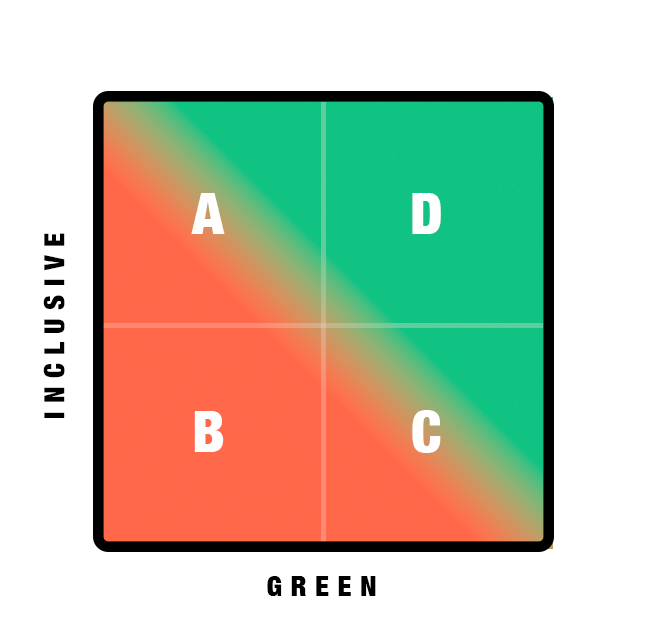
I made a simple diagram of the green-inclusivity map of politics and policies.
It doesn’t cover everything that’s important, of course, but it does cover two essential dimensions.
The horizontal/green axis shows how green a policy is, or how green a political party tends to be. At the far left is explicitly anti-green policies. To the far right, deeply regenerative policies.
The vertical/inclusive axis shows how inclusive it is. At the bottom are strongly exclusive (authoritarian) policies. At the top are deep democracy policies.
That gives us the following quadrants:
- A. Inclusive but extractive
- B. Exclusive & extractive
- C. Exclusive but green
- D. Inclusive & green
FAMILIAR POLITICAL PARTIES
I’ll take some examples to see where they fall in this map. First, some familiar political parties.
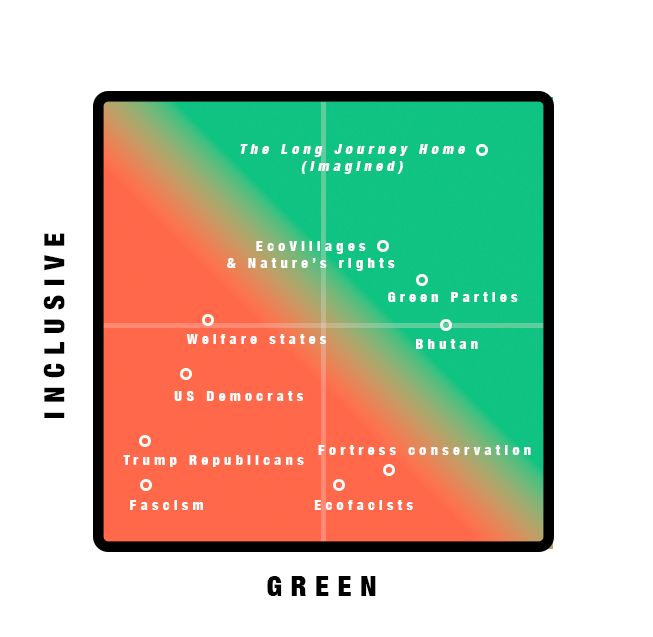
In the U.S., Democrats are moderately inclusive within the human sphere, although still in the pockets of Big Money and only marginally green. Trump Republicans would be quite far down on both dimensions. They want to exclude minorities from voting through gerrymandering and other policies, and their policies are often explicitly anti-green.
In Norway, the Green Party are somewhere in the top right quadrant. They are averagely democratic, and somewhat include the imagined views of non-human beings and species and future generations. They are about as green as any political party can be in our society. In both areas, I imagine they would go much further towards the top right if it was realistic in our society. Most other parties are middling in terms of democracy, and somewhere on the left side on the green axis.
EXAMPLES BY QUADRANT
And then, some examples of each quadrant, including some especially clear ones.
A. Inclusive but extractive. In this quadrant, we find 20th-century welfare states, or liberal parties that champion human rights but rely on extractive growth. This liberal orientation can be strongly inclusive within the human sphere, which brings them somewhat into the inclusivity side of the map.
That said, it’s difficult to imagine an orientation that’s deeply inclusive while also strongly extractive. In this map, if you are highly inclusive, it means you bring in the voices of the non-human and future generations, and that means you’ll have to be at least somewhat green.
B. Exclusive & extractive. Authoritarian regimes are often also extractive. As mentioned above, the Trump Republicans unfortunately fall into this category. Historical fascist regimes, under Hitler, Mussolini, Pinochet, and others, were even lower on the inclusivity scale and equally extractive.
C. Exclusive but green. Ecofascism is an interesting example of a dangerous orientation that’s at the low extreme of one axis and the high extreme of the other. We’ve seen only hints of this so far, which is for the best, though the risk may grow as ecological collapse deepens. We may, for instance, see forms of ecofascism emerge among some of the super-wealthy. Among existing ecofacists, for instance in Eastern Europe, I get the impression that they claim to be green without actually being very green.
Some forms of fortress conservation is another example for this quadrant, where nature is preserved at the expense of the indigenous population.
D. Inclusive & green. Green parties are mainly in this quadrant, as mentioned earlier, although they can typically go much further on both dimensions. They are limited by the realities of our current society, culture, and civilization. Bhutan is likely here too, reasonably green and inclusive, a somewhat flawed democracy although young and aspiring.
The imagined future society in my own Long Journey Home project would be in this top right quadrant, and further along than just about any political party today. They strive to be deeply democratic and actively engage marginalized people and include the voices of non-human beings and species, rivers, mountains, oceans, and future generations (they give voice to them, as best as they can, in councils, community decisions, and the law and legal system). This society is also regenerative and deeply green.
REFLECTIONS ON THE QUADRANTS
The top left (inclusive/extractive) and bottom right (exclusive/green) are, in some ways, mirror images of each other. They are both high in one dimension and low at the other. As I see it, they are both self-contradictory. One cares for people but not so much for the living systems we are part of or future generations. The other cares for our living systems, but less for (other) people.
Both come from a zero-sum orientation. To make life better for people today, we need to extract natural resources. To protect our living systems, we need to oppress people.
The bottom left (exclusive/extractive) and top right (inclusive/green) quadrants are, at least, more internally consistent.
The exclusive/extractive quadrant is a kind of lose-lose quadrant. Most people lose, and our living systems lose. Just a very few benefit from it, and only in a narrow sense and in the short term.
The inclusive/green quadrant is a win-win quadrant. Since it’s inclusive, it does depend on people wanting it and that’s its weakness. If people want it, that’s also its strength. It’s the only one that’s sustainable both socially and ecologically, as long as people want it.
Looking at the few examples I placed in the diagram, I wonder if more examples would create a pattern similar to a Hertzsprung–Russell diagram for stars (!) – a diagonal band across the chart, with a few outliers.
THE TOP SECTION OF THE DIAGRAM
I mentioned briefly that it’s difficult for me to find examples for the top of the diagram from current politics, whether for the left or right side of the diagram.
On the left side, it’s because none are as inclusive as they can be in terms of including voices for non-human beings, ecosystems, and future generations. (In practice, it would be someone speaking for them, and their rights embedded in enforced law.) Current parties and policies are, at most, inclusive within the human realm, and that brings them only up to the middle or just above.
On the right side, it’s because none are as green as they can be in terms of working for a thorough transformation of our society, culture and civilization, and creating deeply regenerative versions of these. I assume many Greens want this and have it as a vision, but it’s not yet realistic in our society and culture.
Some do write, speak, and do work on these topics, and live it in their own lives and in smaller groups. They fit higher up. Some examples are Arne Næss with his Deep Ecology, Joanna Macy, ecovillages, people working with deep democracy models, and so on.
A FEW MORE THOUGHTS
I first called this article A politics of oneness. That’s what it is, of course. A wish to create a regenerative and inclusive society grows out of recognizing our interconnectedness. We are all local and temporary expressions of the living system we call Earth. Our own health and well-being, and even our existence, depends on a thriving social and ecological whole.
Our old maps were useful, and now they hide what matters most. A politics that ignores ecology and excludes voices drives us toward collapse. A politics that is both green and inclusive gives us a chance to thrive. Our political maps need to reflect this reality.
These dimensions don’t capture everything, but they highlight what matters most in our time. They show us whether our politics align with the living systems we depend on, and how wide our circle of concern reaches. They help us cut through superficial politics, focus on what truly matters, and create a future where life can thrive.
WHO IS THIS FOR?
Who are these kinds of updated political maps for?
I imagine some groups will resonate with it, especially people who are into sustainability, systems views, and so on. They will at least understand it, although I am sure they have their own views and see inevitable shortcomings of this and similar models. (Spiral Dynamics Green and second tier.)
People who have a modern mainstream mindset may not see the need for such a model. It may seem naive, hippieish, idealistic, and so on. To speak to this group, emphasizing the science and the pragmatics of it may be important. We are in ecological overshoot, which has dramatic consequences, and this is a framework we need to include to understand politics, society, and our economy. By exploring these kinds of maps, and taking these kinds of concerns into account, you can be ahead of the competition. (Spiral Dynamics Orange.)
People who are traditionalists and religious will likely see these maps as irrelevant to their lives. To speak to these groups, it may be good to emphasize that the aim is to care for God’s creation, family, community, and our children and their children. It’s about creating a world where people are taken care of. (Spiral Dynamics Blue.)
Of course, even by adapting the language and speaking to their values, only a few will likely be interested. That’s fine. That’s how the world works.
A NOTE ON AI USE IN THIS ARTICLE
I used AI to summarize the article, which is the first paragraph. Otherwise, I used AI minimally for feedback of the kind you would receive from an editor.