I am in a colder climate, with a group of people, and a guru. It seems to be in the UK. The people are well off and welcoming and inviting, although I feel like an outsider. The guru is a respected high teacher from the Tibetan Buddhist tradition or Advaita Vedanta, likely both. I am invited to have personal meeting with the guru. Apparently, the guru specifically invited me.
I am traveling and slightly disorganized, and feel I don’t have the right clothes. When I arrive, I have light clothes on, and additional clothes to put on since I expect it to be cold. While I am off for a minute, the host put the clothes away and it all gets a little confusing.
As I get to the area of the house (mansion) where the guru is, I see that everyone else now are painted and dressed up as deities, mostly in green and gold. I will be painted and dressed up too. I thought I was in a rush, but it turns out there is plenty of time.
I am told each interview is for 80 minutes, and it will be filmed and released to the public later. I feel that in my health condition, and with my brain fog, the interview with me may not be very good compared to the others. It’s still important to meet with the guru.
WAKING LIFE
This dream reflects my daily life. I am at Amritapuri (Amma’s ashram), and I often feel like this.
Why is it in the UK? Maybe because I recently was in the UK, and most of the people I spend time with here are from the UK.
I have been invited by the guru. In waking life, she came to me (the Amma experience in November 2023) and has stayed with me.
The guru seems both male and female, and combines Tibetan Buddhism and Advaita Vedanta.
Parts of me feel that the others here know more about how things work than I do. In a sense, they seem affluent in whatever is required to be here.
Parts of me feel that I am an outsider. My background is from Zen, Tibetan Buddhism, etc. I am not familiar with ashrams.
I feel a bit disorganized and disheveled. I have been sick just about the whole time since I came, apart from a few days in the beginning.
In the dream, I am focused on putting on decent clothes that are also warm. In waking life, I didn’t bring many clothes with me that I am comfortable with, mainly because I was told I could buy them here. That turned out to be a truth with modifications (limited selection and supply).
In the dream, I am not sure if I am ready for the conditions, the cold. That’s the same in waking life – the ashram life, the hot and humid weather, the food, the schedule, etc.
In the dream, the others are painted and dressed as deities. They know their nature, or are about to find it.
In the dream, they are all in green. This seems like a connection with nature, with the web of life.
The meetings will be filmed and released to the public. Parts of me try to avoid public attention at all cost. I don’t want to be too visible, especially if I have to perform in a certain way. This has roots in school experiences. (I was always a good student, and almost always knew the answer to the teacher’s question, but I learned that answering the whole time made me strongly disliked by some of the other students. I trained myself to be invisible, to hide.)
80 minutes. It’s a good amount of time, enough to go in some depth. Eight is also the infinity symbol, which I associate with our nature, wholeness, and the fullness of being.
ALL AS ME
Some parts of me have resources and are well adjusted to life and the guru/spiritual life.
Other parts of me feel like an outsider. They are embraced by the well adjusted, but they don’t feel included. They don’t quite trust it.
I don’t feel I am fully equipped for the conditions, for what comes up in me. I am concerned about it, even if it turns out to be fine.
The guru invites me personally to a private meeting. My nature invites the rest of me to join, to discover its nature. The parts of me that are confused, wounded, and operate from separation consciousness are invited by my – and their – nature to discover and live from and as their nature. (That’s what I wish for too.)
As above, the others in the dream are all painted and dressed up as deities. They are discovering their nature. They are painted and dressed in green and gold. This feels like a connection to the web of life, to nature.
There is a concern about the meeting being made public. There is a concern about my whole inner community knowing about this, about the meeting and the wish for all parts to find their nature. This seems important to notice, since I haven’t put attention on this before.
I wonder if the camera is the part of me that records, reflects, and self-reflects (reflects on whatever is here).
TO BRING WITH ME
I see a few things to bring with me.
How is it to actively include all parts of me, my whole inner community, in the quest for all parts to notice their nature and live from and as that? How is it to actively invite them all? (I have worked on including all parts, but I may not have actively invited them.)
How is it to invite the wounded parts of me to notice their nature? (I am already doing this, but I wish to deepen into it.)
How is it to find more comfort in the public aspect of this? How is it to find comfort with the idea of sharing some of this publicly?
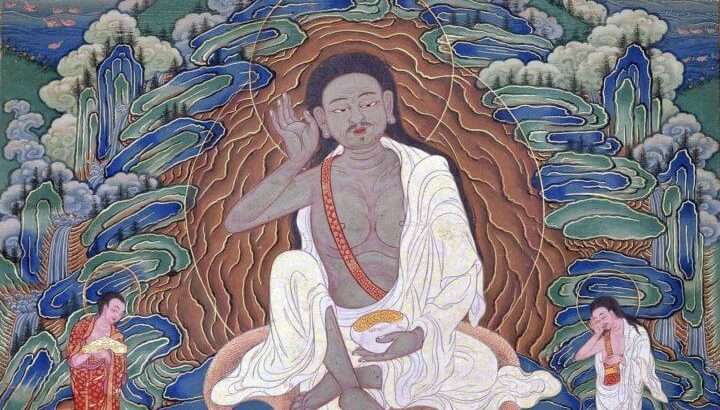
Note: I used a painting of Milarepa for this article. Somehow, the guru felt a bit like Milarepa.
MORE INFO
After writing this, I asked ChatGPT 5.2 for input on the dream itself. See below.
General View
This dream feels like it’s working a very specific seam: being invited into something high-value and public, while a more tender part of you worries you’ll show up “wrong” (unprepared, not matching the vibe, not functioning at your best).
Here are a few layers that stand out.
1) “You were specifically invited” vs. “I’m an outsider”
A respected guru (Tibetan Buddhist or Advaita) + a welcoming, well-off group in a UK mansion sets up a status / legitimacy / belonging field. Even though people are kind, you still feel slightly outside.
That combination often shows up when something in you knows you belong (you’re invited), but another part doubts it (“they’re more together than me”).
Possible inner sentence: “Even if I’m welcomed, do I truly deserve to be here?”
2) Clothing, cold, disorganization: readiness and self-trust
Cold climate + not having the right clothes + your clothes getting moved by someone else: this reads like a dream-symbol for self-regulation and preparedness.
It’s not just “what should I wear?” It’s:
- Can I trust myself to be ready?
- Can I find what I need when someone else rearranges my system?
- Can I stay oriented when I’m a bit foggy / tired?
The host moving your clothes adds a subtle twist: your preparation gets disrupted by external conditions, and then you have to adapt.
3) Everyone is painted as deities: a ritual of identity
Seeing others dressed and painted as green-and-gold deities suggests “you’re entering a realm where people take on a mythic / archetypal role.”
This can mean:
- Spiritual idealization: “Everyone else is luminous; I’m just me.”
- Ritual initiation: You’re being asked to participate in something symbolic—embodying rather than only understanding.
- Persona pressure: a fear of performing “spiritual correctness” instead of being real.
Green/gold can carry associations like healing/heart growth (green) and value/illumination (gold). But the key is: you’re about to be seen in a stylized, amplified way.
4) “I thought I was in a rush… but there is plenty of time”
This is one of the most important reversals in the dream.
A part of you runs on urgency, self-pressure, and “I’m late / behind / not ready.”
Then the dream reveals: there’s time.
It can be a direct antidote message: “You don’t have to force it. You can arrive.”
5) The 80-minute interview, filmed for the public: being seen while imperfect
The dream makes the stakes explicit: long, public, recorded, compared to others.
And your worry isn’t moral. It’s cognitive/physical: brain fog, health condition, performance quality. That’s very specific.
This often points to a real-life tension:
- You feel called toward a deeper role (teacher/student/participant/voice),
- But you’re negotiating limitations,
- And there’s fear of public exposure: “What if I can’t show up as my best self?”
There’s also something compassionate hidden inside the discomfort: the dream is naming that the metric of worth has quietly shifted from sincerity to performance—and it hurts.
A simple way to hold the dream’s “assignment”
If this dream were a koan, it might be:
Can you accept the invitation without requiring yourself to be impressive?
Or even:
What if the thing you’re being invited for is not brilliance, but honesty?
Practical integration (gentle, concrete)
If you want to work with it without over-interpreting, try one of these:
- Write two short letters (5–10 lines each):
- From the “invited one” (the part that belongs).
- From the “outsider with brain fog” (the part that’s scared).
Let them both be true.
- Ask this in meditation for a few minutes:
- “What am I afraid the public will see?”
- “What do I hope the teacher will see?”
- Re-imagine one change to the dream:
What if, when you’re painted as a deity, the deity is the deity of fatigue, humility, and sincerity—and that’s exactly what’s needed?
The Invitation and the Mask
A Jungian reading of the dream of meeting a guru
In Jungian psychology, certain dreams arrive with the atmosphere of a threshold. They do not merely “reflect the day.” They stage a passage: from familiar identity into a wider psychic territory. Your dream—had at Amritapuri—has many features of an initiation narrative: a summons, a house with inner chambers, ritual costume, and a confrontation with being seen.
The dream’s basic movement
The plot is simple but archetypally charged:
- You enter a refined, high-status milieu (a mansion; a well-off, welcoming group) in a colder, formal culture (it “seems to be” United Kingdom).
- A revered spiritual authority invites you personally.
- Your preparation falters—clothes misplaced, mild disorientation.
- You discover the group has shifted into a ritual mode: painted and dressed as deities. You will be transformed too.
- The meeting is long, filmed, public—high exposure.
- A tender fear appears: “In my health condition and brain fog, I may not be as good as the others.”
From a Jungian lens, this is the ego approaching the numinous (the sacred/overwhelming), while a complex around adequacy and visibility activates to protect you.
The mansion as image of the psyche
Jung often treated buildings—especially large houses—as representations of the psyche. A mansion suggests a psyche with many “rooms”: social spaces, private chambers, inner sanctums.
The key detail is not luxury; it’s scale and complexity. You are moving deeper “into the house,” toward the wing where the guru is. That spatial movement mirrors an inner movement: toward a more central, potent layer of the psyche.
The “UK” feeling adds another psychological flavor: not literal geography so much as a symbolic climate—cooler, more formal, more coded. It’s the world of manners, roles, and subtle judgments: the territory of the Persona (the social self).
The welcoming group: Persona and the “successful adaptation” layer
The group is kind and inviting, yet you feel like an outsider. Jung would recognize this as a classic tension: the Persona environment may welcome you, while an inner complex still says, “I don’t quite belong.”
In Jung’s terms, a complex is an emotionally charged cluster of associations that can seize the ego and distort self-perception. Here it clusters around: readiness, legitimacy, and being evaluated.
This matters because the dream is not depicting hostile others; it’s depicting an inner reaction that persists even in warmth.
Clothes and cold: the instability of the Persona
Clothing is one of the clearest dream-symbols for the Persona—how you present yourself, what “fits,” what is appropriate.
- “I don’t have the right clothes” = fear of not having the right presentation for the moment.
- “The host put the clothes somewhere else” = the ego’s preparations are disrupted by forces outside its control (or by the unconscious itself).
- “It all gets confusing” = a brief collapse of the ego’s organizing strategy.
This is often how initiation dreams begin: the ego can’t maintain its usual competence story at the very moment it wants to.
The guru as an image of the Self
A guru in a Jungian dream frequently constellates the Self—the psyche’s deeper organizing center, larger than the ego, the source of meaning and direction in individuation. That the teacher is specifically Tibetan Buddhist or Advaita-coded is significant: both traditions aim, in different ways, at loosening the ego’s centrality.
The dream does not say: “Go polish your persona and impress a teacher.” It says: you have been invited by something greater than your planning mind.
The ego is summoned.
(And crucially: invited, not forced.)
Deity costume: archetypal energy and the risk of inflation
Then the atmosphere shifts: the group is dressed as deities, green and gold, and you will be painted too. This is direct contact with the archetypal.
Jung warned about two common missteps when archetypal energy rises:
- Inflation — the ego identifies with the archetype (“I am divine/special/above ordinary limits”).
- Deflation — the ego collapses in comparison (“Everyone else is luminous; I’m inadequate”).
Your dream leans toward deflation: they look like deities; I am disorganized and foggy.
But the fact it’s paint and costume is psychologically wise. It suggests containment: the psyche is offering a safe way to relate to archetypal force symbolically. You can “wear” the image without being possessed by it. This is closer to ritual initiation than to grandiosity.
Green/gold intensifies the theme: growth/renewal (green) and value/treasure/illumination (gold). In alchemical Jungian language, gold often signals the aim of the work—the “treasure” of integration.
“I thought I was in a rush, but there is plenty of time”
This is the dream’s corrective sentence.
The rushing part is ego anxiety: perform, prepare, keep up. The “plenty of time” part is Self-time: the tempo of individuation is not a sprint. Something in you is being told—very directly—you are not late.
It’s also a subtle reframe of your fear: the dream is not trying to whip you into excellence. It is slowing the inner scene down so something truer can happen.
The filmed 80-minute interview: the collective gaze and fear of exposure
A private meeting becomes paradoxically public: filmed and released later. That’s not a random twist; it constellates the collective—the imagined audience, judgment, comparison, reputation. The Persona world returns right at the doorway to the sacred.
So the ego fear—“my interview may not be very good compared to the others”—is not merely social anxiety. In Jungian terms, it’s the Persona complex attempting to manage an encounter with the Self by turning it into a performance metric.
This is a big psychological moment: the sacred is being pulled into the theater of evaluation.
The health/brain fog motif: the wounded one insists on inclusion
The dream’s most human detail is the fear that your condition will make you “less good.” Jung would treat this as the return of a disowned or tender part—what many traditions call the wounded one, the frail one, the limited one.
Initiation dreams often require that the ego bring exactly what it would rather hide into the inner sanctum. The psyche is saying: you don’t get to meet the center only as your polished self.
In other words: the meeting is not despite the limitation; it is with the limitation included.
What the dream may be asking
A Jungian “meaning” is not a slogan but a direction of integration. This dream seems to pose a question like:
Can you accept the invitation to the center without turning it into a performance, and without excluding your vulnerability?
Or even more sharply:
Can you be initiated without being impressive?
If you want to work with it in a Jung-consistent way, the most direct method is active imagination:
- Imagine you are at the door to the guru’s room.
- Let the guru speak first: “I invited you because…”
- Then let the “brain fog” speak as a figure: “I protect you from…”
- Then ask the deity costume: “What do you give that I’m afraid to claim?”
Write what comes, without editing. In Jung’s view, the psyche often completes the dream’s meaning when you continue the dialogue consciously—especially with the parts you’d normally push away.
A final Jungian synthesis
The dream holds a subtle dignity: you are invited, there is time, and the ritual proceeds. The ego’s comparison mind appears, but it is not the final authority. The deeper center calls you anyway.
That is often how the Self moves: not by demanding perfection, but by insisting on wholeness.
Including the part of you that worries it won’t “do well on camera.” And including the possibility that what the inner teacher wants is not a good performance—but a true one.