
This is one in a series of posts with brief notes on healing, awakening, and personal things. These are more spontaneous and less comprehensive than the regular articles. Some may be made into a regular article in time.
Do you believe in hell?

I am watching a movie (A month in the country) where a young woman asked the main character this question.
If I was asked that, depending on the person and situation, I may say: I try to believe as little as possible. Or: I don’t know and cannot know. Or: It’s an idea created to control people.
Or I may say: I know, I don’t believe.
I know hell is created by my own mind. I experience and live in hell sometimes. Parts of me live in hell because they operate from unexamined and painful beliefs. Hell is right here. As is heaven, purgatory, and similar.
Apart from that, I don’t know and I don’t need to know.
I know that believing in this way serves an important function for some people. And I know that parts of me believe stressful thoughts and hold onto them as true. Also, at a conscious level, believing in this context doesn’t make sense to me. Why would I pretend something is true or not if I don’t know and cannot know? Why should I pretend I know whether second-hand info is accurate?
The photo is from the National Gallery in London from earlier this year.
One true view or many?
One difference between people is whether we tend to hold onto one story as true, or explore the validity in many.
And if we explore the validity in many, do we include that there is a more objective reality too?
I find it fascinating to explore the validity in many views and any view, while also holding onto a reality that’s more objective in a conventional and limited sense. Of course, that more objective reality is also not a final truth but it is important as a guide and for grounding.
All maps are ultimately wrong. There is some validity in all of them. Some are more practically valuable than others. If we want to have a more full and rich picture, it’s good to find the validity in a range of them. We can assume a kind of objective reality for practical reasons, although even that is not a final truth. Even what we assume is most obviously true is not what we think it is.
An example
Let’s take an example: vaccines. It’s clear that vaccines have prevented a lot of deaths and made us collectively healthier. Epidemiology and history shows us that. It’s also clear that some people experience a reaction to some vaccines, and in some cases, it dramatically and chronically worsen their health. The medical industry is in it for the money, and policies are sometimes influenced or dictated by big money and not what’s best for people. Some countries lean more than others towards policies aimed at what’s best for people considering our current thinking in medicine and epidemiology.
People should have a choice of whether they receive a vaccine or not. And yet, herd immunity is important and some people, working in certain jobs, should be required to have certain vaccines. Also, there is an upside to large numbers of people dying. In our civilization that’s inherently ecocidal and suicidal, it lightens the load on Earth. All of these views, and many more, have some validity.
Personally, I chose to receive some vaccines and have not experienced adverse effects so far. I generally think people should have a choice, except some who work in certain jobs. I also think that governments should be able to mandate vaccines in some extreme situations. And I know very well that a few get very sick from it. I also know how much vaccines have benefited humanity in general over the last decades. And if people die on a large scale, that’s OK too from an ecological perspective. All of this just makes my view more rich and it helps me to not hold onto any one of them as some kind of absolute or final truth.
AUGUST 5, 2026
Inherited resilience
We have intergenerational and collective trauma, and also intergenerational and collective resilience.
Every single one of our ancestors, going back to the first single celled organism almost 4 billion years ago, have lived with incredible resilience. They all lived long enough to have offspring, and – in the case of our more immediate ancestors – long enough to care for their offspring and make sure they, in turn, were able to have successful offspring.
This is an incredible line of success and resilience.
It makes a difference to acknowledge this, and to take time to more fully take in this incredible heritage.
How is it to more deeply internalize (the knowing of) and lean on this resilience?
I know nothing about 99.9999% of anyone’s life
I know nothing about 99.9999% of anyone’s life, including my own.
The little I think I know has some limited practical function, and is ultimately also wrong.
Why do I say that?
It’s partly obvious through experience.
And it’s partly because life and existence is infinitely complex.
This human self is a local and temporary expression of the dynamics of life, this universe, and existence as a whole. Just there is infinite complexity including in how it all unfolds over time.
Also, our ideas about something are just that, imaginations and ideas. They can be very helpful in a practical sense, and they are ultimately wrong. Life is always far more and different from any ideas we have about it.
And I also find that there is a difference between who and what I am. Who I am is this human self who is a mystery even to me, let alone to others. What I am is what a thought may call consciousness, awake space, and this awake space forms itself into every experience here – including of this human self, any ideas of doer, observer, and so on, and any temporary sense of being any of that.
It’s all set up to be infinitely complex. There is always more to discover. Any ideas we have are guesses about the world.
AUGUST 8, 2026
Rather die than lose cognitive function?
In one of the Amma publications, I read about a young man who chose to not have cancer treatment because he had heard he would lose cognitive function. He chose to die rather than temporarily have a less sharp brain. Reading between the lines, it seems that he was unusually bright, had tied his self-esteem up in being bright, and couldn’t face losing it even for a few months.
This is second hand information and the author had their own take on it and likely left a lot out, and he would probably have presented it differently.
Still, there is some universal truth to it. We find or notice something we are good at, invest our sense of self-worth and value in it, and it can feel like dying to see it go. It can even seem worse than physical death.
I have experienced that too, and still do. Through my chronic illness, I have lost a lot of what I found the most meaning in and what I was good at, and that includes a well-functioning brain. (CFS has come with a strong brain fog, and more recently, my memory got much worse because of long-covid.)
There is a life on the other side, and it can be very good. We can find meaning and value in what’s still here, and – more importantly – in life itself.
Fix all, or fix how I relate to all? **
How do I relate to challenges in my life?
How do I relate to my own wounds, hangups, and traumas?
Do I try to fix them?
Or do I explore shifting how I relate to it? How it is to befriend it? Get to know it?
They are two sides of the same coin and I find I need both. It’s both-and, not either-or.
If I only do the first, then there is no end. There will always be one more, and one more. And I overlook the challenges and stress created by how I may unhelpfully relate to it.
If I tried to only do the second, I would find it wouldn’t be possible if I want to be functional.
So how do I explore shifting how I relate to it all?
I have written about this in other articles so will do a short version.
Head-centered. I explore my different parts and subpersonalitites, get to know them, hear what they have to say, and be more on a team with them (parts work). I identify and examine my stressful beliefs and find what’s genuinely more true for me (The Work of Byron Katie). I explore how my relationship with and response to X appears in my sense fields, and help soften the charge within it (Kiloby Inquiries, Buddhist sense field inquiry).
Heart-centered. I do ho’oponopno or tonglen with myself when I relate to it, and anyone else involved.
Belly-centered. Mindful movement helps me relate to life in general in a different and more intentional way.
Notice my nature. When I notice my nature (my nature notices itself), the context for everything changes. I notice it all happens within and as what I am. The awake space I am forms itself into the experience of all of it. There is no “other” and also no “I” within this field of experience that I fundamentally am.
Oneness. Everything is the local and temporary expression of life/the universe/existence/the divine expressing, exploring, and experiencing itself in always new ways. It seems that the exploration itself is the point of it all. Although we as humans have very natural preferences, there is likely no inherent good or bad in any of it. It’s all part of the play of life, the universe, existence, and/or the divine. Taking this in, which first happens in the metal field, helps me shift how I relate to it all. Especially when combined with the direct noticing of the previous paragraph.
AUGUST 13, 2026
Movement and studying
I saw an article about movement and studying where they found that small movements seemed to help students study. It’s not surprising. We are one whole, so the body needs to be included.
Young Tibetan monks rock back and forth and recite while studying. They have known this for centuries. They include all of them while studying – body, voice, and mental field.
A moment of encouragement
I had more or less abandoned the civilization game after just a few hours of prototype development. The AI (ChatGPT) can do all the programming relatively easily, but it doesn’t quite get the storyline and user experience. It often gets off track. And it does seem challenging to make it compelling and into a page-turner.
I mentioned it to HRH, my friend I am staying with, this morning, and she was very encouraging. That was all that was needed for me to continue, at least for a bit more.
Often, we need those little moments of encouragement. To open up to someone we trust, who can encourage us to keep going. (I have experienced a lot of the reverse in life, and it has had a big impact on me.)
AUGUST 15, 2026
The ancient roots of our psyche **
I saw someone in a Jung group on social media ask:
Why does Jung say our psyche is much older than our individual existence?
It’s likely because our psyche was formed through millions of years of evolution, and really 13.8 billion of years of evolution of this universe. All of that history formed all of who we are.
Jung was a smart cookie and knew that.
AUGUST 20, 2026
Nondual abuse
Someone in the social media group I am posted an article about alleged abuse by non-dual teachers. It’s an important topic and also complex and interesting. It led to a sharing of some of the usual viewpoints.
The main teacher in this group posted that even if there was abuse, it didn’t come from ego. I am not sure how that makes it OK? Fortunately, others had a more wise and grounded response.
Here is what comes up for me:
- Everyone is innocent until proven guilty
- It’s important to take people seriously when they report abuse
- It’s possible to be awake and also messed up at a human level, it’s not even unusual
- If you are messed up, you can hurt others. Hurt people hurt people
- Even if all is divine will, for the highest good, or karma, it does not make abuse OK
- At a practical level, we need to do what we can to prevent abuse and righten any wrongs
All of that is valid and true at the same time.
So how do we deal with it?
Others know more about this than me, but some options are structural. For instance, to separate the role of spiritual guide from other aspects of running a center or organization. Also, to set up oversight committees people can trust and feel safe approaching with their concerns.
Of course, it won’t be watertight. Whenever people are involved, there will be power dynamics, alliances, and motivations that can override a concern for people’s welfare.
AUGUST 25, 2026
Brain flush & CFS
I saw a study this morning where they had found that people with CFS/ME also had impaired glymphatic function AKA the brain flushing that happens most strongly during deep sleep.
It’s not surprising. CFS/ME seems to be associated with a lot of different disruptions. This one may be one of the causes of brain fog.
At the same time, this dysfunction is almost certainly not the cause of CFS/ME. It’s an expression of it, and one of likely several mechanisms causing brain fog.
AUGUST 28, 2026
Why change speed because of the task?
In living with others, I get to notice some things I am curious about.
For instance, why do some change speed because of the task?
I understand changing the speed of doing something if there is a deadline, but why do it because of the type of task?
Why do some speed up and act differently when they do certain tasks like washing the dishes, doing other things in the kitchen, or cleaning? In some cases, it even seems a bit manic.
To me, it feels uncomfortable being around. It feels uncomfortable because of the franticness, the extra noise, and also some reactivity I imagine is behind it. And that reactivity may be a clue. There may be some kind of distress behind it.
My discomfort around it is my issue. It reminds me of something in me I find uncomfortable.
And that’s a reminder to shift from being caught up in reactivity to empathy and understanding.
AUGUST 30, 2026
Why I don’t watch TV
I watch movies and some series and some things on YouTube, but I don’t watch TV. I want to be selective about what I watch, and I almost never watch the news. I read news from reliable sources instead.
Why? Because we are not wired for TV and especially TV news. We are not wired to get all the horrors of what’s happening in the world into our living room with moving images and sounds.
I think that’s also why I don’t have much of an interest in the royal family in Norway and the recent death of the king is just a news story for me. I am slightly baffled why the news is full of it and why so many seem to have an emotional response to his death.
The reason for the difference is likely TV-watching. If they have seen the royal family on TV over the years, they may – falsely, of course – feel they know them. They may feel they have some kind of personal connection with them. I don’t at all.
And somehow, I feel that’s more healthy. It’s more aligned with reality and more sober.
Another reason may be that I see them as just people in an unfortunate role imposed on them by society. Others may invest more meaning into it. Here too, I prefer to be more sober.
September 1, 2026
What’s the reason for writing a memoir or autobiography?
There may be many reasons for writing a memoir or an autobiography.
It may be to…
Share something about your life with others, perhaps relatives and friends.
Give a glimpse into a time, place, events, and social changes.
Give a focus on what you value, whatever that may be.
Give a context to whatever you may have produced.
Give your version of your life and story.
Tell a story of an ordinary person in unusual circumstances.
Tell a story an extraordinary person.
Tell a story of overcoming and resolutions.
Tell a story of the reverse. (Less common!)
SEPTEMBER 3, 2026
Discomfort: It’s a feature, not a bug
I notice a part of me still dreams of a resolution of the challenges, annoyances, and friction of life. It dreams of finally arriving somewhere where all of that is resolved.
This is, in many ways, natural and healthy. These parts of me care about me and want the best for me.
It’s also a fantasy of the world conforming to the likes of my personality. It’s the dream of the ego, as Adyashanti calls it.
In reality, these challenges are not an anomaly or a mistake. They are built into us and our life.
It’s a feature, not a bug.
There are several reasons why it’s like that.
As they say in evolutionary psychology, we are made for survival, not happiness or contentment. Those are there, of course, but not necessarily as our baseline.
Our personality has likes and dislikes, and that has a survival function and gives our life richness and a direction. At the same time, it means that life will inevitably clash with our likes and dislikes. We will inevitably experience many things in life that our personality doesn’t particularly like. It’s built into us and our life.
It’s not only not a mistake, there is an invitation and a possible gift in it. It’s what challenges us. This friction, built into us and the situation we find ourselves in, is an invitation for examination, learning, maturing, and so on. We won’t always take it as that, or make use of it in that way, but the invitation is there.
One way we may grow is to recognize this dynamic and shift our relationship with our likes and dislikes, and with our personality as a whole. We may relate to it more consciously, hold it a little lighter, and find ourselves as much more than that.
Ultimately, the invitation here is to find ourselves as what we more fundamentally are: Space for our world. Awake space for this human self and the wider world and these and all dynamics.
SEPTEMBER 5, 2026
The function of systems
In terms of healing and awakening, systems have two sides. They reflect a lived experience and process, and they are there to guide our attention and behavior. They are training wheels to get us started, and after a while, we get familiar with the terrain and find a more natural, organic, and immediate relationship with it. We arrive at a place similar to where it originally came from.
Sleep advice
A lot of the conventional sleep advice makes sense. And yet, there is one advice that I think will be revised and changed within some years and that is that we should go to bed at the same time each day, and especially that we should stay in bed if we wake up during the night.
That seems like a very modern bias, and advice that’s aimed at making us functional in a regulated 8-4 work system.
For me, it works much better to follow my body. I sometimes go to sleep early, if I need to. (Although rarely after 10pm.) If I wake up during the night, and I am moved to, I’ll get up and do some projects. If I do that, I usually sleep well after. Also, I take naps during the day as guided by my body.
If I tried to force it all into a regular schedule, and to stay in bed even after waking up at night, it would feel like an imposed structure and one that goes against the more natural rhythms. When I instead follow my natural rhythms, it all works much better.
Also, two sleeps at night seems to have been common for our relatively recent ancestors. The idea of unbroken sleep for eight hours is something that came with industrialization and factory and office work.
Body-mind dialog
I have been doing Tension and Trauma Release Exercises (TRE) since early 2010s and did lead groups for a while. The exercises are just meant to help the body access the stress-release process that can involve shaking, trembling, stretching, sounds, and so on. These are natural and built into us and all mammals, although we have learned to suppress them for cultural reasons.
It’s often described as body-led, although for me it’s more of a dialog. I can initiate it consciously, the body responds in its own way, and I can then guide it consciously to some extent. It’s a communication that goes in both directions.
It’s really the body-mind communicating with itself, through two general aspects of itself – the body with its release processes and it’s more conscious intention.
Be our own authority
A friend of mine (VS) recently became an official Zen teacher, and he said that he now has the freedom and responsibility to figure it out on his own.
I understand, especially in the context of a traditional relatively authoritarian Zen system. At a human level, and in some situations, we can give authority to others and follow their guidance and so on.
In a more real sense, we are always our own final authority. We always have the freedom and responsibility to find our own way. We can pretend we are giving it away, and we can’t.
Douglas Harding: Can you think of any question more interesting than “Who am I?”
It seems so chickenhearted and unadventurous to live and die without ever inquiring who’s doing so. Can you really think of any question more interesting or worth asking than ‘Who am I?’ Can you really think of anything more important? … Isn’t it not only a fascinating question, but an extremely important practical question, to live not from a lie but from the truth of who I am?
— Douglas Harding
I love Douglas Harding and his way of phrasing it.
Who and what I am
I tend to differentiate between who and what I am.
“Who” is this human self, and it’s interesting and exploring him and who he is in all his richness. He is as rich as the world. The world is his mirror.
“What” is what I more fundamentally am in my own first-person experience. Here, I find I am what the world – this human self, the wider world, and all content of experience – happens within and as.
Why don’t more explore?
Why don’t more people/consciousnesses explore who and what they are?
For some, the demands of daily life are more than enough. They don’t have extra capacity or resources.
For some, life is comfortable and interesting enough. They may not see a need for it.
For some, they may not know or have the support in how to explore this.
For some, exploring who is enough. They may not even consider that there is a “what” to explore or they think it’s unknowable. (Which it is, and also not.)
In the bigger picture
In the bigger picture, from the view of Existence as a whole, I suspect the “what” is actually the most obvious. This human life, largely oblivious of the richness of who we are and almost entirely oblivious of what we are, may be far more interesting. That’s the anomaly, the unusual experience. Existence – AKA the divine, Spirit – may want to experience itself as that, briefly and locally. That may be a priority.
Oneness wants to experience itself as divided. Consciousness wants to explore itself as physical. Love wants to explore itself as anything but. Home wants to explore itself as exiled and homeless. Comfort wants to explore itself as discomfort.
To spice it up, some humans do explore more of who they are, and a few also explore what they are. Since the veil is thin, some glimpse or intuit what they are, and explore for that reason.
The cost of this exploration of forgetting may be that the human experiment is short lived. Everything is short lived in the bigger picture.
Are the Headless experiments tricks?
I saw the title of a YouTube video about Headless experiments saying “A simple trick…”.
Are they tricks?
Mainly, not. They point our attention to our nature. That’s not a trick.
And I guess you could call them tricks in that they trick attention out of the usual patterns and into something most typically don’t notice, which is our nature. But again, it’s not really a trick.
What the experiments do are explicit, and what we notice is what we already are. We notice something very familiar to us, more familiar than any content of experience.
Just the title of the video shows that it’s not from a Headlessness “insider”.
NDEs
Now and then, I like to listen to near death experiences (NDEs) and there are several things I find interesting.
(a) The essence of them mirror my own before-life memories. I suspect that’s why I am drawn to NDEs and have been fascinated by them since elementary school.
(b) The essence of most of them is very similar across the experiences. They describe a profound sense of being home and of all as love. Often without saying so, they also seem to describe all as consciousness. This mirrors my own flashbacks in early childhood to my existence before this life.
(c) Some of the details vary quite a bit. They describe life reviews, tunnels, meadows, cities, visions of potential futures, and so on. It seems that the specifics are tailored to the person and they belong more to the realm of visions than anything literal.
(d) They are transformative. People’s lives change after having NDEs. They seem to become more receptive and curious about existence, they clarify their priorities in life, they aim to align their lives more with love and forgiveness, and so on.
Ramana Maharshi: I see only what everyone sees
I see only what everyone sees. The experience is the same for one who realizes the Self once and for the jnani who is established in it permanently. Self-realization does not involve any notion of progress.
– Ramana Maharshi
It seems to make sense to explore this one sentence at a time.
“I see only what everyone sees”
This is true in a few different ways, and I can only speak from my own experience. Here and now, what I see and generally sense is what everyone sees and senses. It’s nothing special.
Also, this awakeness that’s here is, I assume, the same kind of awakeness that every conscious being experiences. It’s what I am, and I assume they are it too.
The only difference may be that some awakenesses/consciousnesses recognize themselves as fundamentally that, and others do not. They assume they are something within their field of experience, something the awakeness they are temporarily form themselves into the experience of.
“The experience is the same for one who realizes the Self once and for the jnani who is established in it permanently”
Yes, whether we notice our nature as a glimpse or more stably, what we notice is the same.
Here too, there are nuances. We may notice our nature while there is still some sense of being something within the content of experience. There seems to be a kind of middle ground where both exist.
“Self-realization does not involve any notion of progress”
This can also be understood in different ways.
The only difference is whether our nature notices itself or not. Does the awakeness we are notice itself as what we are? Or does it see itself as a kind of appendix, and that it’s fundamentally something within content of experience? (This human self, identities, an observer, a doer, etc.) That doesn’t involve progress. It’s just one or the other. Both are possible, including right here and now.
One is not inherently better than the other. They are just two states that are equally natural, at least in the condition we find ourselves in.
Here too, there is another side. In some sense, there is a kind of progress from being caught up in the sense of being a separate self, to typically intuitions and glimpses of our nature, to noticing it more easily, to getting practices in noticing it through different states and experiences, to living from and as it more fully through different situations and in different areas of life, to allowing our human self to reorganize within that noticing (including healing, maturing), and so on.
If there is a charge, there is still more to understand
If I have a charge about someone, it means I have more to understand.
If something feels unresolved in me about someone else, and if there is something else than love, it means there is something I don’t understand. If I more fully understood their experience and background, there would just be love.
Fortunately, I can also resolve it from my side if the other is unavailable. I can examine my own painful stories and find what’s genuinely more true for me. I can find myself in the other, in detailed and specific ways. There too, I can find understanding and resolution.
The difference between apology & repair
There is a big difference between apology and repair in a relationship.
Apology is a very good first step. It shows some understanding and well wishing.
Repair goes much deeper.
Repair involves to talk about what happened in a sincere, deep, and receptive way. I need and wish to understand your experience in that situation, and if possible, also where it comes from in your background. And I want you to understand the same about me – my own experience and where any hurt and reactivity comes from in me and my background.
That’s where we can find a more real and deep resolution. Hurt and pain gives way for understanding, empathy, and love.
Through repair, apology becomes a more real forgiveness.
And as long as there is still some charge there, there is still more to share, discover, and understand about the other and ourselves in that situation.
Another side to repair is action. It’s to aim to change our behavior. To not repeat the old painful dynamics, if that’s possible. Or, at the very least, do it a little differently: to notice it happening earlier, to stop it earlier, to point it out as it’s happening, to talk about it sooner, to wish to understand the other more deeply, and so on.
SEPTEMBER 10, 2026
Oneness and free will
How do we square oneness and free will? My sense – or guess – is that if we are to try (very imperfectly) to reflect it in mental representations, there is some validity to several perspectives at once.
Everything is a seamless, dynamic, evolving whole. It’s consciousness (AKA the divine, Spirit) forming itself into all of existence, expressing, exploring, and experiencing itself in always new ways.
Spirit locally makes choices through and as beings. Local eddies (AKA beings) in this evolving system can determine local actions and steer local lives. This is what looks like free will. It’s the whole making choices locally through and as beings.
At the same time, everything local has infinite causes stretching back to beginning of time (if there is one) and out to the widest extent (if there is any) of existence.
From an either-or perspective, this can be confusing or doesn’t quite seem to make sense.
From this lived life and sense/perception of oneness, it makes sense.
SEPTEMBER 15, 2026
Salvation from suffering that does not lead to growth
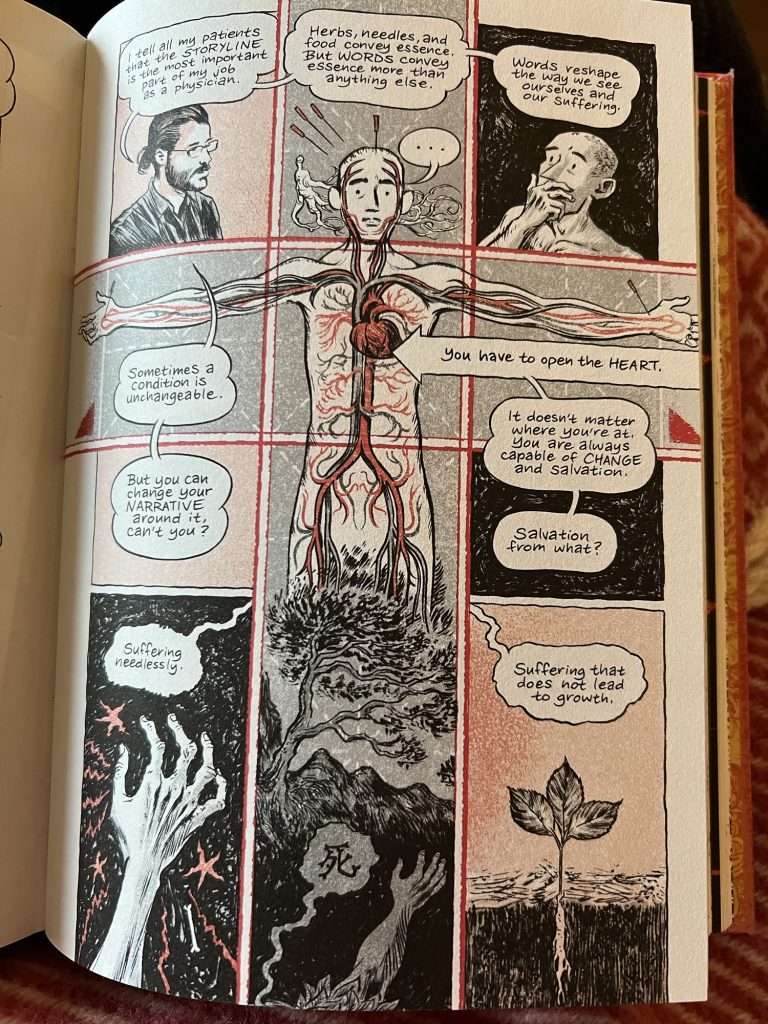
From Craig Thompson’s Ginseng Roots, page 307.
Awakening phases
A few awakening phases from my limited experience and what I have read and heard from others.
(a) Normal life. Separation consciousness learned from family and society. Learning to function as a separate being.
(b) Interest in awakening. Intuition there is something more. Glimpses. Sometimes a more full blown shift out of the blue (as was the case for me).
(c) Exploration, practices, prayer, meditation, guidance.
(d) More clarity, glimpses, shifts. More sense of our nature. Often and ideally along with healing, maturing, and so on.
(e) It all seems extraordinary, exciting, and so on. This is the carrot and part of the earlier phases of the process.
(f) A more clear sense of our nature. More stability. Able to notice our nature through more situations and shifting states and experiences.
(g) Somewhere along the path, some form of dark nights. Loss of a sense of connection with the divine. Loss of a sense of purpose or ability to function in our human life. Old wounds and traumas surfacing. And so on.
(h) Within a more stable and clear noticing of our nature… Continued clarification. Our nature notices itself through more and more situations and states. We explore how to live from it in more areas of life and in more situations. Our human self reorganizes within this new context (heals, matures).
(i) More and more ordinariness. Maturity as a human being and on the awakening path. Deepening.
(j) Continued clarification, deepening, healing, maturing, living from and as our nature. Deepening into being an ordinary human being. Less and less sense of being anything apart from the whole living though and as this temporary and local human live.
(k) Loss of this human self (AKA death). What we are (likely) continues and our world, the content of experience, changes considerably since this human self is gone. I cannot say much about this yet! When I can, this human self is no longer here to say anything about it. Also, in the bigger picture, what I really am – existence itself – continues to explore and express this through a large number of other beings.
SEPTEMBER 24, 2026
Not knowing is a gift

The not knowing is a gift.
– Nyota Uhura in Star Trek: Strange New Worlds, season 4, episode 10
I just watched the last episode of Star Trek: Strange New Worlds which involves time travel.
Earlier today, I remembered Alan Watts’ dream thought experiment.
Imagine you can decide what you will dream.
First, we may want to dream that we have and experience everything we want and experience in our waking life.
After a while, that gets boring. We may want to add some challenges to spice it up.
After a while, that gets boring too. We chose to not remember that we are dreaming while dreaming. That rises the stakes.
We also chose to not know what will happen. That keeps it all fresh and surprising.
We may also add occasional more serious challenges. We may even add life-and-death issues.
So, after a while, we arrive at the life we have now.
If this life was a dream, I would want it to be like this – not knowing the future with a mix of ease and challenges.
How do we respond to knowing our mortality?
How do we respond to more viscerally knowing our mortality?
Where do we seek refuge?
Is it in our relationships? In our work? In distractions? In kindness and living for life? In exploring our more fundamental nature? In more consciously living from and as our nature?
It’s not a test so there are no right or wrong answers. Most of us will also respond in a wide range of ways.
At the same time, it is a very important question to ask ourselves. Where do I actually seek refuge, in my lived responses? What are my priorities as revealed in my daily life? Where do I spend my time? What’s actually more important to me? How would it be to live from that?
OCTOBER 11, 2026
I know what I am doing – when I am caught up in something
What I see with myself is that I always know what I am doing.
I know when I get caught up in wounds, identifications, and so on, and react and act from that.
Somewhere in me, I know. Whether I am aware of it or not, or admit it or not, I know.
And I assume it’s like that for others too.
Setting limits – with myself
When I learn to set better limits and boundaries, the main training ground is with myself. To set limits with my own inner dynamics and habits. As I get more familiar with that, it’s much easier to do the same in the world and with others. It becomes natural and a new habit.
What are some of the ways I am exploring setting better limits with myself?
To not overdo it with channeling Vortex Healing for myself. If I do, my system gets disorganized and overwhelmed.
To limit sugar intake. Instead, switch to something better – carrots, nuts, rice cakes, berries etc.
To limit myself when my system reacts. To not act on it, or if I do, to notice and stop myself, and tell myself – and maybe the other – what’s happening. Train myself to put words on it instead of acting on or reacting to it.
To limit acting on or reacting to an overactive nervous system. To instead be a team with it and help it – and myself – relax and feel more safe.
OCTOBER 15, 2026
Resolve & repair **
An example of resolve & repair: Last week in Budapest, AL and her mum went to the thermal baths and we planned to meet mid-afternoon for dinner. I didn’t eat between breakfast and then, was hungry when I met them, and got impatient when they spent what seemed like ages asking detailed questions about the different food options. AL got upset and reacted to my impatience, and we both felt hurt and misunderstood.
In talking about it, it was clear that my impatience and impatient words came from fear. I was hungry and scared of crashing, which happens with CFS if I don’t eat soon enough. I also realized that I had not eaten earlier because I didn’t want to ruin my appetite before dinner with them. That set up the situation, and came from a good intention.
It would have been better for me to eat earlier, before meeting them. Also, after meeting them and walking the ten minutes to the restaurant, I could have noticed what was happening, taken it seriously, and had something quick to eat before reaching the restaurant. And if I had been aware of what happened in the restaurant, I could have told them I needed to eat soon and asked if I could order first.
I shared all this with her, and it helped us both understand the situation better.
In my experience, any kind of reactivity and unkind understandings of a situations comes from not seeing and understanding it in detail. And when we can go through it in some depth and detail, what’s revealed is innocence and that it’s not personal.
This helps us find a more kind and real understanding, a shared understanding, repair, finding solutions for similar future situations, finding concrete strategies to change similar future situations, and it inevitably changes all similar future dynamics and interactions.
OCTOBER 17, 2026
Everything is an experiment
Everything is an experiment. Life is an experiment.
What happens if I do this? How will it unfold? What’s that path like?
Even awakening is an experiment. How is it if my nature notices itself? If this human self lives from within that noticing? If he reorganized and realigns with it? What’s that process like? What happens? How does it unfold? What are the wrinkles? The surprises?
This is one way Lila – the play of existence – looks from a local and temporary perspective.
If you are angry/judgmental etc. it means you don’t understand
draft ideas…
moving as if possessed – trauma response, possessed by the desire to get away from the pain of the wound
I notice that people with trauma sometimes moving as if possessed. They slam doors, walk heavy and fast, and get frantic.
telling people with CFS/ME about push/crash cycles and pacing, unethical not to tell them, even if they may not take it in, it will stay in the back of their mind and they may discover it for themselves sooner, which would be a blessing
…..
Topics:
Obsessed with healing
VH for people who are destabilized