I asked ChatGPT for an article on global ecological overshoot, and gave it quite a few pointers for what to include. See below.
See also additional texts on how we each participate in the evolution of humanity and Earth, economic systems aligned with ecological realities, a text written in an imagined regenerative civilization 300 years from now, and a letter of gratitude from that time.
Global Ecological Overshoot
A Larger Perspective
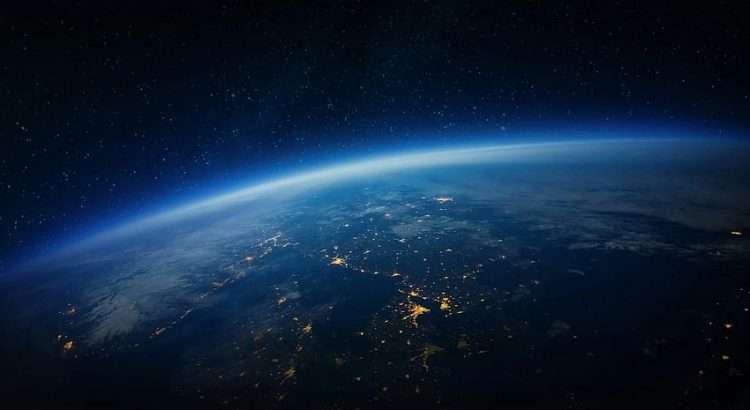
We are not visitors on Earth, nor beings standing outside nature. We are one expression of Earth’s own unfolding: a species through which this living planet has developed reflection, symbolic thought, technological power, and the capacity for both destruction and care. Our societies, cultures, economies, and choices are all taking place within the larger seamless system we call Earth.
In that sense, humanity is a kind of experiment within Earth’s long evolution. Through us, this planet is exploring what consciousness, memory, technology, domination, care, and deliberate transformation can become. Each of us participates in that experiment. Each choice, each institution, each community, each act of extraction or regeneration becomes part of the larger pattern. We are local expressions of a deeper living process, and each of us helps shape what happens next.
That perspective does not make the crisis smaller. It makes it more meaningful. The question is not only whether our present systems can continue. They cannot. The deeper question is whether humanity can become a wiser expression of Earth’s unfolding—whether this experiment in civilization can move from overshoot and domination toward a more mature form of participation in life.
Before Agriculture: A Different Orientation
Before agriculture, human beings generally lived in more direct relationship with local ecosystems. These societies were diverse and should not be romanticized, but many seem to have lived with a more immediate awareness of dependence on land, water, animals, plants, and seasonal cycles. Survival depended less on large-scale control of ecosystems and more on skillful participation within them.
In many such cultures, and in many indigenous and traditional cultures that still preserve aspects of this orientation, the world was experienced less as inert matter and more as alive, relational, and meaningful. Humans were not separate from nature, but part of a larger web of life. That older partnership orientation cannot simply be copied today, but some of its qualities remain deeply relevant: reciprocity, restraint, reverence for life, local ecological knowledge, respect for limits, and a felt belonging within a living Earth.
These older and still-living strands of human wisdom can help inspire what a future regenerative civilization might be: a civilization aligned with ecological reality, grounded in reciprocity and restraint, and organized in deeper partnership with life and Earth.
The Civilizational Shift
Agriculture, Surplus, and Durable Power
The agricultural revolution did not make overshoot inevitable. It made many important things possible: settlement, continuity, cities, writing, and long cultural memory. But it also transformed the structure of human life. Surplus could now be stored, counted, taxed, defended, and seized. That made it possible for power to accumulate and remain concentrated over time.
Once surplus could be controlled, durable hierarchies became easier to maintain. Class divisions, territorial control, large states, standing armies, and systems of command could stabilize around the management of land, labor, water, and food. Agriculture did not create domination by itself, but it made large-scale domination far more structurally possible.
From Hierarchy to Domination Culture
Over time, this fed into what can be called domination culture: a way of organizing life around hierarchy, expansion, concentration of power, extraction, and the treatment of land, animals, and often people as resources. Land increasingly became something to control, simplify, own, and exploit. Forests became timber reserves. Rivers became irrigation systems. Animals became units of production. Human labor could be organized at much larger scales.
This was not true everywhere in the same way, and partnership-based traditions persisted in many places. But the broad arc of dominant civilization increasingly moved toward management, accumulation, control, and disembeddedness from the living systems on which it depended.
Separation and the Myth of an Infinite Earth
The Worldview of Separation
Modern industrial civilization radicalized this trajectory. It rests on deep assumptions: that we are fundamentally separate from nature, that the Earth exists primarily for human use, that natural systems are effectively inexhaustible or replaceable, and that growth can continue indefinitely. In practice, our systems behave as if they exist on an infinite Earth.
This worldview has been shaped not only by economics and empire, but also by strands of religion and philosophy that placed the sacred outside the world, imagined humans as fundamentally above or apart from the rest of life, or treated Earth mainly as a stage for human salvation and use. These themes were never the whole of religion, and many spiritual traditions also preserved deep reverence for life and participation in a living cosmos. But where religious imagination reinforced hierarchy, human exceptionalism, and distance from the living world, it helped support the wider logic of domination.
Systems Built on Separation
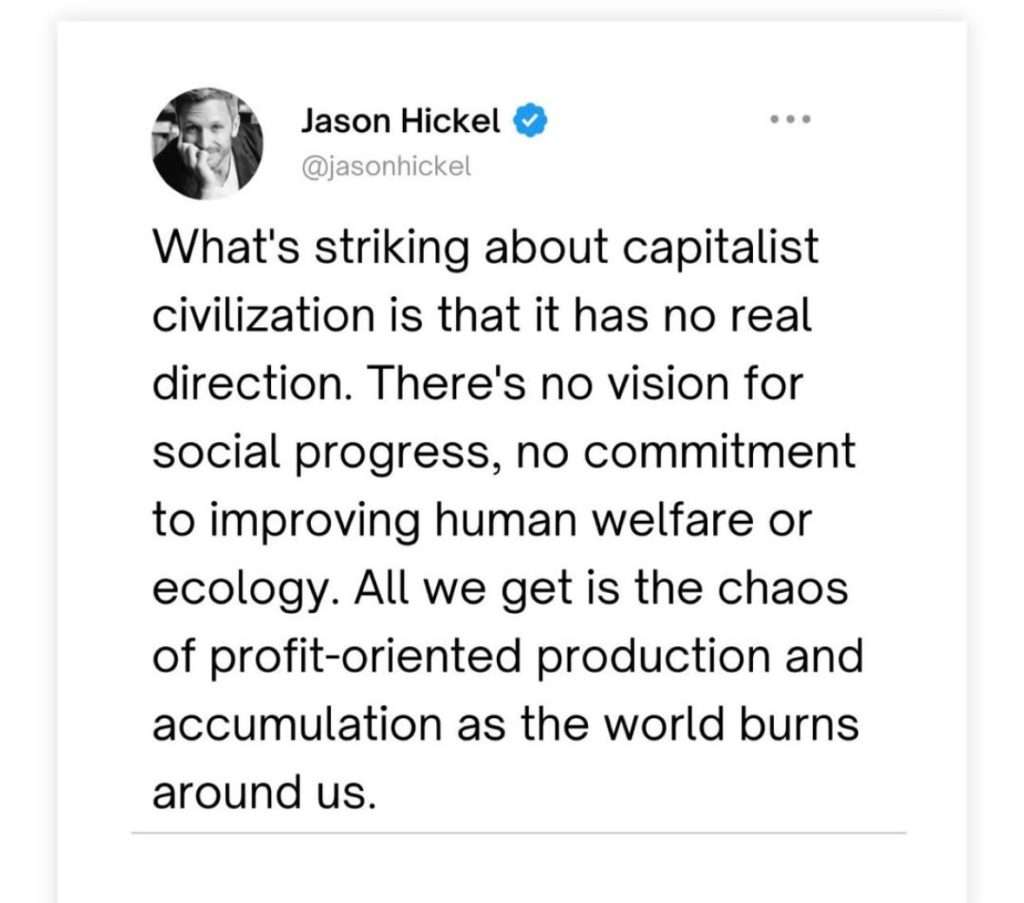
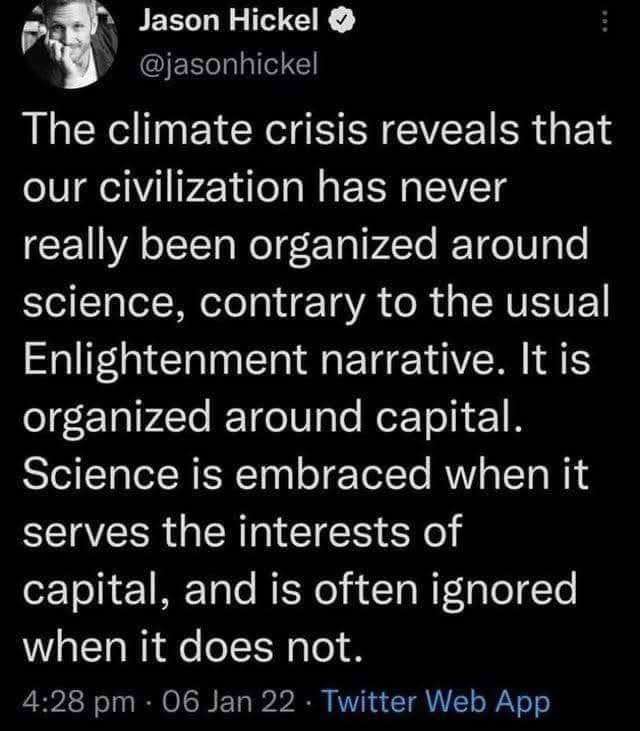
This worldview is built into nearly everything. The economy treats forests, soils, rivers, minerals, and oceans as inputs. Production systems assume endless extraction and somewhere else to dump the waste. Food systems simplify ecosystems into production zones. Political systems reward short-term gain and systematically discount long-term ecological reality. Fossil fuels then gave this entire arrangement extraordinary power, allowing industrial civilization to push beyond many local limits and turn overshoot into a planetary condition.
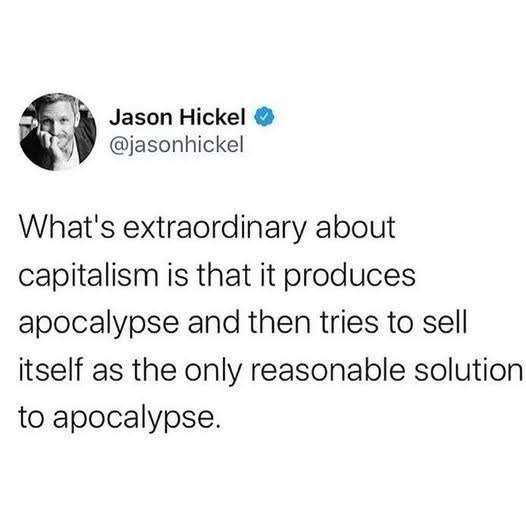
What we have built is, in effect, an overshoot civilization: a civilization organized around drawdown rather than regeneration, around expansion rather than balance, and around the illusion that human systems can remain healthy while the living systems around them are degraded.
Overshoot Is the Larger Frame
Climate change is one expression of overshoot, but only one. The larger problem is that civilization is consuming the living foundations of its own existence. Even major progress on emissions would not solve overshoot if humanity continued destroying soils, exhausting freshwater, overfishing oceans, eliminating species, and converting diverse living systems into simplified extraction landscapes.
Overshoot is the wider frame because it reveals the common pattern beneath many crises. The pattern is a civilization organized as though it were exempt from ecological law: entitled to unlimited drawdown, endless expansion, and the degradation of the very living systems that make its existence possible.
Why So Many Seem Unaware
It Is Hard to See
Overshoot is often difficult to perceive directly. Supermarkets may still be full. Water still comes out of the tap. Electricity still flows. The damage often shows up first somewhere else: in a distant forest, fishery, wetland, aquifer, coral reef, or species population. Overshoot is real, but it is often delayed, displaced, and hidden from everyday perception.
It Is Hard to Interpret
Modern systems are remarkably good at concealing ecological drawdown. Global trade allows wealthy societies to import the ecological capacity of distant regions. Fossil fuels temporarily compensate for declining local fertility or scarcity. Debt allows societies to consume now and defer costs into the future. Technology can create the impression that limits have been overcome, when they have often only been postponed, outsourced, or obscured. A society can therefore look prosperous even while undermining its own foundations.
It Is Hard to Think
Modern culture normalizes overshoot. It is shaped by the assumption that more is better: more production, more infrastructure, more extraction, more consumption, more growth. Economic expansion is treated not merely as a tool, but as a civilizational good. At the same time, public discourse tends to fragment reality into separate issues—climate, biodiversity, pollution, water, food, waste—rather than seeing them as interconnected expressions of a larger overshoot dynamic.
Overshoot is also a genuinely difficult systems problem. It involves population, consumption, technology, agriculture, trade, economics, power, and worldview. Many people and institutions are not well equipped to think in that integrated way. It is easier to focus on isolated symptoms than on the larger metabolism of civilization.
It Is Hard to Bear
To take in overshoot fully is to confront the possibility that the basic trajectory of modern civilization is self-undermining. That can evoke fear, grief, guilt, helplessness, denial, or numbness. People often retreat into narrower frames that feel more manageable: carbon alone, recycling alone, technology alone, or individual consumer choices alone.
It Is Hard to Act On
A full recognition of overshoot raises deeper questions about wealth, empire, growth, inequality, consumption, and the legitimacy of current institutions. Existing power structures therefore benefit when the crisis remains fragmented, softened, or partially hidden. If the whole pattern were widely seen, the demand for civilizational transformation would become much harder to contain.
It Is Not the Kind of Threat We Evolved to Notice Easily
Human attention is often drawn more strongly to immediate, visible, local dangers than to slow-moving, cumulative, systemic ones. Overshoot rarely arrives as one single event. It often unfolds as gradual depletion, weakening resilience, and compounding stresses that only later become unmistakable.
What Is Actually Needed
What is needed is not just better policy or cleaner technology. What is needed is a transition from overshoot civilizationto regenerative civilization.
A regenerative civilization would be a civilization aligned with ecological realities, living within limits, restoring the living systems it depends on, and organizing itself in deeper partnership with life and Earth.
A Transformation of Worldview
This requires a different understanding of who we are and where we live. The worldview of separation must give way to one of participation, interdependence, reciprocity, limits, and belonging. Humanity is not outside the biosphere, managing it from above. We are one expression of it, dependent on its health at every level.
This is where the older partnership orientation becomes relevant again. The point is not to copy pre-agricultural life, but to recover and reinterpret some of its deeper wisdom: that the Earth is not a warehouse of resources, that life is relational, that limits are real, and that a good human future must be embedded in a larger living whole.
A Transformation of Systems
That shift in worldview must take institutional form. It requires a reorganization of our systems of economy, production, food, water, energy, materials, waste, transport, settlement, and governance. These systems are currently built on the assumptions of separation and the fantasy of an infinite Earth. They need to be redesigned around regeneration, resilience, sufficiency, long-term stewardship, and respect for ecological limits.
Without both levels of change, inner and outer, worldview and systems, the crisis will continue. A civilization built on separation will keep reproducing that separation in its institutions.
Likely Scenarios for the Coming Decades
There will not be one universal human response. Different regions will respond differently, and different subcultures within the same region will respond differently too. Some wealthy regions may preserve relative stability for a while through stronger institutions, imported resources, and technological buffering. Other regions may face earlier breakdown through drought, crop failure, debt, conflict, or political fragility.
Within the same society, some groups may become more authoritarian, exclusionary, and committed to preserving privilege. Others may move toward mutual aid, ecological restoration, local food systems, and lower-consumption forms of life. Some may cling to denial or fantasies of technological rescue. Others may accept limits and reorganize around resilience, stewardship, and place.
The most likely broad pattern is neither a smooth green transition nor immediate extinction. It is more likely to be an era of uneven descent: disruption, simplification, conflict, adaptation, and partial transformation unfolding differently across regions, classes, and cultures.
Four Broad Pathways
Fortified Overshoot
In this pathway, enclaves of privilege try to preserve order and consumption through borders, surveillance, militarization, and sacrifice zones. Ecological decline continues, but its costs are externalized onto poorer populations and regions.
Chaotic Unraveling
In this pathway, breakdown outruns coordination. Ecological, economic, and political stresses interact faster than institutions can respond. Food and water insecurity grow, infrastructure degrades, and social trust erodes.
Adaptive Simplification
In this pathway, some societies consciously reduce throughput, relocalize food and energy systems, restore ecosystems where possible, and reorganize around resilience rather than perpetual growth.
Regenerative Transition
In this pathway, some societies recognize that overshoot is not merely a technical problem but a crisis of worldview and civilization. They begin laying the foundations for regenerative civilization: more place-based, participatory, ecologically literate, and aligned with the realities of a living planet.
The Harder Possibility: Severe Population Decline
Overshoot may lead not only to hardship and regional collapse, but to a dramatic reduction in human numbers over time. The sequence could unfold across gradients: mounting instability, regional breakdown, cascading systemic failures, severe depopulation, and, in the most extreme case, possible human extinction.
That most extreme outcome should not be dismissed out of hand. But the more likely danger is a long era of interacting crises that greatly reduce human numbers and sharply contract the scale and complexity of civilization.
If Some of Us Survive
If industrial civilization contracts but humanity survives, the future may belong to smaller, more regionally rooted societies. These would likely be much more constrained by local ecological reality and much less able to depend on vast global systems of extraction and transport.
Some may become neo-feudal, militarized, and harsh, with power concentrated around land, water, weapons, or remaining infrastructure. Others may develop more partnership-based forms, drawing on both ancient human patterns and surviving cultural wisdom: local democracy, distributed power, reciprocity, ecological restraint, practical knowledge, and a deeper felt sense of belonging to place.
If survivors understand overshoot clearly, they may build cultures with strong taboos against overuse and institutions designed to protect watersheds, soils, forests, and biodiversity. They may preserve some knowledge from industrial civilization, but only what can be maintained under lower-energy conditions and within ecological limits.
In the best case, the long human future after overshoot would not be a simple return to the past, but the emergence of a new kind of society: perhaps more modest materially, but ecologically wiser, culturally deeper, and more consciously rooted in partnership with life. That too would be a form of regenerative civilization, shaped under harsher conditions but more aligned with the realities of a living planet.
The Essential Point
Global ecological overshoot may be the most important issue facing humanity because it is the wider frame that contains so many other crises. It is about population, yes, but also about worldview, power, food, water, energy, waste, production, and the civilizational logic that ties them together.
Before agriculture, human beings often lived with a more immediate awareness of belonging to the living world. With agriculture, and especially with the rise of hierarchical civilizations, humanity increasingly moved toward stored surplus, concentrated power, control, accumulation, and domination. Fossil-fueled modernity turned those tendencies planetary. Now the consequences are converging.
The real question is whether humanity can move from overshoot civilization to regenerative civilization. That would mean a profound transformation in both how we understand ourselves and how we organize collective life: from separation to participation, from domination to partnership, from extraction to regeneration, and from the fantasy of an infinite Earth to a mature relationship with a finite, living planet.
The deeper question is whether humanity can become a wiser expression of Earth’s own unfolding. Each of us participates in that possibility. Each of us helps shape the experiment. And each of us, in ways both small and large, plays a vital role in what kind of future this living planet is able to bring forth through us.
Beyond Overshoot
Global ecological overshoot is not only a material crisis. It is also a crisis in how we are participating in the larger life of Earth. We have built systems as if we were separate: separate from nature, separate from consequences, separate from the living processes that sustain us. But we are not separate. We are one expression of this living planet’s own unfolding.
From a wider view, humanity is not outside Earth, managing it from above. We are Earth in one of its experimental forms: conscious, symbolic, technological, self-reflective, and dangerously powerful. Through us, this planet is exploring what intelligence can become. It is also discovering what happens when intelligence becomes detached from the living whole that gave rise to it.
That is why overshoot is not just a failure of policy. It is a distortion in relationship. A civilization organized around extraction, abstraction, and endless growth cannot remain in harmony with a finite living world. It will overshoot. It will undermine its own foundations. It will mistake drawdown for wealth and domination for maturity.
What is needed, then, is not only reform but transformation. Not only greener systems, but a different civilizational consciousness. We need to move from control to participation, from separation to interbeing, from accumulation to reciprocity, from managing Earth to belonging to Earth. This is what a regenerative civilization would mean at the deepest level: not just sustainable techniques, but a culture that knows itself as part of a living whole and organizes accordingly.
Some of the guidance for this future is ancient. Many indigenous and traditional cultures, and many deep spiritual traditions, have remembered what modernity forgot: that life is relational, that limits are real, that the world is not a dead backdrop, and that human flourishing depends on right relationship with the larger field of life. We cannot simply return to earlier forms, but we can let their wisdom inform what comes next.
The transition ahead may be difficult, uneven, and marked by loss. But it is also part of a larger unfolding. The question is whether humanity can become a wiser expression of Earth’s own intelligence. Each of us participates in that possibility. Each of us helps shape whether this civilizational crisis becomes only collapse, or also initiation.
A regenerative civilization would not be perfect. But it would be more humble, more reciprocal, more rooted, and more aligned with the deeper patterns of life. It would know that we do not stand over this world. We arise within it, belong to it, and help shape its future through how we live.
Read More