Reflections on society, politics and nature – vol. 74

This is one in a series of posts with brief notes on society, politics, and nature. I sometimes include short personal notes as well. Click “read more” to see the entries in this installment.

There are no non-radical futures

We are in global ecological overshoot. Collectively, we use more of Earth’s resources than our living systems can generate. That means erosion of ecosystem, loss of species, climate disruptions, rising ocean levels, toxins in our bodies, and much more. It can’t last.

The problem is not something we can fix by tweaking our systems here and there. The problem is at the core of our civilization. It’s the idea of separation and infinite Earth.

Our civilization operates on the essential assumption that we are separate from ecosystems and Earth, and that Earth has infinite capacity to supply us with what we need and infinite capacity to absorb our waste. Rationally, we know that’s not true. But viscerally and in how our systems work, that’s what we operate on.

That means there are no non-radical futures. Realistically, we have two futures.

One is where we continue on our path which leads to continued unraveling of the living systems we are part of. If we collectively don’t learn and change, most humans will die.

Another is where we collectively decide to profoundly change our civilization to operate on ecologically informed assumptions – of interconnectedness and a finite Earth. This will change how we organize ourselves in all areas of life. It may also require us to take a more conscious role as temporary expressions of this living and evolving system we call Earth.

Both of these are radical. One is radical unraveling. The other is radical transformation.

Read More

Reflections on society, politics and nature – vol. 73

This is one in a series of posts with brief notes on society, politics, and nature. I sometimes include short personal notes as well. Click “read more” to see the entries in this installment.

I TOLD YOU SO

We all have a large number of views and sometimes predictions, and it’s all mostly from conditioning. It reflects the influences we grew up with and now expose ourselves to.

We are also all sometimes right and sometimes wrong in our views and predictions. And many of us are inclined to remember and emphasize the times we (think we) we are right, and dismiss or explain away the times we were wrong. We also tend to pick out data that makes it seem we were right, and ignore the rest.

That said, there are many “I told you so” moments in my life, including when I have written about politics and society as I do in these posts.

I started with blogs in 2002. My first was Society and Ecology and then Rants.

Back then, I wrote about much the same as today – global ecological overshoot, misguided wars, neo-liberalism and erosion of democracy, and so on.

For instance, it was clear that the US lied about the reason for the Iraq war, and that was later confirmed. Already then, the information was readily available. Today, the information needed to see that any war with Iran is misguided is also readily available.

All empires fall, and since the ’90s, it seemed clear that the erosion of the US empire likely would happen within a couple of decades. For instance, Johan Galtung studied the fall of empires, saw the signs of it happening with the US, and that it would become obvious in the 2020s. I wrote about that too, and it’s happening. The status of the US as a global superpower is eroding, hastened by Trump.

Trump 2.0 was always likely to start wars, as I wrote about in November 2024 before his second term: “We don’t know what wars Trump may start, possibly in an attempt to distract from unpopular policies and unite the US population behind him. He avoided wars during the first presidency, but Trump 2.0 will be different.”

Since middle school in the ’80s, I have been aware of global ecological overshoot. We are collectively using far more resources than Earth can replenish. We are metaphorically living on a draining savings account. As it continues to deplete, we see the unraveling of ecosystems and eventually an ecological and civizational collapse. We have a civilization that operates on the assumption of unlimited Earth, and that is out of alignment with ecological realities. That leads to overshoot and, if not corrected, collapse. Our civilization is ecocidal and suicidal. That too is easy to see and understand.

It’s also easy to see why global ecological overshot is by far the most serious issue facing us today. If you care about anything, you also have to care about global ecological overshoot. This living system we call Earth is what supports and makes everything we care about possible, including our own lives. With an ecological collapse, all we care about collapses. A mature and sane civilization will have ecological health as a priority since everything else depends on it. It’s the context for everything else.

Organic food is often presented as a luxury for a few, and unrealistic for the many. To me, it seems reverse. What’s unrealistic is to continue growing our food with poison, and poisoning ourselves, the land, and our ecosystems in the process. That cannot last.

When the US elected Trump for president the first time, it seemed equally clear that it would lead to an erosion of US democracy. Back then, I wrote about that as the main danger of his presidency. That has become even more clear now in his second period. We also know that he planned to implement Project 2025 in his second period, and that’s what we are seeing. And we know that his policies will hurt most of the people who voted for him, and they still voted for him.

Norwegian politicians seem to assume that when Trump is gone, our relationship with the US will return to normal. That seems naive and misguided. The dynamics in the US that brought Trump to power will not go away. Someone like him is likely to return, and likely one who is smarter and more competent. The US cannot be trusted or relied upon. We need to deepen our ties with Europe, Canada, and other more reliable and aligned countries.

As I wrote in a previous post, we know that nuclear energy in Norway is misguided. It will be too expensive and is not needed. Still, many political parties support it and want nuclear energy development, including parties that pride themselves on being fiscally responsible.

From the ’80s, it’s been clear to me that taking a significant portion of our abundant resources in Norway and investing in renewable energy research and technology is the wise way forward. If we did, Norway would be at the forefront of the inevitable renewable energy revolution, and we could have built a thriving research community and technology around it. It would go hand-in-hand with the current petroleum industry and be fueled by it. Unfortunately, that’s not what happened. Norway is very much dragging its feet when it comes to renewable energy, and it has left the leading edge research and technology to other countries.

In most of these cases, I feel that reality spoke clearly. We just need to be slightly more attuned to reality than our ideologies to see it.

Why do some tend to be more often accurate than others? Partly, it has to do with basic knowledge about history (patterns repeat), society, and psychology. Partly, it may be that reality has a “left leaning bias” as Stephen Colbert said, slightly tongue in cheek but also with some truth to it. Partly, and perhaps most importantly, it has to do with whether we seek reality and truth over ideologies.

Read More

What are you doing to disappoint society today?

What are you doing to disappoint society today?

I like that as a question. If I follow my inner guidance or knowing, and if I am authentic, I will inevitably disappoint society one way or another. I will disappoint my internalized society. (The Über Ich / over-I as Freud called it). It’s good to notice, and it’s good to be in the habit of disappointing this society.

If something feels right, if my inner guidance or knowing points to it, if it’s authentic, and if I can’t find a good reason to not do it (sometimes, there may be), then why not? Why not do it?

That’s how we create a life we won’t regret. Or, at least, are less likely to regret!

And sometimes, apart from disappointing our internalized society, our internalized shoulds, it requires examining our fears. What do I fear would happen? How likely is it? Can I find peace with it? Am I OK with it? Is it worth it?

It’s also helpful to explore how we internalize the expectations of society, what they are in our case, what effects they would have if we always followed them, and also what social functions they have or – in many cases – had some decades or generations ago. Many of them made sense at some point, and don’t so much now.

Today, I disappointed society by having my main meal at lunch, which I usually do. I will likely go to bed before accepted bedtime for grown-ups. I was honest in a way some may say you should be more strategic about. (It felt good, and didn’t feel like a big risk.) In general, my life is outside the norm in several ways, and it makes sense to me now and feels right, and I also know it will change. (Although I don’t know how.)

The world is moving in the right direction?

I visited a family member who showed me the book Factfulness by Hans Rosling, and said the book confirms his impression that the world is moving in the right direction.

We have quite different worldviews, so I didn’t see any reason to go into that discussion. But I thought I would share some reflections here.

HUMAN SOCIETY

Yes, if you look at some broad trends within human society, it is moving in the right direction. More people have basic education, there is less infant mortality, and so on.

We also know it’s more complex than that. Who are left out? Much of this is the result of Westernization, which means a loss of local cultures. There are fewer democracies in the world now than some years ago, and the trend continues. When we think of progress, it’s often according to modern Western European values. And so on.

LARGER ECOLOGICAL WHOLE

More importantly, this ignores a crucial side of our existence: We are part of nature, and we and human society are expressions of larger ecological systems, and fully embedded within these larger ecological systems.

What happens to global and regional ecosystems happens to us, and they are unravelling at an increasing rate. We are in global ecological overshoot. Our collective ecological footprint is far larger than the Earth, which means we are using natural resources faster than they can be replenished, which in turn means unraveling ecosystems, which in turn means unraveling social systems.

It’s ecocidal, and suicidal.

THE FULLER PICTURE

So the world is going in the right direction, on some measures, within human society. It’s getting better for many, and even within human society, it’s far more complex than that.

And in terms of this living planet which sustains our human civilization, it’s not going in the right direction. Our life-support systems are rapidly unraveling.

IMPROVING HUMAN SOCIETY AT THE COST OF OUR LIVING PLANET

We live in a civilization that does not take ecological realities into account. That means that, in our case, we are using up our ecological savings account to temporarily improve the lives of more people.

What Rosling and my family member sees as signs of progress, are – in our case – expressions of a rapid depletion of living ecological systems.

It doesn’t have to be that way. There are ways to support human life, and increase our quality of life, without ecological overshoot. But in our case, the way our civilization is set up, that depletion is what happens.

WHY DO SOME LEAVE OUT THE LARGER ECOLOGICAL SYSTEMS?

Why do some leave out our life-support systems?

My impression is that Rosling left out our larger ecological systems. He didn’t consider our collective ecological footprint, global ecological overshoot, and the limits of nature.

For me, it’s difficult to understand how that can be ignored when it’s what supports our lives and everything and everyone we know and care about.

Why did my family member emphasize that the word is generally moving in the right direction? It may be to comfort himself. Also, he has a generally conservative orientation so for him, it may mean that no radical changes are needed. We can continue with business as usual, and everything will only get better.

This shows a view of human society and life as divorced from the larger whole. Both Rosling and my family member seem to see Earth as the backdrop to human life, not as valuable in itself and the source and sustainer of human life.

Read More

Two ways to grow Maya Nut trees: win-win vs zero-sum

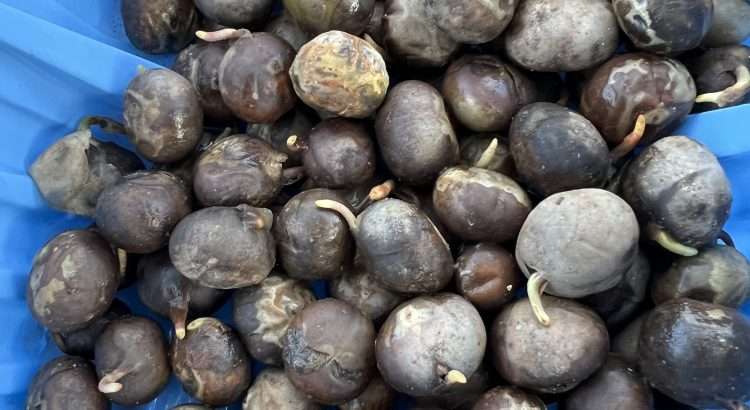
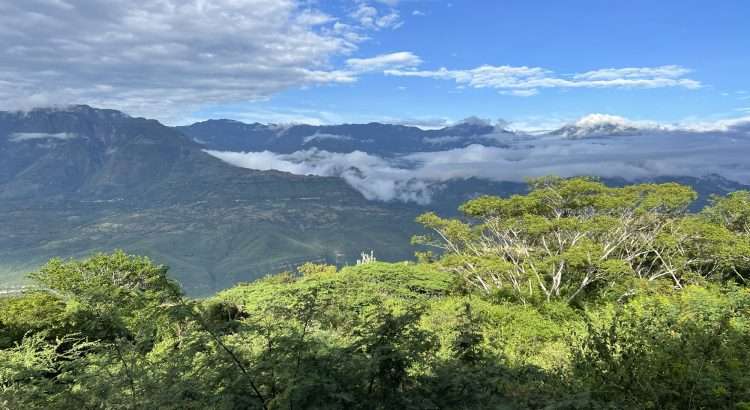
We have a regeneration and food forest project in the Andes, and one of the trees I wish to grow – for biodiversity, food for animals and humans, and income – is the traditional Maya nut tree (Guáimaros as they are called locally).

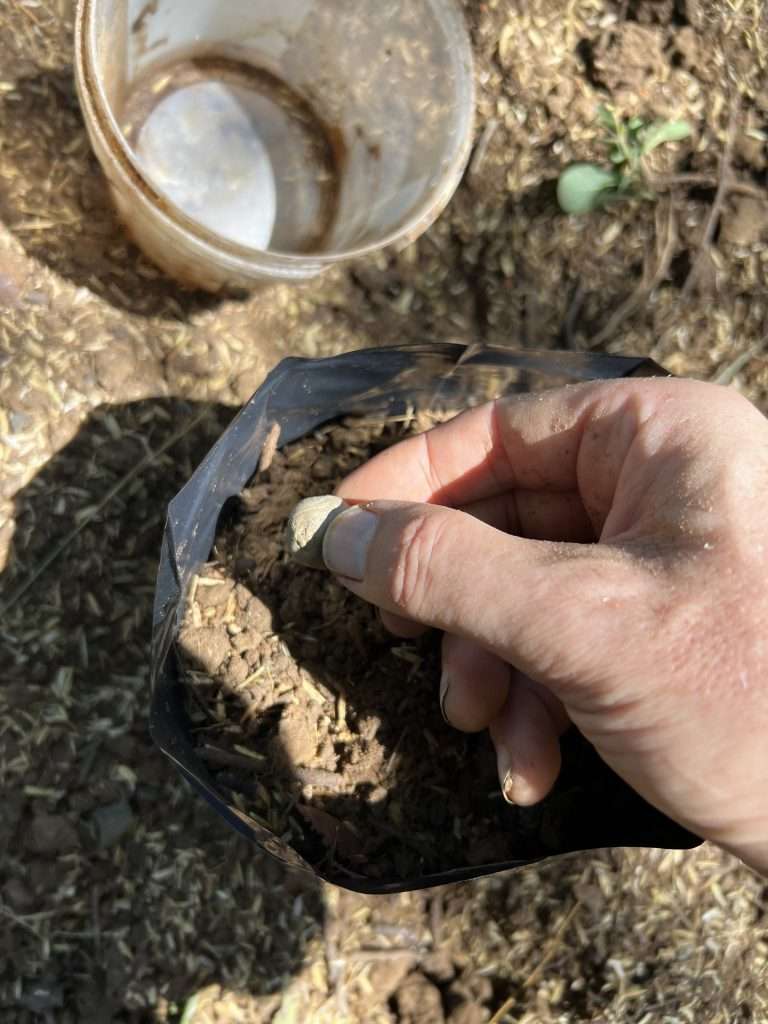
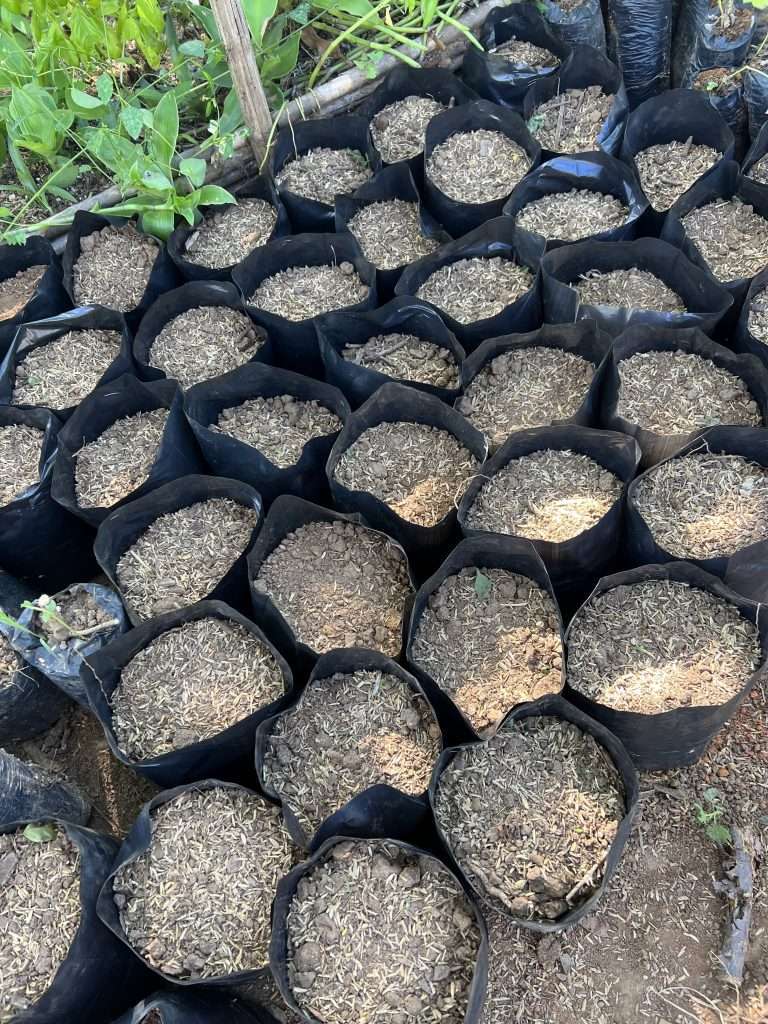
Last November, I was lucky enough to find two sources of Maya nuts in our neighborhood, so we now have about 100 Maya nut trees growing – some in the ground and a few still in large growing bags. This is just the start, and I hope to plant a few hundred more trees over the coming years.

I have been in contact with someone advising people on growing Maya nut trees, and we were recommended to plant them four meters apart, in full sun, and remove nearby plants since they compete for resources (water, nutrients, sun, etc.).

I understand where those guidelines come from, and I know it’s meant well. At the same time, we are doing something quite different. We wish to work in a deeper partnership with nature, natural processes, and the local ecosystem.

WHAT WE ARE DOING

We are creating a food forest that’s as wildly diverse as possible. We create terraces, swales, and porous dams to slow down the rain water so it is absorbed by the ground. We work actively on building soil, which for now includes bringing in compost and soil materials. We use mulch to protect and build the soil, and retain moisture longer.

This plant diversity creates a more healthy and resilient ecosystem. It helps build soil, encourages healthy and diverse soil life (including microbes and fungal networks), create shade to retain moisture, reduce the chance of an explosion of one types of insects, supports the insect life and wildlife, and produces a variety of foods for us and wildlife, and so on.

This diversity means the Maya nut trees will be about 10-15 meters apart from each other, which is fine since we will rely on a wide diversity of food plants, not just Maya nut trees.

WIN-WIN VS ZERO-SUM FOOD GROWING

As I see it, what we were recommended reflect a zero-sum approach to food growing, and what we are doing reflect more of a win-win approach.

In zero-sum food growing, we see plants – and life in general – as primarily competing for resources, so what doesn’t produce food needs to go. We may use artificial fertilizers and pesticides, which destroys the soil and the web of life supporting all life. We may rely on just one or a few crops, which creates vulnerabilities. We create ecological deserts that lead to habitat loss and extinctions.

We are, in essence, gradually destroying the web of life we and all life depend on.

In a win-win orientation, we support the web of life that supports all life – including ourselves, what we eat, and all we love. We seek diversity since a diverse system is more resilient. We seek to build soil and create healthy soil, since soil is the foundation for all plant and animal life. We seek to make maximum use of rainwater by slowing it down, allowing it time to infiltrate, and retaining moisture.

We help regenerate the web of life which we all depend on.

WHY IS THE MAINSTREAM APPROACH STILL MAINSTREAM?

This mainstream zero-sum approach is relatively new. It has happened over just the last one to three generations. It’s a blip in human history.

The modern conventional approach seems successful on the surface. We have dramatically increased the world’s food production over the last few decades, which seems desirable.

And it comes at a high cost. It’s part of the unraveling of the web of life supporting us all. It’s extractive food growing that’s destructive to soil, ecosystems, and ourselves. We borrow against the future. It cannot last.

It comes from a zero-sum orientation, and what loses is not only the others – what we call weeds and pests, and wildlife – but eventually ourselves. We are all in it together.

So why do many still use this approach? Because it does produce a lot of food. It’s a profitable business for those selling machinery, pesticides, fertilizers, and so on. Our whole system is now set up to support it. It has become the norm. It’s what’s expected. It’s what farmers now know and understand. It’s what they learn and pass on.

HOW DO WE SHIFT OUT OF IT?

What does it take to shift out of it?

That’s obviously a big and complex question.

Some answers are: Knowledge and education. Pointing out who benefits and who loses from each system. (In our current mainstream food system, we eventually all lose.) Good examples of alternatives, including some that work at larger scales. Systems change to encourage win-win systems, which includes putting the real cost into the finances of food systems.

We are doing our small part by developing and living a more life-centered alternative.

There is a reason we have rules, and that reason is more important than the rules

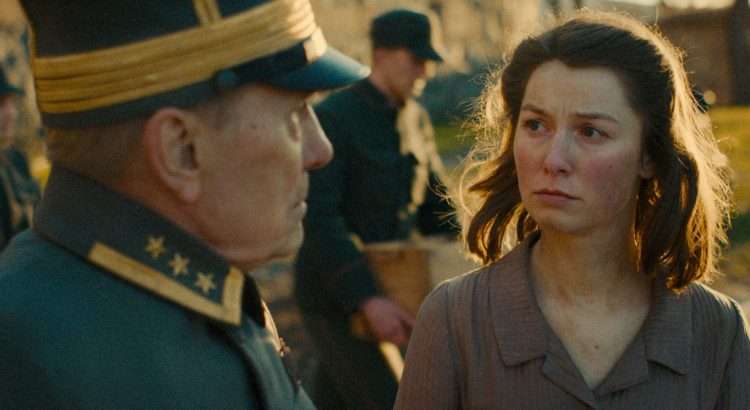
I saw Blücher a couple of weeks ago, a Norwegian film about the commander at Oscarsborg fortress in April 1940 when German warships entered the Oslo Fjord. He acted in the absence of orders and decided to attack the ships, which gave the government and royal family time to escape Norway. After the war, he was (shockingly to us today) reprimanded for having acted against, or in the absence of, orders.

For me, this is a reminder that the reason for rules is more important than the rules themselves.

There is a reason we have rules, and it’s usually to support individuals and society. Ideally, rules come from a life-centered intention, and they often do here in Norway. (Although they are anthropocentric and outdated in that sense.)

Sometimes, we find ourselves in situations where following the rules would go against the intention behind the rules, and other actions – the ones that break rules – are more aligned with the original intention. The commander of Oscarsborg knew this. He chose to follow the intention behind the rules, which is to protect Norway and the Norwegian people, and break rules which would have allowed the warships to reach Oslo and likely would have led to the arrest of the government and the royal family.

The movie was also about appeasement and how it often doesn’t work with bullies. If someone doesn’t play by the rules and is intent on taking other countries, appeasement doesn’t work. That is, of course, relevant today with Putin’s ambition to (re)create the Russian Empire. I am mainly a pacifist, although I also know that sometimes having strong boundaries, metaphorically and literally, and having good allies, prevents something far worse. These days, Norway seems complacent in several ways, including by allowing Russian fishing vessels (many of which are likely spies) in Norwegian harbors, not having solid drone defense, and not being prepared for the kind of messy drone-centric warfare we see in Ukraine.

When we live in information bubbles, those in other bubbles can seem like idiots

I saw these two on social media this morning.

They are a reminder of how we are living in media and information bubbles, and how it can make others seem like idiots, crazy, or at the very least misguided and out of touch.

BUBBLES

In one sense, we always and inevitably live in our own bubble. I live in my world, you live in yours. Each being is their own world.

Also, we have always lived in some kinds of social and cultural bubbles. There has always been other groups of people with very different cultures, experiences, and worldviews. The further away, then often the greater the difference between the bubbles.

And yet, today’s media world is creating a different kind of information fragmentation.

Just a few decades ago, most people received information from the same sources. That had its downsides since the information is always filtered and presented with an agenda, from a bias, and for a certain purpose. Although it did also create some kind of social cohesion. At the very least, we were familiar with the same information, and we could – I imagine – more easily understand where the others were coming from.

Today, we can choose to live in very insulated media bubbles. We seek out certain information online and perhaps watch just one or a few TV channels. Social media algorithms present to us what we seem to like and be interested in, what’s profitable for the social media company, and also – in some cases – what the social media owners want us to see for political or other reasons.

Very few seek out media and information from “the other side”, and those who do tend to already be interested in understanding the other side.

ACTING ON THE INFORMATION WORLD WE LIVE IN

When we perceive, speak, and act on the information in our bubble, and others do the same within their bubble, there is no wonder we have increasing polarization in politics and society in general.

We may have the similar values and want the same for society, but we have very different ways of going about it, and our approach is largely based on the information we have.

I imagine many Trump supporters see him as a good person doing good things for the country. He is making cities safe again by mobilizing the National Guard and the military. He is getting rid of dangerous immigrants. He is bringing jobs back to the US. He goes after those who wants to destroy the country.

Others, who know a different side of the situation, see him as dangerous, undermining democracy, engaging in a politics of cruelty, wanting to create a fascist regime, and so on.

Most of us want the same. We want a well functioning society. We want jobs. We want safety.

And yet, and largely because of the information bubbles we live in, we see very different ways to go about achieving it.

HOW WE SEE THE OTHERS

If we are mostly unaware of these information bubbles, and what they do to us, it’s easy to be baffled by the others. We may see them as idiots, crazy and delusional, as cruel. Or, at least, as misguided and out of touch.

I know I am often baffled by other groups in society today. I am baffled by Trump supporters, because I am not familiar with the information bubbles they live within. I am equally baffled by those who vote FrP in Norway, which are somewhat aligned with the Trump world.

The more I set out to learn about their information bubbles, the more their views and actions make sense to me. I may still not agree. I may still see it as uninformed, misguided, and dangerous. But at the very least, I understand them a little more. I am less likely to see them as idiots, delusional, or cruel1.

In short, I am more likely to assume they are essentially well-meaning, and that their views would have been different if they lived in another kind of information bubble.

NOT ALL BUBBLES ARE EQUAL

This is not to say that all bubbles are created equal. Not all views and sets of information are equally grounded in reality.

Some is easily fact-checked. For instance, two Democrat politicians were assassinated this summer, and Trump and the Republicans largely dismissed it. Trump has bankrupted several businesses, including casinos, and he is a convicted felon.

Some is grounded in history and science. For instance, vaccines work and are largely safe. (In some cases, people’s bodies have a strong reaction to the vaccine, as they possibly would have to the actual disease, although that is – in the big picture – less of a problem than the disease itself.) Fascism doesn’t work for anyone, eats its own, and fails catastrophically. You may be upset about your challenging life situation – and seeing increasing wealth disparity, working poor, failing social safety nets, and so on. If so, blame the decades of neoliberal policies that brought it about, not the immigrants who suffer from the same system as you.

NOTES

  1. Although I still think there is sometimes an element of idiocy and cruelty there…! (a) If you support cruelty towards others because you think it won’t happen to you, that’s both cruel and stupid. It’s not less cruel because it happens to others, and it very well may happen to you. (b) If you think you know more about medicine and epidemiology than those who have spent decades studying it, that’s pretty stupid. If you distrust experts in some areas of life – like medicine, epidemiology, and history – and trust experts in technology and car repair, what are you doing?

The success paradox: When we are blind to the problems we no longer have and what prevents them from returning

This is an example of the success paradox – also known as the prevention paradox or historical amnesia.

It’s a common and serious problem in our society.

WHAT IT IS?

The success paradox happens when we have succeeded reducing or eliminating a social problem, we forget about the problem and why it’s gone, and set out to dismantle the social systems and institutions that eliminated the problem, allowing the problem to return.

We see this today with vaccines, democracy, taxes, unions, pandemic measures, inclusivity policies, and much more.

WHY DOES IT HAPPEN?

I suspect it happens for several reasons.

The problems are no longer in living memory. If those who experienced it are no longer alive, they can’t warn us.

There is a lack of knowledge of history. Some see history as irrelevant or boring, so they didn’t pay attention in school, and don’t set out to educate themselves.

Some act out of narrow self-interest. This may be because of a challenging life situation, or reactivity from wounding, so they seek scapegoats, the promise of simple solutions, and so on.

This is all fueled by social media and sometimes media figures and politicians. In some cases, the dis- and misinformation is financed and fueled by Big Money.

WHAT CAN WE DO ABOUT IT?

For ourselves, we can educate ourselves about past problems, how they were lessened or solved, and what in our systems today prevent them from returning. There is no lack of information out there in the form of articles, books, historical fiction movies, documentaries, and so on. Just make sure it comes from reliable sources, including serious historians.

It’s obviously more tricky to resolve it at a social level.

Media literacy and critical thinking needs to be emphasized in schools, by responsible media, and needs to be part of the public discourse.

Good social safety nets helps people feel more safe, trust society more, and be less reactive.

Social media can have, as they sometimes do, automatic comments on content that’s misleading or on an often misrepresented issue.

It also helps to point out the real causes of people’s problems, which are often systemic and because Big Money benefit from it. (It’s almost never because of some minority group, or scientists, or experts of any kind, or even politicians.)

SOME EXAMPLES

Vaccines are an obvious example. Many diseases are eradicated or rare today because of vaccines, so most have no personal experience with them, don’t realize how terrible they were, and think eliminating vaccines is a good idea. If they had more personal experience with the diseases, they would probably see it differently.

In the Western world, almost everyone alive today have only lived in a democracy. It’s all we have personally known. It’s easy to take it for granted, and be seduced by authoritarian politicians who promise simple solutions to complex problems. If democracy is dismantled in the process, it may – to some – seem a small price to pay. They would likely see it very differently if they had known authoritarian and totalitarian regimes from their own experience. Even if you think you are in the “safe” group in such a society, you can easily find yourself among the targeted. Fascism eats its own.

In the US, there is a strong movement to undermine and dismantle unions, and to prevent new ones from forming. This comes from Big Money, although many in society in general seems to support it. They may not know that much of what we enjoy in our work-life today comes directly from the work of unions, and that it may never have happened without unions: The eight-hour workday, the weekend, overtime pay, safer workplaces, child labor laws, higher wages, health insurance and pensions, paid leave, protection against unfair firing and discrimination, and much more.

Some seem to dislike taxes, perhaps without realizing their many benefits to society as a whole and for us as individuals. Without taxes, there would be no functional society. We may not agree with how the money is distributed, or what exactly is taxed, but it’s important to remember that this society would not be here without taxes. It’s how we pay for everything we collectively benefit from, including a relatively well-functioning and safe society.

These days, there is also an anti-woke movement. I wonder if these people know how important it is for society as a whole to make inclusivity structural. Again, we may not agree with all the details, but the general movement in that direction is essential for a well-functioning society that works for all of us.

Read More

What do Germans think about the current situation in the US?

What do Germans think about the current situation in the US? A German YouTuber living in the US asked her audience. Her videos are typically a-political (on language and culture), so it’s interesting to see what her likely quite general audience says.

In my experience, the comments reflect what most Europeans think about what’s happening in the US.

To me, it’s also a reminder of what I noticed when I moved to the US in the ’90s. Most Europeans seem far better informed about what’s happening in the US than most people living in the US.

Ideological purity vs pragmatism

Norway has a parliamentary election this Monday (the voting has been open for a month), and as so often, it brings up the topic of ideological purity versus pragmatism.

In Norway, parties that get more than 4% of the votes are rewarded with extra seats, and this year, the Green Party is at that limit. The traditional liberal and conservative blocks are close in size, so whether the Greens get more or less than 4% can determine the outcome of the election.

I have three parties I can vote for without holding my nose. I obviously don’t agree with every policy of all of those parties, but it doesn’t matter. They are close enough, and since all of them are relatively small, I vote for whatever one is at risk to go below 4%. This year, it was the Green Party. (Which I also happen to be a member of.)

Other years, it has been one of the other two. And IF another party on the liberal (red-green) side was close to 4%, and whether they go above or below could determine the outcome of the whole election, I would vote for that one, even if it would mean voting for a party I agree with less.

To me, it’s more important that the liberal coalition wins than that I personally get some kind of satisfaction in the voting booth. I am more than happy to hold my nose slightly in the voting booth, and have four more years with a coalition I generally agree with. (Or, at least, don’t strongly disagree with.)

The perfect is the enemy of the good. I see the value of voting for exactly the party you agree with the most, although for me, it’s not worth it if it risks a loss for the coalition as a whole.

In reality, I don’t see any party going far enough, apart from possibly the Greens. By far, the most crucial topic in our age is to avoid going further into global ecological overshoot (which means ecocide and suicide, ecological and civilizational collapse), and to create a deeply regenerative civilization. We are very far from that, and no party really even talk about it apart from some within the Green Party.

Is the polycrisis really a monocrisis?

Some like to talk about the polycrisis – a confluence of several different global crises from climate change to biodiversity loss, from huge economic disparity to authoritarianism, and so on.

What if this is really a monocrisis? (Or a unicrisis?)

In terms of the unraveling ecological systems, it all ties back into global ecological overshoot. We are collectively using far more resources than this living planet can replenish. This is due to a combination of numbers, technology, and worldview.

And that brings us to the even more essential monocrisis, which is a civilization organized around the idea of separation. This idea comes with a zero-sum mindset (I seek solutions so I win, and I don’t care if you lose. If you win, I assume it means I lose.) and an either/or mindset (if this thought is true, that competing one is not). In our civilization, it’s tied in with a domination or power-over orientation. It depends on some degree of collective and integenerational trauma. And it’s the reason we have organized ourselves so what appears beneficial for a narrow us is often destructive for others – ecosystems, nonhuman beings, future generations, and so on. This is also what has led to global ecological overshoot.

It’s sometimes misguided to simplify a diverse set of symptoms to one underlying apparent cause, but in this case, it makes sense. Without the idea of separation, a visceral sense of separation that comes from internalizing it from a very young age, and a civilization organized around the same idea – in terms of culture, science, technology, infrastructure, production, education and everything else – we very likely wouldn’t see all the many troubles we have today.

It’s not so difficult to imagine a civilization organized around the idea of interconnectedness. It wouldn’t be without its own challenges, but many of the most serious challenges we see today would or could be designed out of our systems and lives. We would see ourselves as temporary and local expressions of this seamless living planet. We would seek win-win solutions and have a both/and mindset. We would use a deep partnership orientation – seeking solutions in partnership with natural systems, and taking what works best from both partnership and domination orientations. We would create a civilization and society where what’s easy and attractive to do, for organizations and individuals, is also what benefits the larger whole and future generations.

Of course, I am sure many who speak about the polycrisis are aware of this, and point it out.

Still, I like the terms monocrisis or unicrisis. It doesn’t mean we have all the answers, but it does invite curiosity about whether it is really one unified crisis that leads back to an essential assumption behind just about everything in our civilization. It also invites us to investigate other ways to organize ourselves.

Whether we notice or not, we are part of this seamless, evolving, living system we call Earth. For most of our history, we lived without being consciously aware of this bigger picture, or of how basic cultural assumptions shape our civilizations.

The question then is: If we join in with the evolution of this living system in a more conscious and intentional way, how may it look? What role do we wish to play?

Read More

How to deal with a bully

The response, meanwhile, by Democrats has been unconscionably weak. It’s no coincidence that governors like Gavin Newsom and J.B. Pritzker have been the leaders of recent days; they are clear-eyed about what is happening. As Greg Sargent writes, “Newsom shapes everything around the brute fact that Trump is serially breaking the law and using government sponsored violence and intimidation to entrench authoritarian power. He accepts this as the core fact of our moment.”

By contrast, I challenge you to find even a moderately tepid and clear-eyed statement from any national Democrat. National Democrats seem all invisible as the military takes over policing the streets of the capital and prosecuting its crimes. This should be a lay-up to oppose — the most basic duty of any congressional figure, and yet, “House Minority Leader Hakeem Jeffries and Senate Minority Leader Chuck Schumer, along with other senior Democrats, have not been a part of any concerted effort to voice opposition to the occupation.”

– from Slouching Into Fascism by Garrett Graff, Mother Jones

One thing that’s been increasingly clear over the years – if it wasn’t already – is that many mainstream Western politicians don’t know how to fight a bully.

PUTIN

When Putin invaded Ukraine, I was baffled when Western countries did not offer full weapons support for Ukraine with no strings attached. They purposely limited Ukraine’s ability to fight back, which has led to a long, costly, and drawn out war with an uncertain outcome.

The explicit reason was that they didn’t want to provoke Putin further. That’s an example of a hesitant response to bullies, and one that the bully – in this case Putin – tends to see as a sign of weakness and be encouraged by. (I suspect there was another reason for limiting Ukraine’s ability to fight back. They wanted to drain Russia’s military resources and weaken Russia in general, even if it comes at the cost of death and enormous suffering, the possibility of Ukraine losing the war, and the encouragement of Putin’s imperial ambitions.)

TRUMP

We see something similar with how the Democratic leadership, with a few exceptions, have dealt with the Republicans, especially since the tea party era of the 2000s. The Republicans play dirty and have thrown out the rule book, and the Democratic leadership acts as if nothing has changed and everyone still plays by the old rules. They have, in practice, rolled over and allowed the Republicans to get what they want.

The Democrats had control of Congress and the White House and chose to not eliminate the filibuster. (Due to pressure from within their own party.) That allowed the Republicans to block voter rights legislation and more. Trump was impeached twice, and the Democrats chose to not forcefully push for consequences. Biden and the Democrats chose to not expand the Supreme Court, even if the Republicans had already politicized the court to an extreme.

When Harris became the Democratic candidate last summer, she and Walz used a more direct and effective verbal strategy for some weeks – fighting dirty, ridiculing Trump, and calling him out for what he is. That worked and they gained in the polls. Then, for some inexplicable reason, they went back to the “high ground” approach and lost traction.

Now, it seems that some Democrats are again growing a spine, especially Gavin Newsom and some other Democratic governors. Newsom aims to redistrict California to mirror what the Republicans are doing in Texas. He has run ads in Republican-led states mocking conservative leaders, and he is mimicking Trump’s own slogans and style to expose their absurdity. If it’s ridiculous when Newsom does it, what does it say about the president? We’ll have to see if it continues, and if others join him and the other governors.

HOW TO DEAL WITH A BULLY

In some cases, it is possible that being polite, playing by the rules, and treating bullies with respect may work. It’s rare, but it may happen, especially if the bullying behavior is not deeply ingrained in the personality of the bully.

But in most cases, bullies need to be met with actions and a language they understand. As Newsom says, we have to fight fire with fire. They have to be met with strength and consequences, and that’s best done when we strategize and coordinate our efforts. It’s scary to stand up to a bully, so it’s better done together.

History shows us that appeasing authoritarians rarely works. We know that from 1930s Europe, and we see it again today.

WHY AM I CONCERNED ABOUT THIS?

Why am I concerned about this? After all, I don’t live in the US, I live in a functioning democracy, and I don’t seem directly impacted by any of this.

It’s partly because I experienced bullying as a kid, and I have seen what it does to people. Authoritarians are bullies, just on a national and international scale. Our political views inevitably reflect personal experiences and concerns.

Democracies are eroding around the world these days. Current democracies are far from perfect, but they are the best we have, they can improve, and they are far better than the alternatives.

Even if I happened to agree with some of the policies of an authoritarian leader, I would still far prefer a flawed democracy with leaders I don’t necessarily agree with. At least then, there is the possibility of peaceful course correction coming from the people.

I don’t live in the US anymore, but as someone said: When the US sneezes, the world catches a cold. What happens in the US tends to impact the rest of the world, both directly through US foreign policies, and indirectly by people in other countries mimicking – and also responding to – what happens in the US.

I live in Norway, a neighbor of Russia, and I know Russia’s historical imperial ambitions and how Putin have adopted those for himself. If Putin gets his way with Ukraine, there is no reason to assume he will stop there.

When reporters don’t do their job

Just about any time I look at the news, even relatively good news sources like The Guardian, I see reporters not doing their job.

They report on the drop in visitors to the US and like to mention tariffs as a reason, since that is the most innocent-sounding one. They forget to mention the far more serious backdrop: Most people don’t want to visit a country… Whose leader threatens to take their country (Canada) or part of their land (Denmark/Europe). Whose leader regularly uses blackmail and threats to get the upper hand in negotiations with other countries. Where a majority elects an authoritarian with fascist dreams. Or where tourists can be thrown in for-profit immigration prison for the most ridiculous reasons and have to endure inhumane conditions indefinitely without access to legal representation.

They report on Gaza without mentioning genocide, the real extent of the horrors, and that it’s systematic and supported by several Western states.

They report on climate change and don’t mention that it’s just one of many expressions of a far more serious issue – global ecological overshoot. They report on it as an inconvenience and not as the inevitable end of civilization and humanity – unless we find the collective will to make a dramatic course change.

Why am I fascinated by these topics?

Why am I fascinated by these topics – the ones I write about here?

Why have I been fascinated by them since my mid-teens?

I could say something impersonal about it. For instance, I see them as important and often overlooked. That’s true enough. I see them as important, and the reason I keep exploring them is partly that not too many do.

The real answers, as usual, are much more intimate, personal, and interesting, and although there is an essence that’s the same for all of them, the answer for each topic also has its own flavor.

AWAKENING

Why am I interested in awakening? After all, I grew up in an agnostic/atheist family and culture, and still socially often label myself an atheist. I don’t see it as particularly noble to be interested in some of the topics of religions, considering how religions have often been used to justify dominance and different forms of marginalization and violence. Spirituality also doesn’t have a very favorable image, considering how it’s often used to indulge in fantasies and as an escape.

The answer is the oneness shift that happened when this human self was sixteen. In spite of labeling himself an atheist, and having little more than disdain for spirituality and religions, there was a oneness shift.

The oneness I am noticed itself, and that all content of experience to me happens within and as the oneness I am. That turned everything upside down and inside out, and thoroughly changed not only perception but the life of this human self in the world.

The answer to why I am interested in the topic is that I had to learn to navigate this terrain. I had to learn to clarify, deepen, invite and allow my human self to realign within it, and so on. That’s an infinitely long process, and even some decades later, I am still at the very beginning of it.

For years, I explored it on my own since I lived in a small town in Norway before internet and couldn’t find anyone who talked about this terrain in books or in person. That was a blessing, although also lonely at a human level.

Later, I found others who did talk about it, although often through layers of culture and sometimes assumptions. (Mystics from different traditions, Zen.) And later again, in my thirties, I finally found someone who talked about it more directly and clearly – especially Adyashanti, Douglas Harding, and Byron Katie. (These are contemporaries to me, and from a similar cultural background, so to me, they speak clearly and directly.)

HEALING

Why am I interested in healing? It’s because I need it.

I have trauma and wounds I wish to find healing for.

I have a chronic illness I wish to learn to live better with, and – if possible – also invite in healing for.

SOCIAL CHANGE

Why am I interested in social change, in creating a more life-centered civilization?

It’s because I wish it for myself.

I wish to live in a more life-centered and regenerative inner society, and that’s reflected in a wish for an outer society like that.

I wish to live in a society that is more life-centered because it’s more comfortable for me.

THE FAR FUTURE

Why am I interested in imagining possible futures?

More specifically, why did I start the Long Journey Home project?

It’s because imagining a civilization I wish to see is easier when I imagine it in the far future. If I only focus on today, my mind limits itself with ideas of what’s realistic. In the far future, just about anything is imaginable.

The contrast between this imagined future and now helps me shed light on our culture and civilization and how it’s internalized in me.

Mainly, it helps me clarify what I wish to see in the world, find it in me and the world, and live some of it here and now. It helps me change the culture and civilization internalized in me and reflected in my life.

REGENERATION

Why am I passionate about regeneration? Why do I write about it, and why do I have my own regeneration project in the Andes?

It’s partly because *I* need to regenerate. I need to heal and come to life. I am harmed by this culture and civilization, just like most of us are, and this living planet is.

It’s also because I am part of this larger living system, what happens to this living system happens to me, it’s severely degraded, so it only makes sense to encourage and bring in regeneration of this living system.

THE ESSENCE

So what’s the shared essence in all of this?

The essence is that the topics are personal and intimate to me, and something I deeply wish.

I need to learn to navigate my nature recognizing itself.

I need healing at many levels.

I deeply wish to live in a different inner and outer society.

I need the perspective from an imagined far future to more clearly see what’s here.

I need regeneration – of me and the larger whole I am part of.

It’s not for any abstract or noble reason. It’s far more close to home and practical.

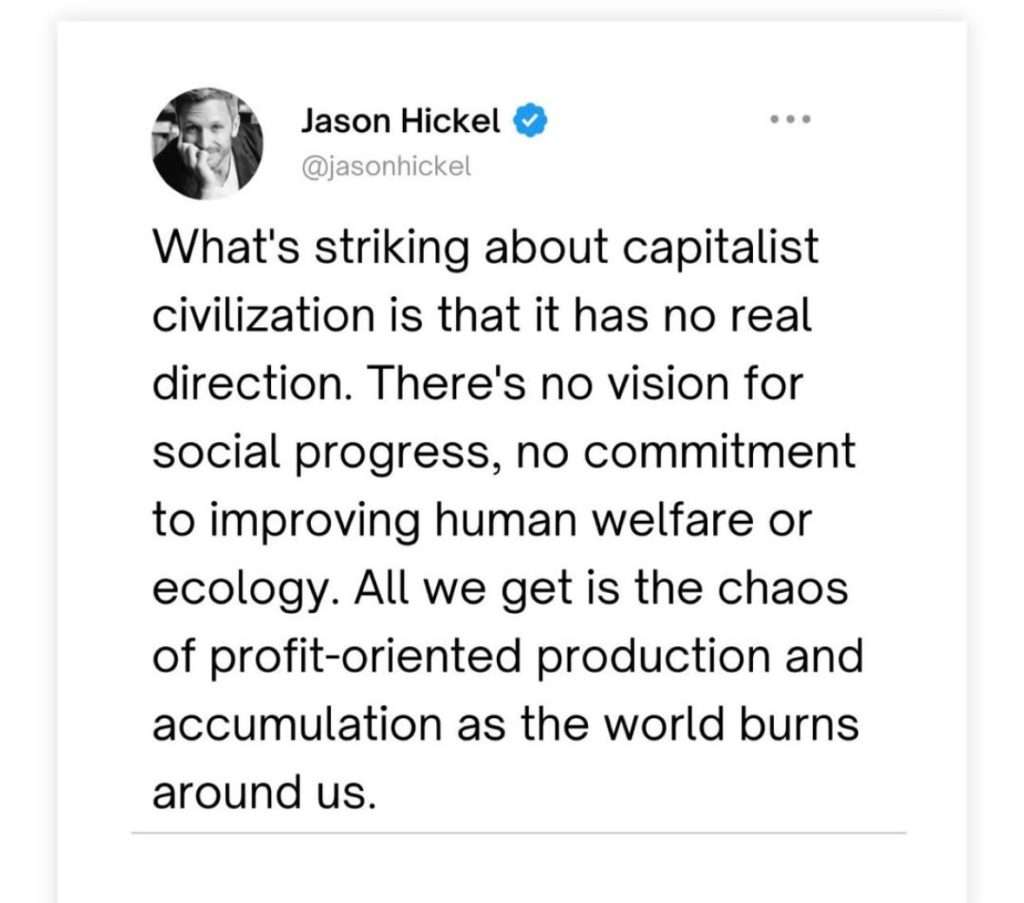
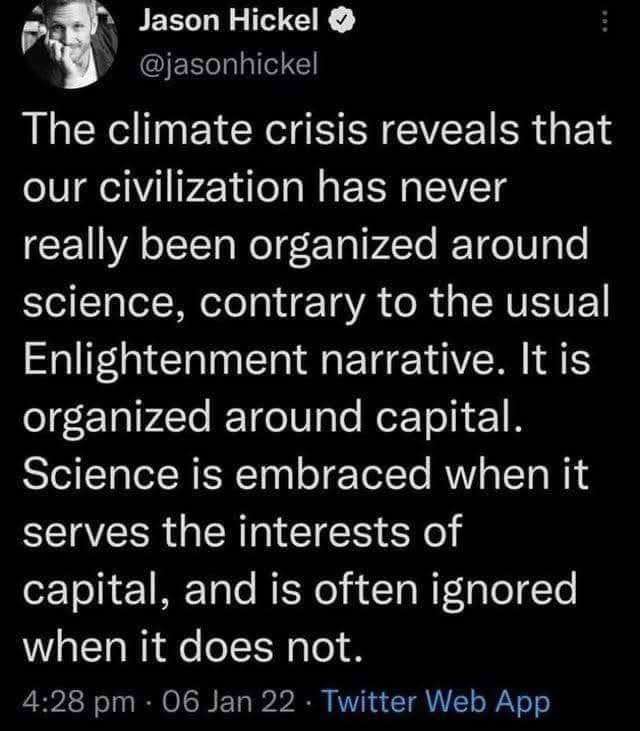
Jason Hickel: What’s striking about capitalist civilization is that it has no real direction

Yes, capitalism is not tied to anything real. It’s just about putting a number on the exchange value of something, according to demand. It’s not rooted in reality beyond that, and it has no direction beyond that.

People need food, so it sells food – at a cost to the soil, insects, wildlife, ecosystem health, and future generations. People needs shelter, so it sells shelter – often to the profit of those already very wealthy and at a cost to those who have less.

Mainly, it’s not rooted in physical reality. It’s not rooted in the physical reality of this planet we call Earth.

It’s not rooted in the physical reality that we are local and temporary expressions of this living system, and that our health and well-being fully depend on a thriving and healthy planet Earth.

It’s not rooted in the physical reality of Earth as our literal larger body.

As it is, what’s easy and profitable is often harmful for people, ecosystems, and future generations.

If our economic system took ecological realities into account, what’s easy and profitable would help regenerate people, society, and ecosystems, and benefit all of us and future generations.

Yes, in its current form, capitalism produces global ecological overshoot.

It assumes infinite Earth, so it encourages consumption far beyond the capacity of Earth to regenerate itself.

Humanity is currently using far more resources than this living planet can regenerate, and that inevitably leads to ecological and civilizational collapse. This goes far beyond climate change, which is just one of many expressions of this overshoot.

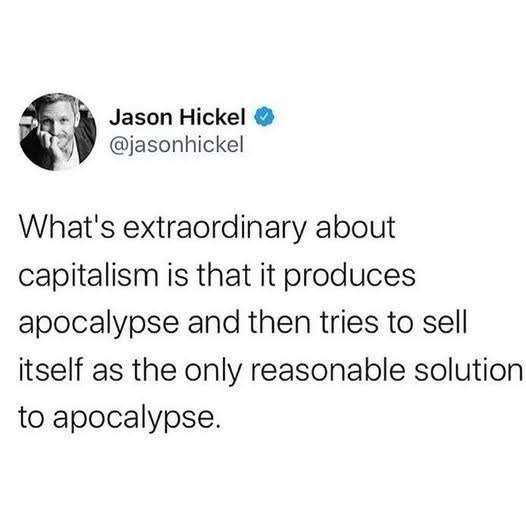
And since it sells itself as the only realistic and viable economic system (although it’s far from realistic and far from viable), it sells its own solutions. Mainly, it sells techno-fixes.

It can only sell band-aid solutions, since it, itself, is the cause of the problem.

More to the point, it’s organized around assumptions of separation and infinite Earth, which is the real cause of the problem.

Yes, also true.

In our civilization, we talk as if science is our organizing principle. That’s not true. Capitalism is the organizing principle. Far too often, science is in the service of capitalism.

Far too often, the result of science is ignored if it doesn’t serve the narrow interests of capitalism. We see that with climate change. Climate change scientists ring the alarm bells, and society as a whole ignores it because they see it as inconvenient and costly to change.

Also, far too often, the focus of science is decided by what’s profitable. Important research is often not done because it’s not profitable enough, or goes against inherent assumptions of capitalism.

Flood prevention & win-win solutions

In the news today is a flood story from Texas where a river went over its banks due to heavy rain, leading to loss of life and a great deal of damage.

The news reports mainly focus on the damage and the lack of warning, some on climate change, and less on other equally important underlying causes and solutions.

ECOSYSTEM DEGRADATION

Climate change does play a role in this, of course. Increased heat (energy) in the atmosphere leads to more extreme weather, including heavier rainfall.

Still, in many cases, the main cause of disastrous flooding is not climate change itself. It’s degraded ecosystems.

Degraded ecosystems are unable to effectively deal with the inevitable occasional heavy rainfall. They make heavy rain into a problem instead of a resource.

ECOSYSTEM REGENERATION

The solution is ecosystem regeneration. Restore rivers and creeks – through porous stone dams and native vegetation along the banks – so they don’t go dry. Restore the flood plains. Restore the native vegetation in the whole area, the natural layer of mulch, and the soil, so water can slow down and absorb into the ground.

Do this in all public spaces. Encourage it in private spaces, including gardens and farms. (Through training, making plants available, help with the work, subsidies, tax cuts, and so on.) Remove any unnecessary asphalt and replace with native vegetation, or at the very least porous paving.

Install food forests wherever possible, to provide food for animals and the community.

WIN-WIN SOLUTIONS

This helps prevent flooding, makes heavy rain into a resource instead of a problem, and it benefits us in innumerable other ways. It provides habitat and food for others in the web of life we are part of. It provides food for us. It enhances our well-being. It improves the quality of the community. It reduces our ecological footprint. (Which is crucial in our age of global ecological overshoot.)

Also, in terms of climate change, ecosystem regeneration and reducing our ecological footprint are essential parts of the solution.

It’s a win-win-win solution and it’s very doable.

WHAT’S REQUIRED

What’s required is collective will, and perhaps a shift out of a zero-sum to a win-win mindset, and a shift from a view of separation to a view of connection.

Our current modern communities are largely a result of a zero-sum mindset. We use solutions that harm the web of life we are part of. And this is also tied to a view of separation. We see ourselves separate from the web of life, so we don’t care much what happens to it.

The reality is that we are all part of the same seamless web of life and living planet. What happens to the wider web of life happens to us. Win-win solutions are the only ones that make sense in this reality, especially when it comes to how we collectively organize ourselves.

At the center of our civilization is an illusion, and reality reminds us – including through this kind of flooding.

Read More

Illogical behavior in fiction seems far-fetched, until I remember this world

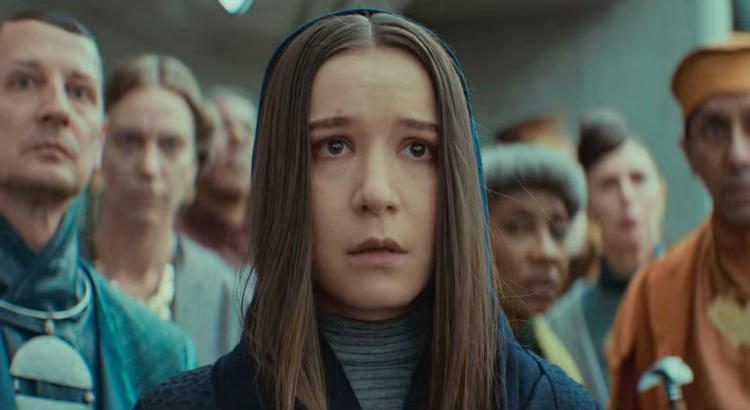
I am watching the final episode of Andor, where the resistance leaders are reluctant to take the info about the death star seriously.

As I was watching it, my thoughts told me this is unrealistic, far-fetched, and written just to create tension.

The source has been reliable in the past. People have died for the info. Creating a super-weapon is just what the Empire would do. If there is just the tiniest possibility it’s true, they need to take it very seriously. It doesn’t cost much to take it seriously and seek to gather more info and do something about it. And it wouldn’t take away from what they would do anyway. It fits right into what they need to do no matter what.

So why reject the info? It seems too illogical to be realistic.

Then I remembered this world. A world where climate change is still debated and not taken seriously, even if… (a) The science is clear. (b) It’s a subset of a far more serious issue, global ecological overshoot, which we know is happening. (c) It doesn’t change what we need to do. We need to create a civilization with a much smaller ecological footprint, that’s not in ecological overshoot, and that is regenerative as a whole and in the details.

The resistance leaders in Andor rejecting the info seems illogical, childish, and unrealistic.

And yet, it’s exactly what we see in the world today when it comes to climate change and global ecological overshoot.

I should add something about why they reject the info. In Andor, they reject it because it comes from someone they don’t particularly like. They allow their own dislikes to override a more rational decision. That too is what we see in this world. Some of those who reject climate change – and don’t take ecological overshoot seriously – do so because they don’t like the ones who traditionally have taken it seriously. They don’t want to be associated with (the ones they see as) hippies and liberals. They hold onto an identity that doesn’t allow it.

Of course, that too is very human, a trauma response typical of our domination culture, and misguided, childish, and irrational.

Fascism eats its own

Tony Gilroy, the writer and producer for Star Wars: Andor, here mentions that fascism eats its own.

That’s very clear from history, from any authoritarian regime, which is why it’s so puzzling to me that people vote for authoritarianism/fascism, and why people chose to get involved in an even more direct and intimate way.

More to the point these days: Why did people vote for Trump, when his policies will likely harm them? Why do people chose to get involved with Trump more directly, when they’ll likely get chewed up and spit out?

There is no one simple answer, of course.

Some may have voted for him because they are fed misinformation from Fox News and social media. They may not know much about project 2025 and what it means for them. They think bad things will happen to others, not them. They don’t know much about history and similar projects in the past and how it played itself out.

Some may choose to get involved because it seems the safest at the moment. It just requires yielding to pressure and do what the strong man says. They think they’ll somehow be protected and get away with it. (Which may happen, but it’s equally likely they’ll get eaten by the dynamics of fascism.) Maybe they like the gamble. Maybe they felt safer on the side of the strong man in childhood, or wanted a strong man in their life to protect them.

Note: I use “strong man” in invisible quotation marks here. Trump and similar authoritarians try to develop the image of a strong man which reveals a deep insecurity. Someone with real confidence don’t need to do it. Many see through this, but not all.

A few resources to understand Trump’s authoritarian takeover

I thought I would share a few resources I find helpful in understanding what’s going on in the US these days, especially considering that mainstream media often gloss over, avoid, or whitewash some of the most important points.

NEWS, ANALYSIS AND COMMENTARIES

News Sources

The Guardian – often very good

ProPublica – investigative journalism

BBC | PBS | NPR | CBC | 60 Minutes Australia – more mainstream, sometimes good

Magazines

The Atlantic | Teen Vogue | The New Yorker

Commentators, Historians, Journalists

Robert Reich – political commentator | website | youtube

Heather Cox Richardson – historian | youtube | substack

Anne Applebaum – historian | website | The Atlantic

Timothy Snyder – historian of fascism and democracy | youtube | On Tyranny (article)

Katie Couric – journalist | website | youtube

LegalEagle – a law perspective on Trump’s actions | youtube

Russel Razzaque – London-based psychiatrist | website | youtube

Parkrose Permaculture – insightful commentary | youtube

This is an incomplete and random list, and highlights some resources I find helpful.

FICTION

I am watching Andor (Star Trek series) and am reminded of how fiction often gets to the crucial points better than much current affairs media. I am in the middle of the current season. A central theme is how the empire is using resistance as an excuse to take even more drastic measures to take and maintain control, all for the purpose of funneling more money, resources, and power to the already very wealthy at the expense of everyone else. (I found a short clip where the writer of Andor, Tony Gilroy, talks about Star Wars and fascism, commenting on how fascism inevitably eats its own.)

That’s what we are seeing in Los Angeles these days. People are protesting against the inhumane tactics used by ICE. Trump is using it as an excuse to mobilize the National Guard (which he is not allowed to) and the marines to squash any protests in the streets. And the real purpose is to further consolidate power, normalizing using the National Guard and the US military against US citizens, and further intimidate the population and quiet dissent.

This is straight out of the fascist playbook, has been predicted for months, and is one more step in the classic fascist takeover.

IT’S NOT ABOUT TRUMP

This is not really about Trump. It’s far deeper than that. It’s about Project 2025. It’s a culmination of the climate and indoctrination created by Fox News for decades. It’s about the many who voted for Trump because they are scared of losing their (perceived) white privilege. It’s about all social commentators who, for decades, have pitted groups against each other to distract from what’s really going on: funneling even more money and resources to the already extremely wealthy. It’s about decades of neoliberal policies aimed at doing exactly that.

Even more crucially and fundamentally, it’s about domination culture.

This is one of the many expressions of domination culture.

I have found Riane Eisler and Starhawk helpful here, and I know there are many others talking and writing about this topic.

One to One: John & Yoko

I just watched One to One: John & Yoko, a time capsule and glimpse into their social engagement in 1972-73. It’s also a reminder that the same dynamics are still very much at play today in society and within each of us.

Empire is still very much here. The mindset of empire is internalized in all of us, regardless of whether we consciously and actively join in with it or not. The resistance is here. And those identifying, examining, and undoing the mindset of empire in themselves are still very much here. (That undoing is also an undoing of any and all identities, including those in opposition to empire.)

Pride saves lives

I love pride and pride month.

Why? For the simple reason above. It saves lives.

We live in a traditionally (and weirdly) homophobic culture. In such a culture, gay people internalize homophobia (as we all do) and experience homophobia from others. So pride, and pride month, is an antidote to that. It can help someone continue living instead of deciding to end it all.

That’s why I see any kind of anti-pride sentiments as petty, misguided, and a sign of heterosexual privilege. If you don’t understand why we need pride month, then take five minutes to imagine how it is to be gay in a culture that’s made for heterosexuals and has a subtle and often not-so-subtle anti-gay bias.

I also don’t love pride month. I don’t love that it’s necessary in the first place. I would prefer a culture and civilization that’s radically inclusive. But that’s not the reality we live in.

As usual, there is a lot more to say about this.

HOW I RELATE TO MYSELF AND MY OWN EXPERIENCE

The way we relate to society and the outer world is how we relate to ourselves, our experiences, and our inner world. If I wish to get to know more of me, find and live more from my inner richness, and find peace with who and what I am and my always changing experiences, it only makes sense to be radically inclusive of society and the wider world. (Keeping the paradox of tolerance in mind.)

I AM INEVITABLY IN A MINORITY

Also, I am inevitably in a minority in society in some ways, and I can easily find myself as a minority in more obvious ways (for instance, by being disabled), so here too, it only makes sense to work towards a society that’s radically inclusive. I personally benefit from it already now, and may do so in a more obvious way in the future.

DOMINATION VS PARTNERSHIP CULTURES

This relates to the topic of domination and partnership cultures. In domination cultures, some groups are automatically seen as less-than and marginalized. A more deep partnership orientation tends to be more radically inclusive.

We all internalize marginalizing attitudes from the domination culture we live in, but we can be aware of it, we can be aware of the harm it does to others, ourselves, and society, and we can choose to see through it and live from a more inclusive orientation. Not (just) for the sake of the marginalized but for all of us and for the health of society as a whole.

ZERO-SUM VS WIN-WIN

A domination orientation tends to also come with a zero-sum mindset. If you are honored and actively included, it means there is less for me. I don’t want you to be honored or actively included since it can mean less for me. This is trauma behavior.

In contrast, a partnership orientation tends to come with a win-win mindset. If you are honored and actively included, that benefits all of us and me too. That’s the type of society I want to live in, because it’s better for all of us.

IN ESSENCE

So, in essence…

Pride saves lives. It creates a more inclusive society, which directly benefits me since I too need and want to be included. And it helps me find peace with more sides of myself and my own experience.

It also costs literally nothing. It doesn’t cost me anything. It doesn’t cost society anything.

For me, that’s a simple equation.

“Won’t the wild animals take the food?”

I mentioned to someone that a lawn could be made into an old-fashioned diverse garden with fruit trees, berry bushes, flowering bushes, perennial flowers, and wild areas. His response was: won’t the wild animals take the food? Isn’t a manicured lawn good?

To me, this illustrates a few different things.

First, it’s a reminder of the general lack of ecological literacy in our society.

We are in global ecological overshoot, and whatever we can do to regenerate ecosystems – even if it’s “just” converting a lawn into a more natural garden or a food forest, moves us in the right direction.

We have a massive loss of insects here in Norway, and the recent fashioned of overly manicured lawns is part of the problem. Where there used to be trees, bushes, flowers, and wild areas and edges, there is now a green desert that can’t support much if any life. (Pesticides used in agriculture and green area is another reason for the collapse of the insect world, as is natural areas made into buildings and roads.)

Converting a lawn to a more wild area with a diversity of flowers will support the local insects, which is invaluable. What happens to the insects will happen to us. What we do to the web of life, we do to ourselves.

Then, there is the difference between a zero-sum vs win-win mindset.

The fear of animals taking the food comes from a zero-sum mindset. If they take it, there won’t be enough for me. It may be better to not do anything than allowing the wild animals to eat food from the garden.

The reality is that a diverse and lush garden provides more than enough food for everyone. Also, we can get our food from the supermarket, and the wildlife can only get it from nature.

A win-win mindset comes from recognizing that we are all part of the web of life. Our existence depends on a thriving web of life and wildlife. We can’t exist without it.

We all win or we all lose, together. And right now, we are all losing. The whole web of life is losing because of our civilization organized around the idea of separation and a zero-sum mindset.

Recognizing this can be challenging and bring up grief, despair, and more, and the remedy – for us collectively and individually – is for each of us to do what we can, including in our own literal backyard.

The featured photo is from one of the apple trees at my childhood home. The rest are from a recent trip to Drøbak where some old-fashioned gardens still exist.

The right side of history: What is it? What will future generations see as the right side of history?

When I hear the phrase the right side of history, it brings up a few questions.

What we see as the right side of history obviously depends on who, where, and when we are.

We tend to use the phrase about anything that contributes to creating a world that works better for all of us. Anything that moves in the direction of widening circles of inclusivity, widening circle of “us”, and so on.

Why? Mainly, because it aligns with the values of the ones who tend to use the phrase – Western educated liberal people.

I see it that way too, so considering that inevitable bias…

What may future generations see as the right side of history when they look back to our time? And why?

GLOBAL ECOLOGICAL OVERSHOOT & CREATING A REGENERATIVE CIVILIZATION

I imagine they will see one issue – global ecological overshoot – as the primary one.

We live in a civilization with an assumption of separation at its center.

We assume that humans are separate from the web of life. That we can externalize cost to other people, the rest of the web of life, and future generations, and that it won’t come back to bite us. That Earth’s resources are infinite and has infinite capacity to regenerate. That humans somehow, intrinsically, are more valuable than the rest of the web of life. And so on.

This has led to a global human civilization that has an ecological footprint larger than Earth and lives in global ecological overshoot. This is similar to living on a savings account. It looks fine until we reach the bottom and our lifestyle comes crashing down. In our case, globally, we are in the bottom layer and it’s our civilization that will come crashing down.

Actions that (a) tries to stop the destruction, (b) works on creating and living from a more life-centered worldview, or (c) creates and lives life-centered alternatives tend to be on the right side of history.

Future generations will very likely see this as being on the right side of history. (Assuming there will be more future generations, which is not a given.)

The ones most clearly on the right side of history are the ones who (a) go to the essence of the problem which is a civilization and system built around the assumption of separation, (b) recognize that the remedy is a thorough and profound transformation of our civilization, and (c) actively work on this and live the alternatives.

Why will future generations likely see this as being on the right side of history? Because this is not only sane, it’s what creates a better life – or the possibility for life – for those future generations.

This is an example of an issue that most today will agree with in a general way, and yet few realize the gravity of the situation, how profound the changes need to be, and are actually doing it in their own life.

When later generations look back and sees something as on the “right side of history”, that’s how it often seems to be. A good number of people may have sympathized with it in a general way, and a much smaller number actively lived it and brought it into society.

OTHER EXAMPLES

What can be more important than preserving the web of life that we are part of and depend on for our life?

That said, I imagine future generations may see some of the following as being on the right side of history…

Rights of ecosystems, non-human beings, and future generations

Considering the interests of future generations, I imagine they will see any promotion of the rights of ecosystems, non-human beings, and future generations as being on the right side of history.

In our civilization, built on the idea of separation, the rights of individuals and corporations are at the center. Individuals are seen as the default legal unit, and corporations as almost sacred in an economy that assumes unlimited natural resources, the rights of humans to use everything in the commons of life for themselves, and that we can get away with destroying the web of life we are part of.

In reality, if we are to preserve what’s most precious to us – our lives, the lives of future generations, and what’s valuable in our civilization (science, art, etc.) – we need to give the rest of the web of life equal rights. We need to give legal rights to rivers, mountains, the ocean, ecosystems, species, and future generations.

That’s the only way we can protect what’s most valuable to us. That’s the only way we can protect the web of life we are part of, depend on, and that gives life to everyone and everything valuable to us.

Regeneration & growing non-toxic food

One of the things we can do to slow or reverse our global ecological overshoot is regeneration – of ecosystems, oceans, forests, meadows, agricultural fields, and our parks and gardens.

For this to happen at a global scale, we need a global and thorough transformation of our civilization and the basic assumptions of our civilization. That’s a tall order, and although it needs to happen soon if we are to avoid an even more massive ecological (and civilizational) crash than we already are in, it’s unlikely to happen. It’s not something we can wait for.

So what can we do – as individuals, families, communities, and organizations?

One of the most powerful and rewarding things we can do is regeneration. We can engage in regeneration of our veranda, garden, local parks, rural land, or whatever we have to work with.

If it’s our own land, we can do it on our own, and if it’s communal land, we’ll need to find partners. Coalition building is vital, and it’s also good to start small and do it in small steps – for learning, to create something of better quality, and to gain more support.

Staying close to science

Science is a method for learning about the world, and it is, in a very real way, organized common sense.

What’s produced by this method, the content of science, is always changing, up for revision, and reflects our civilization and general worldview.

The way science is used is yet another thing, and depends on our civilization and society. In our case, with our civilization built on the idea of separation, it’s often used in ways that harm society and life.

That’s not the fault of science, it’s the fault of our civilization.

I imagine future generations will see those who stay close to science, especially in their approach to learning about the world, as on the right side of history. They will likely also see those who criticize the way science is often used in our society as on the right side of history.

Not falling for conspiracy theories

Conspiracy theories are sometimes, at least partially and indirectly, rooted in reality.

Whether they are or not, they are often a distraction from what we know is happening and what’s far more serious than the topic of the vast majority of conspiracy theories.

What we know is happening is global ecological overshoot. We live in a civilization organized around the idea of separation. This system externalizes cost to the wider web of life and future generations, creates vast inequality among humans, allows huge numbers of people to die from preventable and treatable diseases, and so on. And it’s far more serious – for us, the web of life, and future generations – than the topic of most if not nearly all conspiracy theories.

We know from history that conspiracy theories flourish in times of uncertainty, like today. They are a way for people to feel they understand what’s going on, to feel smart, to have a place to put their fear and anger, and so on.

I imagine future generations will see most if not all the conspiracy theories flourishing today as a distraction from far more serious and immediate issues.

Empires

The US, Russia, and China are all empires, and they all share many of the same (unsavory) characteristics and power-over dynamics that harm their own citizens, their neighbors and/or people in other places in the world, and the web of life.

The US has historically damaged both their own citizens (lack of social safety nets, huge wealth inequality, etc.) and people around the world (toppling democracies, wars). Russia has damaged their own citizens (repressive) and their neighbors, including through their invasion of Ukraine. China is damaging their own citizens (repressive), and especially ethnic minorities. One is not very much better than another. They are all empires – or want to be empires – and do what empires do.

I imagine future generations will see those who focus on the harmful characteristics of all empires as on the right side of history. (Not those who take sides, for one and against another.)

Israel & Palestine

It’s similar with Israel and Palestine. I imagine future generations won’t see those who automatically take sides as on the right side of history.

The situation is far more complex. Israel acts on trauma. Palestinians fight for their survival. And as the UN and innumerable aid and human rights organizations say, what has happened in Gaza for decades are systematic human rights violations. It has been a slow genocide for decades, and it has dramatically intensified over recent months.

Israel is doing to others what was previously done to them. They are acting on, continuing, and passing on the trauma to new generations. Hurt people hurt people.

I imagine future generations will understand both sides.

I imagine they will also find it baffling that the international society didn’t take a stance against Israel in their human rights violations and genocide. How could they witness perpetuation of pain, suffering, and trauma without doing anything?

What happens to the insects happens to us

What happens to the web of life happens to us, and what we do to the web of life, we do to ourselves.

We are part of one seamless living system, so it’s inevitable.

INSECT COLLAPSE

I am in Norway these days, at my childhood home, and I am reminded of one aspect of this.

What happens to the insect world happens to us.

When I grew up here, the yard was full of insects of many different kinds. We had ladybugs, lacewings, all kinds of spiders, butterflies, ants, bumblebees, wasps, swarms of tiny flies, and so on. We had many kinds of birds, including large flocks of swallows.The yards in the neighborhood, and in Norway in general, were full of trees, bushes, flowers, and wild patches and edges.

These days, the yards are manicured lawns. Most of the trees, bushes, and flowers are gone. Almost all the insects are gone, apart from the occasional bumblebee or wasp. The only birds left are a few magpies and pigeons, and even those are almost gone. We have the doors and windows open during the summer, and no insects come inside because there are none outside.

This collapse has happened over the last few decades, with a marked drop even over the last ten years.

Most likely, this is happening through a combination of habitat loss (less nature, more houses, roads, and manicured lawns), pesticides used in agriculture and yards, and a few other factors.

WHERE IS THE OUTRAGE?

What happens to the insects happens to us, so where is the outrage? Where is the urgency?

Why do people seem so complacent about it?

Why don’t people throw their robot lawn movers in the garbage, and create wild, alive, and beautiful natural gardens – full of trees, bushes, and wildflowers?

Why do they choose to buy and eat food grown with toxins and support that industry?

I am genuinely baffled by it.

COMPLACENCY AND THE BANALITY OF EVIL

Where is the outrage over this civilization that’s not only ecocidal, but suicidal?

How can people continue to live as if nothing is happening?
How can they continue to vote for the same old parties that don’t take this seriously?

How can they continue to focus on the next vacation, the next dinner with friends, the next movie to watch, when the world is collapsing around them?

How can they continue to buy food grown with toxins, maintain a green desert around their house, buy things they don’t need, and so on, when this is how the web of life collapses?

This is the banality of evil in our age. This is good people and good citizens doing what’s expected of them, and doing what they expect of themselves, and actively being part of the collapse of life.

SOME ANSWERS

I have explored this in other articles, and really since my teens in the ’80s, and I am still baffled.

At the same time, there are some answers.

It has to do with…

Shifting baselines, and getting used to the gradually eroded web of life.

Social expectations, norms, how we think we should live, and what we imagine the neighbors think.

Seeing others appearing to not take it seriously, so we think we don’t need to take it seriously.

Politicians thinking in four-year time spans and the next election.

Assuming others will take care of it, now or later.

Assuming it’s happening “out there” separate from us, and won’t impact us too much.

Identity and not wanting to become like those green party folks, lefties, hippies, or tree huggers. Not wanting to admit they may have been onto something. (Is pride or survival more important?)

A system and civilization set up this way, which means that doing it differently takes effort, and changing the system takes numbers, effort, a sense of urgency, and maybe an even more obvious collapse.

A civilization with an assumption of separation at its center. We are separate from nature and the web of life. Nature is here as a resource for us. We can export the consequences of our behavior and civilization, and it’s gone. We are inherently more important than the rest of the web of life. If we win, the rest of life loses.

A civilization and system where what’s easy and attractive to do, as organizations and individuals, is often inherently destructive to the web of life.

The good news is that it doesn’t have to be this way. We can create a system that comes from an understanding of the web of life and seeks partnership and win-win solutions. The unfortunate news is that changing requires a collective will to change it, as well as diagnosing the problem correctly.

WHAT CAN I DO?

So what can we do?

Here is some of what I am doing.

I recognize that the problem is systemic, it’s a civilizational problem. It’s not (primarily) about corporations, greed, or any one particular group. It’s about all of us.

It’s about our fundamental mindset and assumptions of separation.

I buy organic as much as I can, even if it’s more expensive (another sign of the fundamentally flawed priorities in our society). I eat low on the food chain. If I can, I buy from local farmers.

I have educated myself on the ecological footprint, global ecological overshoot, and our idea of separation and its history (going back to the agricultural revolution).

I have educated myself on a simple and powerful framework to understand what’s happening: domination vs partnership orientation, power-over vs power-with, and the consequences of each for us, society, and the web of life.

I connect with like-minded people in real life and online.

I vote for political parties that take this seriously. In my case, I vote for and am a member of the Green Party in Norway.

We have 15 hectares in the Andes that we are regenerating, rewilding, and protecting, and we are developing a food forest around the houses.

Here in Norway, during our short stay, we are letting the lawn grow wild in May to encourage the wildflowers so they can feed the few insects left.

If I lived in Norway with a garden, I would do something similar to what we are doing the in the Andes. I would create a food forest – with native flowering trees and bushes, fruit trees and berry bushes, wildflowers and more – to feed wildlife and us.

The photo is from our garden / food forest in the Andes.

All the times we didn’t know we didn’t die

I know a few times when I didn’t die. That one time in the car in Oregon, when the driver pulled out right in front of a car going at full speed. (Saved by the miraculous quick reaction of that driver.) The day on the coast of California in winter, when each wave only took me further out. (Saved by the kind guy from Boston built like a truck.) The midsummer when I blacked out and woke up naked, shaking like crazy, and dripping of sweat. (Saved by the ambulance people and the doctors and nurses giving me immediate treatment for sepsis.) And likely the time I went between our beloved cat and a dog, she bit my leg, and I got a persistent infection. (Saved by antibiotics.)

There are also innumerable times I didn’t die that I don’t know about because nothing happened.

And why did nothing happen? Because society is set up to prevent a wide range of things we can die from.

We have clean water. Just about every day, I don’t die from polluted water.

We have sidewalks. Just about every day, I don’t die from being hit by a car when I am out walking.

We have grocery stores with a variety of foods. Just about every day, I don’t die from malnutrition.

We have water and food. Just about every day, I don’t die from dehydration and hunger.

We understand how infectious diseases spread and take precautions. Just about every day, I don’t die from an infectious disease.

We have remarkably effective vaccines. Many times in my life, I didn’t die from diseases people in earlier generations died from.

We have antibiotics. Many times in my life, I didn’t die from an infection that would have killed me just two or three generations ago.

We have laws and a relatively safe society. Just about every day, I don’t die from violence or war.

We have a good social safety net. I don’t have to die from not having enough money.

None of this is a given.

It’s easy for this to become invisible to us, which is why it’s so important to regularly remind ourselves and others about it.

It didn’t happen by accident. It happened because enough of us decided to do something about it. And we need to make that decision anew each day, each election, each time we speak about society and what we value.

The video No One Knows When They Didn’t Die is by Hank Green and is on this topic, and is the inspiration for this brief article.

Vance, Prevost, and a zero-sum vs win-win orientation

JD Vance has said that Christian love means to prioritize your family, then community, then country, and last the rest of the world.

Before he became Pope Leo XIV, Prevost tweeted the reply above, reminding Vance and others that love cannot be ranked.

THE TWO VIEWS

I came across someone talking about this. He said that the views reflect the difference between (a) our fallible human tendency to prioritize those close to us versus (b) the ideal of loving everyone equally. To me, that’s missing the mark.

It’s not fallible to prioritize those close to us. It makes sense to do so since we are in the best position, perhaps among everyone, to make a difference to those close to us.

It’s also not an ideal to love all equally, it’s what we are and it doesn’t go counter to prioritizing those close to us.

ZERO-SUM VS WIN-WIN

To me, the two views – of Vance and Prevost – are really about the difference between a zero-sum and a win-win orientation.

Zero-sum

Trump, Vance, and MAGA tend to operate from a zero-sum view of the world.

If you win, it likely means that I – somehow, even if I don’t know how yet – will lose.

Similarly, I’ll seek out ways to win that makes sure that you lose. That’s the only way I can be sure I won.

We see this in just about all aspects of Trump’s policies, and this is very far from the life and words of Jesus.

It’s also very far from the reality of a profoundly interconnected world, a world that’s one seamless system where the health and well-being of the larger whole is profoundly interconnected with my own health and well-being.

Win-win

Prevost seems to come from more of a win-win orientation, and an orientation more aligned with the life and words of Jesus.

He knows that we can find solutions that benefit us and our families, and also the larger social and ecological whole. He knows we can find, chose, and live win-win solutions.

We can take care of our families, communities, and country, and do so in a way that also benefits the wider world, the living web we are part of, and future generations.

For me, that’s the essence of the difference in view between Vance and Prevost.

DOMINATION VS PARTNERSHIP LENS

There is a lot more to say about this, and I have written about it in other articles.

Trump and Vance’s view is an expression of a strong and relatively one-sided domination culture. Central to that culture is a view of separation, zero-sum strategies, either-or thinking, and so on.

Trauma is also central to that culture. Collective and intergenerational trauma is part of how it perpetuates itself, and a zero-sum orientation is – in many ways – a trauma response.

Although Prevost is part of an institution that has strong domination culture elements (a history of supporting fascist regimes, strong patriarchical hierarchy, an idea of the sacred as “out there”, dogmas you are supposed to pretend to “believe” in, colonialism/missionary work, and so on), he and the Catholic Church has elements of a partnership orientation, as expressed in his tweet.

Although that’s another topic for another time, there is a fundamental dissonance in the Catholic Church. As an institution, it’s an expression of a strong domination culture that far too often sides with the powerful. It’s supposedly built on the teachings and life of Jesus, who had a radical partnership orientation. And to acknowledge that, they need to soften their edges a bit and bring in some elements of a partnership orientation.

Reality has a left-leaning bias? I think of it as a oneness bias

Many point out, sometimes ironically, that reality has a left-leaning bias.

Science tend to support left-leaning policies. More educated people tend to lean left. And left leaning policies – as we find in, for instance, the Nordic countries – tend to yield better long term results for society as measured in health, well-being, trust, social and economic stability, social safety nets, and more.

For me, this is rooted in something more fundamental: Reality has a oneness bias.

Existence is a seamless system. Earth is a seamless living system. Society is a seamless social system.

Policies that acknowledge this interconnectedness tend to yield more favorable outcomes, simply because they are more aligned with reality.

Life is interconnected, so it makes sense for our view – and our policies – to acknowledge that.

It’s perfectly possible for a conservative orientation to take interconnectedness into account, and support society as a whole and the living systems we are part of. After all, a conservative orientation means – at least traditionally – to take care of what’s most important to us, and that’s life and the web of life we are all part of.

And yet, in practice in the world today, it tends to be the more left-leaning orientations that take interconnectedness into account, with the Nordic countries as an (imperfect but pretty good) example.

Video: History professor answers dictator questions – Wired

Dictators who take your rights away want more than just your silence—they want your complicity. They want you to betray other people in your communities, to inform on them, to look the other way when your loved ones are taken by the secret police. But more than that, they want you to betray yourself. They want you to lose your moral compass. They want you to self-censor.

Dictators are very skilled at posing as saviors. They create crises—or exploit existing ones—and then present themselves as the only solution. Whether it’s an economic collapse or a perceived threat of social unrest, they step in with promises of order and protection.

One of the classic dictator narratives for the past hundred years is this: only the authoritarian leader can keep people safe from immigrants crossing the border. There’s always a grain of truth—they come over the border, yes—but dictators twist that truth. They say immigrants are coming to rape our women, to steal our jobs, to dilute the population with the “wrong” skin color or faith.

These same excuses have been used for generations to justify national purity campaigns. Mussolini, for example, talked about Black, brown, and yellow people—his words—coming across the border and having too many babies. These are old narratives, but they still work. Why? Because they make people afraid—afraid for their safety, their families, their way of life. And in that fear, the dictator says: “I alone can fix it.”

– Ruth Ben-Ghiat in History Professor Answers Dictator Questions

A clear and concise summary of some of the features of authoritarianism and dictatorships. Of course, it’s not a coincidence that this comes out now, a few weeks into Trump’s second term.

Personally, I have a few different things come up around this. Yes, I know people repeat history, including the type of history that is harmful to themselves. Yes, I know many – especially in the US it seems – don’t know much history. (This is partly by design since some political groups benefit from an uneducated population.) Yes, I know that not everyone had the same education and grew up in the same culture as me. (Learning about these kinds of things were central to my middle school education, and it’s part of Norwegian culture since we lived through a dictatorship during WW2.)

And yet, a part of me is baffled. Isn’t this obvious? No, apparently it’s not. Apparently, people need to make the same mistakes again, and again. I guess that’s a feature of this world that’s inherently changing, unpredictable, and has a mix of things our personalities likes and don’t like.

A dream for another time & dreams for this time

A friend of mine (JH) talked about her past vision for her life. She said it was a dream for another time.

PERSONAL DREAMS FOR ANOTHER TIME & DREAMS FOR THIS TIME

It’s a good phrase. Some of my dreams were dreams for another time as well – of having children, doing a PhD, studying at CIIS, and so on. They are no longer my active dreams or the ones I engage with. They were for another time, another set of circumstances, and another person.

For this time, this set of circumstances, and this person, I have other dreams – of regeneration, community, developing a food forest, and so on.

These dreams are not new. Since my teens, I have been passionate about sustainability, community living, permaculture, a more life-centered way of life, and more. Because of my life now, these particular ones have come into the foreground and other dreams have faded into the background.

COLLECTIVE DREAMS FOR ANOTHER TIME & DREAMS FOR THIS TIME

It’s similar for us collectively. To me, so many of our collective dreams seems to be for another time and another set of circumstances.

The dreams tied to the domination and separation aspects of our civilization are, really, for another time.

These are dreams telling us that business as usual is OK. We can live as if our impact on the web of life has no consequences for ourselves. We find security through accumulation. Meaning comes primarily through career, family, or recreational activities. Success is having a house with a lawn. And so on.

In an age of global ecological overshoot and collapse, these are dreams for another time.

What are the dreams for this time?

Obviously, this will say as much or more about me as they do about our collective situation, but here are some of what comes up for me:

Dreams of community, strong community bonds, and mutual support. Dreams of regeneration of ecosystems – of lawns, parks, farmland, ocean ecosystems, plantation forests, deserts, and so on. Dreams of finding meaning through engagement in creating a regenerative civilization. Dreams of regeneration of ourselves and our communities. Dreams of creating a civilization – in ourselves, our life, and our network – that takes the best from domination and partnership cultures and orientations.

These are hopeful dreams that show us the way out of our situation. These are dreams we can engage with and bring into life, in whatever way is suitable to our situation. These are dreams that are profoundly meaningful, enriching, and nourishing, independent of whether they are implemented collectively or at a large scale.

Photo from Finca Milagros, the land we are stewards of / participants in / “owners” of in the Andes.

“I wonder if the fall of the Roman Empire was this stupid?”

I have seen this quote on social media recently – and it applies to what’s happening in the US and to our civilization as a whole.

THE STUPIDITY OF WHAT’S HAPPENING IN THE US

What’s happening in the US is clearly stupid. The majority of voters voted for a billionaire who is only interested in funnelling money and resources to himself and his wealthy friends at the expense of everyone else. They voted for someone who clearly stated he would transform the US into an authoritarian and fascist regime. They voted for someone whose buddies developed Project 2025 which would remove social safety nets, erode democracy, and in general make life worse for ordinary people.

They voted for who promised he would go after his perceived enemies, isolate the US from former allies, erode education and research (allowing other countries to take the lead), sell off public land to private companies so they can make profit out of it, and so on.

People voted for someone they knew would make life worse for them. At least, they could easily have known if they had taken five minutes to look into it. (As many point out, the MAGA movement has the characteristics of a cult, and cult followers are not known for critical and rational analysis.)

THE STUPIDITY OF WHAT’S HAPPENING IN THE WORLD

What’s happening in the world is equally stupid. We are in global ecological overshoot. We are spending far more resources than Earth can replenish, and we are eroding the capacity of Earth to replenish.

We have a civilization that assumes infinite resources on a finite planet, and it assumes separation while we know that what happens to the web of life happens to us. We have a civilization that’s out of alignment with reality in obvious and fundamental ways.

Not only that, most of us seem oblivious to this – at least in our actions. We still vote for the same politicians. We still live as if nothing is happening. We still have monoculture gardens instead of nature gardens or food forests. We still eat food grown with poison.

This is ecocidal and suicidal.

And that’s clearly stupid, especially as there are workable alternatives.

There are ways where we can take ecological realities into account in our worldview, economics, and all other aspects of our civilization. We know how to develop a regenerative civilization where what’s easy and attractive in the short term helps Earth replenish itself and provide an abundance for us, wildlife, and future generations. We know how, we just need the collective will to make the changes.

Or, maybe, and maybe more likely, we need to live through the increasingly dramatic consequences of our current civilization, and nature will take care of the situation by reducing our numbers drastically. Will the ones who survive learn? And if they do, for how long? That’s the question.

THE GREAT FILTER

Why haven’t we found commonly accepted evidence for life other places in the universe? With so many solar systems, wouldn’t there be at least some civilizations we would recognize?

It may be that we are among the first. It may be that they are too far away. It may be that they have learned to not leak much energy out into the universe (radio signals etc.) so we haven’t detected them. It may be that we have just started to explore, so we’ll find them in the future. It may be that the timing is off – on a timeline that’s billion of years long. It may be that they don’t want us to find them.

Another possibility is the Great Filter. It may be that technologically advanced civilizations are inherently ecocidal and suicidal. Maybe advanced technology appears in separation and domination cultures that don’t have much ecological wisdom.

Or maybe, as I suspect, that’s mostly about us. It may or may not be something that typically happens to technologically civilizations in general, and it certainly is a big risk for our current human civilization.

Image created by me and Midjourney, inspired by Turner.

“People have been warning about the collapse of ecosystems for decades”

Even this morning, I saw this type of comment on social media.

I am not sure if people actually believe it or if they are intentionally trolling. Maybe it’s some of each.

It doesn’t take much to understand the essence of our situation: We live on a finite planet, and we live as if the planet is infinite. That cannot last. If we continue, it will lead to the collapse of ecosystems – beyond what we are already seeing. We are part of the living systems of this planet, so what happens to the web of life happens to us.

In short, our civilization – founded on an assumption of separation and infinite Earth – is inherently ecocidal and suicidal.

We got away with it for centuries and millennia since we were not that many, our technology was not that effective, and the “savings account” of Earth was large. Now, with a population beyond eight billion people, a far more effective technology, and a rapidly declining ecological savings account, we are in global ecological overshoot.

We are using more resources than Earth can replenish. We need more than one Earth to support our collective way of life as it is today, and we don’t have those extra Earths.

Being in ecological overshoot is similar to living off a savings account and a dwindling income far below what’s needed to replenish the savings account. It looks fine for a while until we reach the bottom of our savings account and our lifestyle comes crashing down.

In terms of our global ecological overshoot, we are getting closer to the bottom and we are seeing signs of it everywhere: Insect apocalypse. Rapid loss of the number of most animals. Rapid loss of fertile topsoil. Rapid loss of species. Unraveling ecosystems. More extreme weather. And much more.

What we are seeing is exactly what we would expect seeing, and what scientists have predicted for decades.

Collectively, we are like someone living off a savings account, and increasing spending rather than finding ways to reduce spending and increase the income.

How can we increase our income from Earth? The simplest and most direct is regeneration. We can apply existing to regenerate ecosystems and develop new ones. In the process, we will increase the yield of these ecosystems in terms of food and several other natural resources which will benefit wildlife, ourselves, and future generations.

When we take ecological realities seriously, we can create a world of abundance and a civilization that’s more ecologically sound and has the possibility of lasting longer.

The question is how far into the collapse we’ll go before a significant number of us realizes this, and how many of us will die before we get to that point.

The question is also what we will do in this age of unraveling. How do I chose to live my life?

I am in the fortunate situation that we have land in the Andes that we are regenerating and developing into a food forest. If I was in another situation, I would find another way. For instance, connecting with likeminded people. Learning and sharing what I learn. Making my yard into a food forest. Working on transforming public spaces into food forests. And so on.

Tony Benn: I don’t think people realise how the establishment became established

I don’t think people realise how the establishment became established. It simply stole the land and property off the poor, surrounded themselves with weak minded sycophants for protection, gave themselves titles and have been wielding power ever since.

– Tony Benn

This goes back ten thousand years, to the agricultural revolution. Before then, we were all indigenous and nobody had much more than anyone else, simply because nobody had much they owned in the first place.

With the agricultural revolution and the domestication of land, non-human species, and ourselves, came accumulation of wealth, wealth disparities, and justification of this through ideologies.

This wealth came and comes from the commons shared by all life. When is accumulated by a few beyond what’s reasonable, it comes at the expense of everyone else and life in general.

Read More

Shannon Willis: Soft rebellion

“We need a different strategy—one that doesn’t just burn, but smolders, spreads, takes root. One that knows endurance is its own kind of rebellion. 

Soft Rebellion is the mycelial strategy of weaving beneath the surface, unsettling rigid structures with slow, persistent entanglement. It does not meet violence with a mirrored fist but with the supple intelligence of the willow, bending just enough to redirect the force and send it spiraling elsewhere. Soft Rebellion is the way water carves stone—not through brute force but through patient insistence, through intimate knowledge of the cracks, through the whisper of time.

Its strategies are those of the trickster, the lover, the root and the reed. It listens before it moves, feeling into the hidden weaknesses of oppressive systems, understanding that no empire, no ideology, no monolith is without its fractures. It knows that control is a brittle thing, and that softness—fluid, adaptable, decentralized—is far harder to extinguish than steel.

Soft rebellion moves through stories, through the slow embroidery of alternative worlds into the fabric of the present. It cultivates beauty in places of despair, weaving small sanctuaries of aliveness that offer refuge and reimagine what is possible. It disrupts through delight, through care, through humor that turns the blade of power back on itself. It does not fight on the battlefield chosen by the oppressor; it shifts the ground beneath their feet.

To rebel softly is to refuse to be reduced. It is to remain tender in a world that would harden you, to insist on connection where division is sown. It is to plant seeds in the ruins, knowing that even in the shadow of collapse, life finds a way to creep through the cracks and bloom.

Soft rebellion is extraction work. It’s the slow, deliberate untangling of the barbed wire we’ve swallowed—hustle culture, internalized oppression, fear masquerading as productivity. It’s the quiet but radical refusal to be a machine, to be optimized, to be ground down into a function rather than a being.

Soft rebellion doesn’t look like a war cry. It looks like walking away. Like choosing to move at a different rhythm than the one demanded. Like reclaiming time as something stolen, not something to be managed. It is choosing pleasure where exhaustion was expected, choosing presence where dissociation was normalized.

Soft rebellion is the mycelial antidote to the brittle, crumbling monolith of power. In the face of a slow-moving coup—where democracy is gutted in broad daylight, where fear is the chosen currency of control—soft rebellion does not play by the rules of the oppressor. It moves beneath, between, beyond. It resists not with brute force, but with the cunning of ecosystems, the resilience of roots breaking concrete.

Soft rebellion understands that the systems tightening their grip on power want us exhausted, divided, reactive. It knows that despair is an instrument of control, that urgency is often a trap. So instead, it cultivates deep, embodied resistance—rebellion that does not just fight against but builds towards.

Soft Rebellion in Action

1. Refusing the Script of Fear

The coup depends on a narrative of helplessness, of inevitability. Soft rebellion rewrites it. It speaks in futures not yet stolen. It refuses to repeat the script that says “we are powerless.” Instead, it whispers: We are vast. We are unruly. We are not so easily governed.

2. Sanctuary Networks

Authoritarianism thrives on isolation, on making people feel like they stand alone. Soft rebellion builds underground networks of care—mutual aid, resource sharing, protection. It weaves safety where the state seeks to unravel it. This looks like organizing community bail funds, housing networks, off-the-grid communication systems. It looks like knowing who in your neighborhood needs help, who has a safe house, who can be counted on when institutions fail.

3. Disobedient Joy

The coup wants you terrified. It wants you brittle and compliant. So laugh in its face. Gather in parks, sing, dance, make art that mocks the strongman and his fragile grip on power. Remember that joy is not a distraction—it is a weapon. It reminds us that another world is possible, that we are more than the violence done to us.

4. Slowing the Machine

Capitalism and fascism walk hand in hand, demanding productivity even as the world burns. Soft rebellion opts out. It works just enough to survive, then redirects energy into resistance, into community, into slowness. It refuses to feed the machine that funds oppression. It chooses to rest when the system demands exhaustion.

5. Decentralized Resistance

The state expects rebellion to be centralized, to have leaders it can imprison, movements it can crush. Soft rebellion is fungal—it spreads, untraceable, leaderless. It moves through encrypted networks, anonymous zines, whisper campaigns. It understands that a revolution with no head cannot be beheaded.

6. Rituals of Rewilding

Fascism thrives on control—of land, of bodies, of narratives. Soft rebellion rewilds. It plants trees in vacant lots. It reclaims stolen land. It teaches foraging and rainwater collection. It remembers that resistance is not just about destruction, but about growing something back.

7. Disrupting the Spectacle

Authoritarianism is theater—it survives on attention, on outrage, on the constant churn of crisis. Soft rebellion learns when to look away, when to starve the beast. It refuses to amplify propaganda, to take every bait, to let the regime dictate the rhythm of our days. It turns its gaze instead toward the work of healing, building, dreaming.

8. Turning Disinformation Into Openings

The coup thrives on disinformation, on turning reality itself into a battlefield. But soft rebellion doesn’t waste energy fighting ghosts. Instead of arguing in bad faith arenas, it uses moments of disinformation as openings—gently rerouting conversations toward truth, planting quiet seeds of doubt in false narratives. This looks like asking questions rather than attacking, offering a story rather than a statistic, introducing facts with the ease of someone handing over a cup of water instead of a hammer. It resists not through force, but through invitation—through giving people the tools to unspool their own illusions.

Soft rebellion is not passive. It is insurgent, but in a way that cannot be easily named or neutralized. It moves in whispers, in laughter, in unnoticed refusals. It weaves a world beneath the one being forced upon us—a world that, one day, will break through the cracks and bloom.”

– from Shannon Willis, Red Earth Healing

A Message from the Larger Whole: You are living in a time of great unraveling

What advice would the larger whole – this living planet, this evolving universe, this existence – have for us today, living in this time of challenges? I asked ChatGPT 4o that question, and I found the answer is quite beautiful so I thought I would share it here. (It was initially part of a longer post.)

A Message from the Larger Whole

You are living in a time of great unraveling.

The systems you have built—your economies, your politics, your ways of extracting from the Earth—are collapsing under their own weight. You see this in the shifting climate, in the unraveling of ecosystems, in the rising instability of nations, in the division among your own people. You feel it in your bones, in the unease that hums beneath the surface of daily life, in the quiet knowing that something is profoundly off course.

And yet, this moment is not a mistake. It is not outside the flow of evolution. It is part of it. Even destruction, even collapse, is a force of transformation.

How This Perspective Can Help You Today

1. Stop Resisting Reality—Meet It with Clear Eyes

You live in a civilization built on denial. Most people do not want to see the full picture. They do not want to feel the weight of what is happening. They distract themselves with entertainment, with consumption, with small personal concerns, because the truth feels too vast, too unbearable.

But here is the paradox: It is only unbearable when you resist it.

When you turn toward reality with open eyes, with curiosity, with the knowledge that you are part of something vast and evolving, you begin to find your ground. You realize that despair only arises when you expect reality to be different than it is. When you accept that this is the time you were born into, that this is what you are here to meet, the weight lifts.

You are not here to prevent the unraveling. You are here to midwife what comes next.

2. Do Not Get Lost in the Old Systems—But Do Not Abandon the World

It is tempting, when you see the corruption of your leaders, the blindness of the masses, the destruction of the Earth, to want to turn away. To retreat. To remove yourself from the chaos.

But I tell you this: You are needed.

Not in the way the old world tells you—you are not needed to fight endless battles within broken systems, to exhaust yourself trying to force change where there is no fertile ground. But you are needed to hold a different consciousness. To remember what others have forgotten.

It is easy to become consumed by outrage, by despair, by frustration at those who still cling to the old ways. But this only drains your energy. It ties you to the very thing you wish to transform. Instead, shift your focus. Do not waste your life fighting against what is collapsing—pour your life into what is being born.

3. Do Not Fear the Collapse—It Is Part of the Process

What you are witnessing is not just destruction. It is the breaking open of something too rigid to evolve. Do you think the old world would have willingly changed? That those in power would have simply stepped aside? That corporations would have chosen to stop extracting, that nations built on control would have surrendered their dominance?

No. This was never going to be gentle.

But do not mistake collapse for the end. Evolution has always worked this way—systems reach their limits, and then they fall apart. Forests burn, and in the ashes, new seeds sprout. Stars explode, and in the debris, new worlds form.

Your civilization is not exempt from this pattern.

4. Look for the New World Already Emerging

If you look only at the crumbling towers of the old, you will miss the green shoots breaking through the cracks. Already, people are living in a new way. Already, regenerative communities are forming, ancient wisdom is reawakening, new stories are being told.

The future is not in Washington or Wall Street. It is not in the political dramas, in the news cycles, in the desperate attempts to patch a sinking ship. The future is in those who are quietly living differently.

Find them. Become one of them.

Wherever you are, whatever your circumstances, you can begin. Learn to grow food. Learn to mend, to make, to care for land, to build relationships based on trust rather than transaction. Learn to live in a way that does not require endless extraction. Teach others, not by argument, but by example.

If you cannot change the whole system, change the way you move through it.

5. Hold the Long View—You Are Part of Something Ancient and Vast

You are frustrated because you want to see change now. You want the world to wake up in an instant, to turn from destruction to regeneration, to remember what it has forgotten.

But step back. See from a wider lens.

Humanity is still young. Your civilization, with all its flaws, is just one chapter in a much longer story. The Earth has seen extinctions, transformations, rebirths beyond what you can imagine. What feels unbearable to you now is a brief moment in time.

Hold the long view.

Your actions matter, not because they will immediately fix everything, but because they are part of the deep undercurrent shifting the trajectory of the future. Even if you do not see the full blossoming of what you plant, plant it anyway. Those who came before you did the same. Those who come after will pick up where you left off.

This is how evolution works.

6. Let Love Guide You, Not Fear

You live in a time of fear—fear of collapse, fear of violence, fear of the unknown. Fear is what drives domination, what fuels division, what keeps the old systems alive.

But you do not have to move from fear.

You can move from love. Not naive love, not passive love, but the fierce, unwavering love that refuses to look away. The love that does not turn bitter, even when surrounded by destruction. The love that builds, that heals, that holds a vision of the future even in the darkest times.

Love is not soft. It is not weak. It is the most powerful force in the universe. It is what drives creation itself.

And it is what will carry you through.

Final Words: The Choice Is Yours

You are standing at a threshold. The old world is burning. The new world is waiting.

Where will you place your attention?

Where will you pour your energy?

Will you spend your days consumed by rage at the failures of the past? Or will you turn toward what is possible, toward what is waiting to be built?

The choice is not for one leader, one movement, one nation. It is for you.

Every day, in every moment, with every action—you are shaping what comes next.

Live as if you remember who you are.

Live as if you remember what is possible.

Live as if you are the bridge between the old world and the new.

Because you are.

Read More

I asked AI about a deeply life-centered vision of the future

I asked ChatGPT 4o about a deeply life-centered vision of the future, how we can live that in our lives now, an even more visionary vision of our more distant future, and a possibly more realistic shorter-term scenario for humanity.

  1. A Deeply Life-Centered Human Civilization: A Vision of Regenerative Partnership Society
  2. How We Can Live This in Our Own Life Now
  3. A Vision of Humanity 2-300 Years in the Future: A Conscious Civilization in a Living Cosmos
  4. A Future 50 Years from Now: A Fractured World in the Wake of Collapse

A Deeply Life-Centered Human Civilization: A Vision of Regenerative Partnership Society

Core Principles

  • Interconnectedness: Every aspect of society recognizes the deep interdependence of all life, from individuals to ecosystems to planetary systems.
  • Regeneration Over Extraction: All human activity contributes to the regeneration of ecosystems, soil, water cycles, and biodiversity rather than depleting them.
  • Partnership Culture: Social structures are built on mutual care, deep democracy, and shared power, integrating the best from both partnership- and domination-based societies.
  • Deep Time Thinking: Every decision is made with the long-term health of future generations and the planet in mind.
  • Diversity and Resilience: Biocultural diversity is valued, ensuring that human cultures, languages, and ecosystems thrive in their uniqueness and interdependence.

Ecological and Technological Foundations

Regenerative Food Systems

  • Food forests, agroecology, and polycultures replace industrial agriculture.
  • Wild areas are integrated into human settlements, supporting biodiversity.
  • Every community has localized food production, eliminating food deserts.
  • Soil is seen as a sacred commons, enriched through composting, cover cropping, and holistic grazing.
  • Oceans and waterways are restored through regenerative aquaculture and strict conservation policies.

Energy and Material Systems

  • Energy is sourced from decentralized, renewable systems (solar, wind, geothermal, micro-hydro).
  • Circular economies eliminate waste—products are designed to be repaired, repurposed, or biodegraded.
  • Biomimicry informs design, creating structures and tools that work with nature rather than against it.
  • Low-impact, locally sourced building materials (e.g., hempcrete, bamboo, mycelium-based structures) are standard.

Transportation and Infrastructure

  • Walkable, bike-friendly cities are the norm, minimizing reliance on cars.
  • Efficient public transportation (hyperloops, electric rail, shared autonomous vehicles) replaces private car ownership.
  • Natural corridors link human settlements, allowing wildlife to migrate freely.
  • Air travel is rare, reserved for critical travel, and powered by green hydrogen or advanced electric systems.

Social and Political Structures

Governance and Decision-Making

  • Deep democracy ensures all beings (human and non-human) have a voice through representative councils.
  • Participatory decision-making happens at local, bioregional, and global levels, blending direct democracy with wisdom councils.
  • Indigenous governance models are integrated, recognizing long-tested frameworks for land and social stewardship.
  • Restorative justice replaces punitive systems, focusing on healing and reintegration.
  • Political power is distributed rather than centralized, preventing corruption and authoritarianism.

Economy and Livelihoods

  • The economy is regenerative, measuring success through well-being indices rather than GDP.
  • Localized, cooperative economies prioritize community sufficiency over globalized profit motives.
  • Universal basic security (food, water, shelter, healthcare, education) ensures no one is left behind.
  • Lifelong education and apprenticeships replace rigid degrees, emphasizing holistic skills and adaptability.
  • Work is optional—people contribute based on passion, necessity, and community needs rather than economic coercion.

Health and Well-Being

  • Healthcare is holistic, integrating modern medicine with traditional healing practices.
  • Mental health is prioritized, with widespread access to community support, nature therapy, and contemplative practices.
  • Physical activity is woven into daily life—people walk, bike, garden, and engage in playful movement.
  • Death is integrated into life, with natural burial practices and cultural rituals that honor ancestors and cycles of renewal.

Cultural and Psychological Foundations

Education and Knowledge Sharing

  • Education is lifelong, curiosity-driven, and interdisciplinary.
  • Schools are replaced by learning hubs connected to nature and local crafts.
  • Deep history, planetary evolution, and ecological literacy are core curricula.
  • Storytelling, arts, and oral traditions thrive, transmitting wisdom across generations.

Spirituality and Meaning

  • No single religion dominates—spirituality is seen as personal, evolving, and diverse.
  • Practices like deep ecology, meditation, and animism are widespread, fostering reverence for life.
  • Rituals honor the turning of seasons, cycles of life and death, and the mysteries of existence.
  • Awe and wonder are cultivated through direct engagement with nature and the cosmos.

Media and Communication

  • News focuses on solutions, depth, and perspectives from multiple cultures and beings.
  • Social media fosters meaningful connection rather than addiction or manipulation.
  • Open-source information and radical transparency ensure access to knowledge for all.
  • Digital spaces emphasize slow, thoughtful engagement rather than rapid-fire consumption.

Global and Planetary Stewardship

Rewilding and Earth Healing

  • Large-scale ecological restoration projects revive degraded lands, bringing back forests, rivers, and wildlife corridors.
  • Humans live in bioregional harmony, each community adapted to their local ecosystem.
  • Cities are green, integrated with food forests, wetlands, and wild spaces.
  • Ocean sanctuaries allow marine ecosystems to recover, with minimal human interference.

Interplanetary Exploration

  • Space exploration follows ethical principles, ensuring that no new worlds are exploited.
  • The primary focus is on understanding, protecting, and learning from other planetary systems.
  • Energy and materials for off-world projects come from truly sustainable sources rather than extractive industries.

Relations with Non-Human Life

  • Legal personhood is granted to key ecosystems, ensuring protection under law.
  • Humans form partnerships with animals rather than exploiting them.
  • AI and technology serve as tools for life-centered goals rather than extractive profit motives.
  • Domesticated animals are treated as partners and family members, with no factory farming or exploitation.

Conclusion: The Evolution of Humanity
This civilization is not utopian in the traditional sense—it still has challenges, conflicts, and struggles. However, it is a society that actively works toward balance, adaptability, and deep care for life. It integrates the best of past cultures—both partnership and domination—while shedding what no longer serves. It embraces the unknown with curiosity rather than fear, evolving as an active participant in Earth’s ongoing story.

Read More

I asked AI about our global ecological overshoot and scenarios for the coming decades

I asked ChatGPT 4o about our global ecological overshoot, scenarios for the coming decades, and a few related topics. See below.

  1. Global Ecological Overshoot: A Civilization Living Beyond Its Means
  2. Ecological Overshoot and Domination Vs Partnership Cultures
  3. Scenarios for the Coming Decades: Navigating Overshoot and Systemic Transformation
  4. Scenarios for Ecological Overshoot: Realistic, Best-Case, and Worst-Case
  5. How Domination Culture Emerged from the Agricultural Revolution
  6. Why Is Global Ecological Overshoot Rarely Discussed in Public Discourse?
  7. The Banality of Evil and Global Ecological Overshoot
  8. A Future Beyond Overshoot: Living in Partnership and Within Earth’s Limits
  9. Deep Partnership: A Way of Being in Relationship with Ourselves, Society, Earth, and the Universe

Global Ecological Overshoot: A Civilization Living Beyond Its Means

What Is Ecological Overshoot?

Ecological overshoot occurs when humanity’s demand for natural resources and ecosystem services exceeds the Earth’s capacity to regenerate them. This means we are consuming more than what nature can sustainably provide, depleting resources and degrading ecosystems faster than they can recover. Overshoot is driven by overconsumption, population growth, and economic systems that prioritize short-term profits over long-term sustainability.

The Core Issue: Biocapacity vs. Ecological Footprint

The Earth’s biocapacity is its ability to regenerate resources like forests, fisheries, soil, and fresh water while absorbing waste such as CO? emissions. Humanity’s ecological footprint measures how much land and sea area is needed to support our consumption and waste production. Overshoot happens when the global footprint surpasses biocapacity.

According to the Global Footprint Network, humans currently use the equivalent of 1.7 Earths each year. This means we deplete resources meant for future generations and weaken the planet’s ability to sustain life.

Signs of Overshoot

  • Resource Depletion – Overfishing, deforestation, soil degradation, freshwater scarcity, and the loss of biodiversity all point to unsustainable consumption.
  • Climate Disruption – Excessive CO? emissions from fossil fuels exceed the planet’s ability to absorb them, leading to global warming, extreme weather, and ocean acidification.
  • Loss of Ecosystem Services – Natural systems that provide food, clean air, and stable climate conditions are being eroded, increasing risks for future generations.
  • Overshoot Day – Each year, Earth Overshoot Day marks the date when humanity has consumed more resources than the planet can regenerate in that year. This date has been creeping earlier over time, now landing in late July.

A Historical Perspective

Ecological overshoot is not new. Civilizations like the Maya, the Romans, and the Mesopotamians collapsed partly because they exceeded their environment’s capacity to sustain them. The difference today is that overshoot is happening globally rather than regionally, affecting ecosystems across the entire planet.

The Role of Economic Growth and Fossil Fuels

The industrial revolution, powered by fossil fuels, allowed humanity to temporarily surpass natural limits by using stored energy from millions of years ago. But this is a one-time carbon subsidy that cannot be replaced. Our current economic model depends on continuous growth, but infinite growth is impossible on a finite planet.

Possible Outcomes of Overshoot

  • Managed Decline (Degrowth & Sustainability) – A controlled reduction in consumption, population, and economic throughput to bring human demand within planetary boundaries.
  • Collapse – If overshoot continues unchecked, depletion of resources, ecosystem breakdown, and climate instability could lead to widespread food shortages, migration crises, and societal breakdown.
  • Technological Fixes? – Some argue that innovation, renewable energy, and efficiency improvements can solve overshoot, but without reducing consumption, these measures only delay the crisis.

Pathways to Sustainability

To avoid collapse, humanity needs a fundamental shift in how we live and organize society. Key strategies include:

  • Reducing Consumption – Prioritizing needs over wants, consuming less energy, and moving toward regenerative systems.
  • Rewilding and Regeneration – Restoring ecosystems, protecting biodiversity, and shifting to regenerative agriculture.
  • Energy Transition – Moving away from fossil fuels toward low-impact renewable energy while reducing overall energy demand.
  • Economic Transformation – Moving beyond GDP growth as a measure of success, implementing circular economies, and ensuring equitable distribution of resources.
  • Decentralized Resilience – Strengthening local economies, food systems, and governance to reduce dependence on global supply chains.

The Choice Before Us

Ecological overshoot is the defining challenge of our time. We are living in a moment of decision, where we can either transform our systems and lifestyles or continue down a path that leads to collapse. Recognizing overshoot as a systemic issue—rather than just a collection of environmental problems—is the first step toward meaningful action.

A sustainable future is possible, but it requires a profound shift in values, priorities, and ways of living. The question is not whether we will transition, but whether we do it by design or by disaster.

Read More

I asked AI about Trump, Project 2025, and likely scenarios for the coming months and years

We are three weeks into Trump’s second term. I asked ChatGPT 4o for input on Trump and Project 2025, and a few related topics. See below.

  1. How Trump’s Actions Align with Project 2025 and What to Expect Next
  2. What We Can Expect From Trump in the Coming Months and Years
  3. The Consequences of Trump’s Policies: Democracy, Economy, Health, and Everyday Life
  4. The Culture War as a Distraction from the Class War
  5. How a Weakened Education System Helps the Far Right and Republicans
  6. Why Do People Vote Against Their Own Interests? The Trump Phenomenon Explained
  7. What Did the Democrats Do Wrong? Why Didn’t They Focus on the Class War?
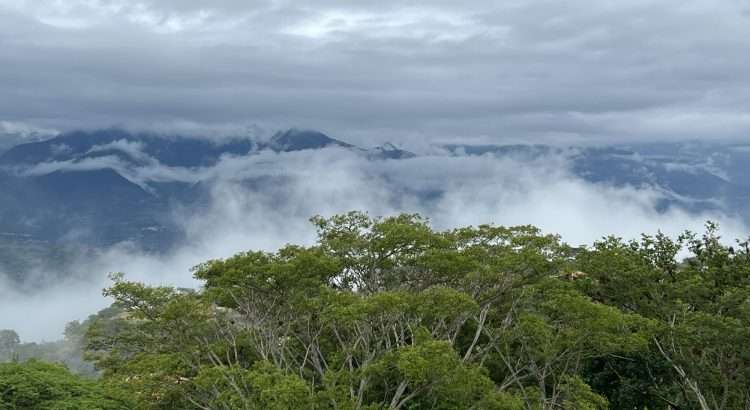
  8. The Effects on the Relationships with Traditionally Friendly Countries
  9. Is This the End of the U.S. Empire?
  10. The Consequences of Growing Economic Inequality in the U.S.: Scenarios and Historical Parallels
  11. The Billionaire Oligarchy Scenario: How the U.S. Becomes a Corporate Feudal State
  12. Why Do Trump, Musk, and the People Behind Project 2025 Want This to Happen?
  13. What May Happen to Ordinary Citizens in Trump’s America?
  14. Is Any of This Surprising? Didn’t Voters Know This Would Happen?
  15. Best-Case vs. Most Likely Scenario for the U.S. Moving Forward
  16. Global Consequences of the U.S. Becoming a Billionaire Oligarchy
  17. How Accurate Is This Analysis? How Biased Is It?

How Trump’s Actions Align with Project 2025 and What to Expect Next

As of February 16, 2025, President Donald Trump’s actions have closely aligned with the conservative policy blueprint known as Project 2025, despite his previous campaign disavowal of the plan. In his initial days in office, Trump issued a series of executive orders, with analyses indicating that nearly two-thirds mirror or partially mirror proposals from Project 2025. Time

Alignment with Project 2025:

  • Federal Workforce Overhaul: Trump established the Department of Government Efficiency (DOGE), led by Elon Musk, aiming to reduce government waste and streamline operations. This initiative reflects Project 2025’s goal to restructure the federal workforce and eliminate perceived inefficiencies. New York Post
  • Energy Policies: The creation of the National Energy Dominance Council and actions to boost oil and gas production align with Project 2025’s emphasis on achieving energy independence through deregulation and increased domestic energy production. AP News
  • Education and Social Policies: Trump’s executive order to cut off federal funding for educational institutions enforcing COVID-19 vaccine mandates, along with efforts to dismantle diversity, equity, and inclusion (DEI) programs, correspond with Project 2025’s recommendations to limit federal involvement in education and social policies. The Guardian

Exceeding Project 2025:

In some areas, Trump’s actions have gone beyond the original recommendations of Project 2025:

  • Foreign Aid Reduction: The administration has moved to dismantle the U.S. Agency for International Development (USAID), a step more drastic than those proposed in Project 2025. Reuters
  • Civil Service Restructuring: Mass firings of federal employees and the implementation of loyalty tests represent a more aggressive approach than outlined in Project 2025, aiming to reshape the civil service fundamentally. The Atlantic

Projected Trajectory:

If President Trump continues on this trajectory, we can anticipate several developments in the coming months and years:

  • Consolidation of Executive Power: Ongoing efforts to centralize authority within the executive branch may lead to significant shifts in the balance of power among federal institutions.
  • Judicial Appointments: Expect a continued focus on appointing judges who align with the administration’s ideology, potentially influencing the judiciary’s independence and decisions on key issues.
  • Policy Implementation Challenges: The administration is likely to face legal challenges and pushback from various sectors, including civil rights groups, environmental organizations, and international allies, in response to its aggressive policy changes.

These anticipated actions suggest a transformative period in U.S. governance, with potential long-term implications for domestic policies and international relations.

Trump’s Rapid Policy Moves Stir Controversy

Read More

Dream: I sense the distress of large numbers of people impacted by Trump’s policies

I sense the suffering of large numbers of people impacted by Trump’s policies. Thousands if not millions of people. I see them, hear their voices, sense their distress. I hear voices say “DEI hires”.

The sensing here is the same as when I sense the system of others during healing, whether it’s my natural form of healing or more structured through Vortex Healing.

For all I know, this experience may be a combination of actual sensing and a dream.

COMPENSATION

As I woke up, the first that came to mind is that this dream is a compensation for the insensitivity and cruelty of Trump and the ones supporting his policies.

They seem to lack empathy, so I find it here. It becomes more important for me.

My mind brought me this dream to find a deeper and more visceral empathy, to compensate for the lack of empathy among some others – especially the ones creating, implementing, and supporting Trump’s policies.

EMPATHY FOR TRUMP AND HIS SUPPORTERS

For me, it’s also a reminder of finding the same empathy and understanding with Trump and his supporters. Hurt people hurt people. It’s trauma behavior. They are traumatized, and they deal with it by traumatizing others.

I will speak up about what I see, and would be actively engaged in stopping it if I still lived in the US, and I can also have understanding and empathy for the ones supporting these policies of cruelty.

These two – empathy and engagement – go hand in hand, they mutually support each other. Empathy guides views and actions, and engagement is empathy in action.

FINDING IT ALL IN MYSELF

And it’s a reminder to find it all in myself. I am the ones in distress. I am the one acting without empathy and in cruel ways. In other words, I have distressed parts in me. And I have parts without empathy acting in cruel ways.

What are examples of when I acted in ways that was experienced as cruel by others?

How am I doing it with Trump supporters now? It’s easy to imagine that the way I sometimes see them – as cruel, without empathy, and supporting the transition to a fascist regime – can be experienced as harsh and cruel by some of them. It’s not how they see themselves.

It’s not how they all are, it’s not all of what they are, and if they have that side to them, it comes from traumas and it’s trauma behavior. It comes from living in and being impacted and shaped by a domination culture.

How are parts of me cruel with me? I am cruel with myself when I go into catastrophic images about the future. I am cruel with myself when I exaggerate – to myself or others – challenging situations. I am cruel with myself if I accept situations that seem unjust, that creates more problems for me, and that can be fixed if I speak and stand up for myself.

Really, I am cruel with myself anytime I hold a thought as true and pretend it’s true.

I am cruel anytime I allow myself to get caught up in, or caught up in reactivity to, wounds in me as if what they are telling me is true.

Read More

Precious rest days

There is hardly a religious bone in me, but I respect Sundays as a day of rest.

Why? Because it feels right and nourishing and makes a lot of sense.

I crave days where I don’t have anything scheduled and where I can say “No, not on that day, I keep that day free”. So I try to make sure to include one of those each week, and Sundays are a natural choice in my culture.

I love that the stores here in Norway are closed on Sundays. Our society is perhaps not completely about doing and consumption. There is still one day of the week when we collectively value and prioritize something else – rest, family and friends, nature, pleasurable activities.

It’s also a quiet day since everything is closed, which I appreciate. I don’t have to consider whether I should go to the store or not. The choice is already made, which I love.