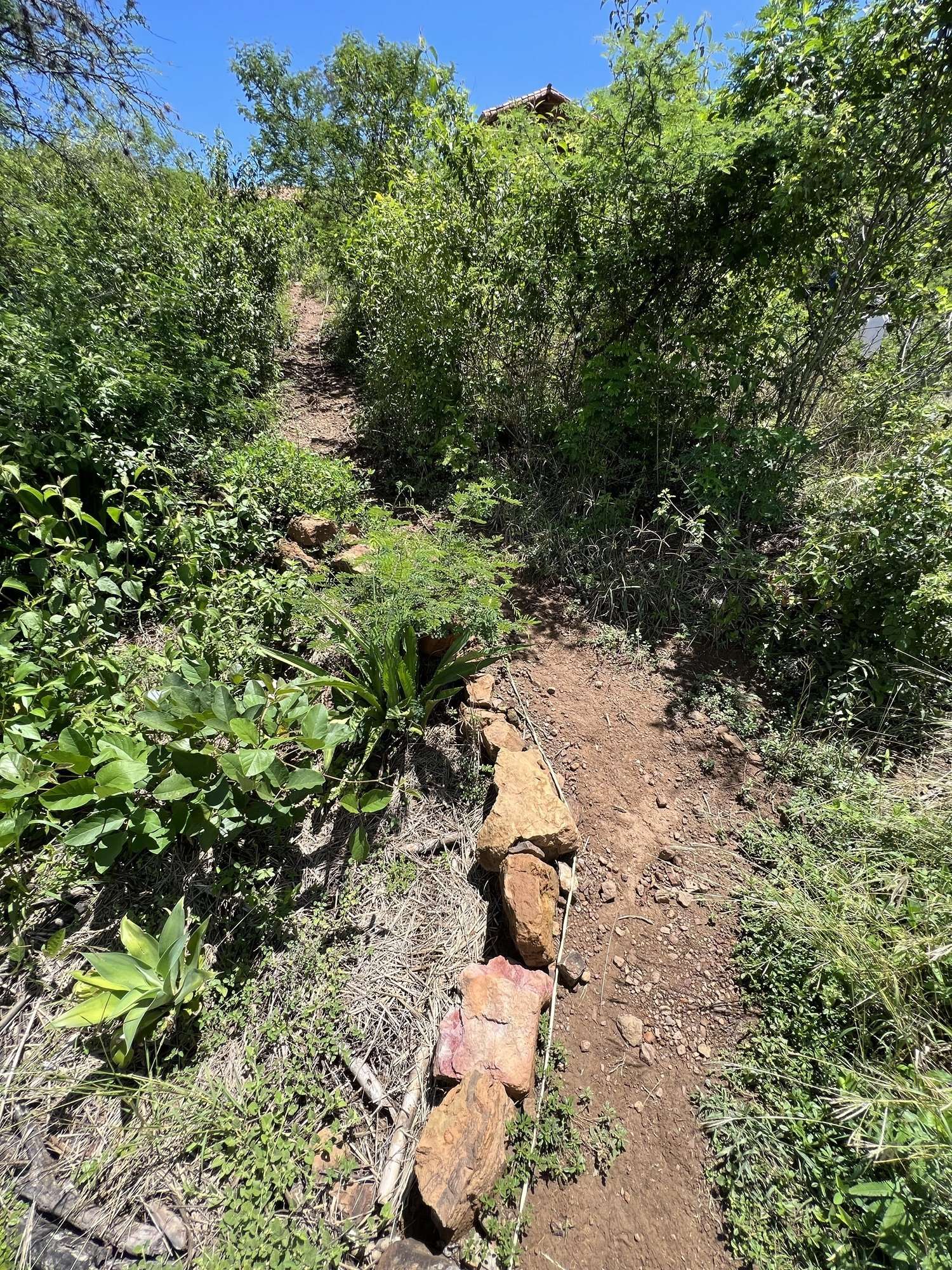
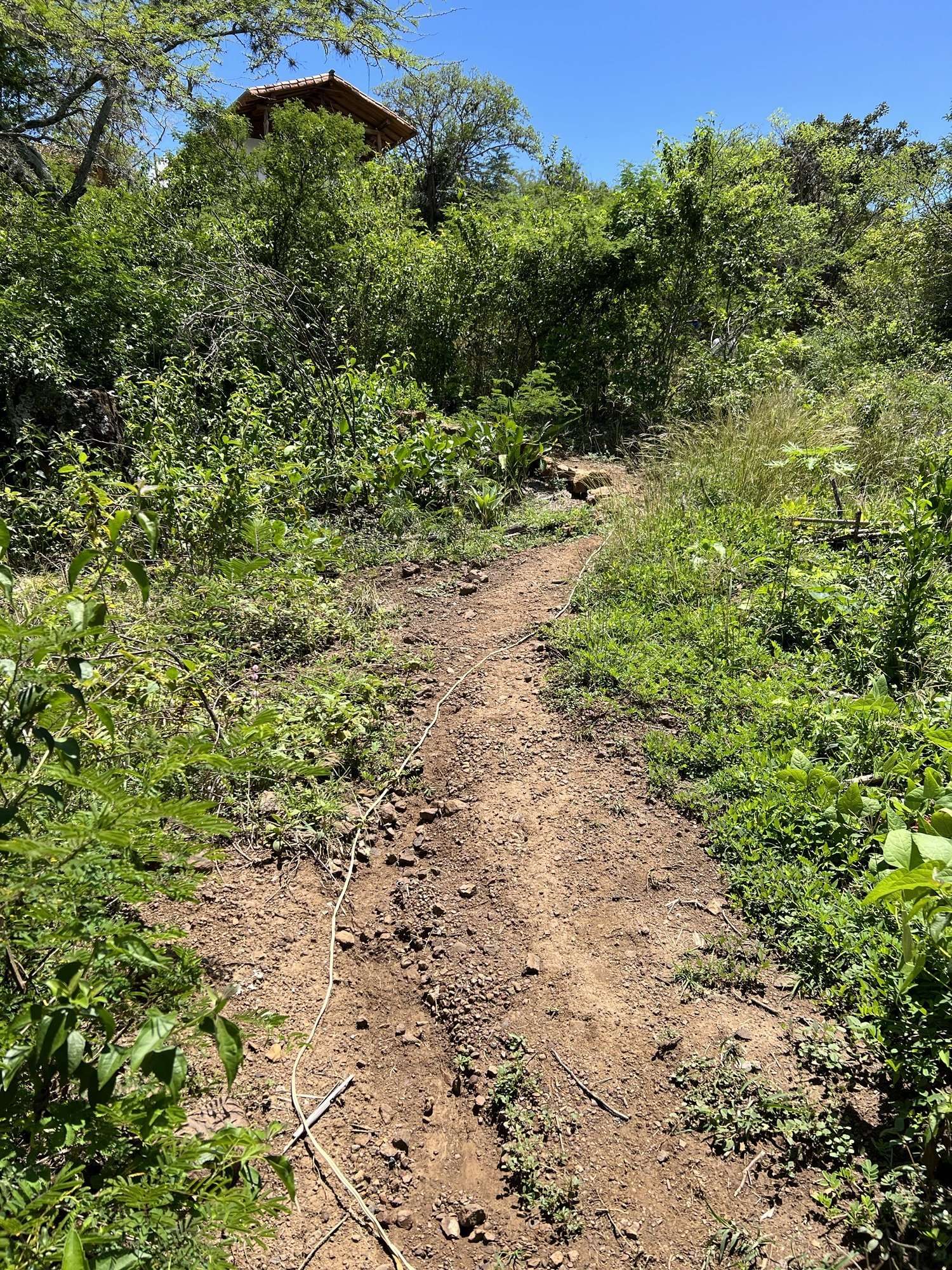
Milagros is relatively hilly, and we have a slope between the two houses.
The images above are of the existing path which just follows the path rainwater naturally takes down the hill.
That’s not a workable solution in the long run so we want to make a better path.
THE PROBLEMS WITH FOLLOWING THE PATH OF THE RAINWATER
If we made it in the same location, we would perpetuate at least two problems:
(a) The water collects at the bottom of the hill instead of draining into the soil where it falls. In itself, it’s not necessarily a problem but we prefer to let it drain into the soil where it falls since we are growing a food forest there.
(b) It will lead to continued erosion. The rainwater will continue to erode the same path as it has for a while now. It removes valuable soil from where we need it and deposits it where we don’t need it. If it’s a stone path, the water will remove the soil holding the stones in place.
SWITCHBACK PATH + IMPROVED RAINWATER ABSORPTION
So what’s the solution?
The main solution is to make a serpentine or switchback path. A path that does not follow the natural path of the rainwater when it runs down the hill.
In addition, we can do several things to improve rainwater absorption.
We already have swales and terraces on that hill and will create more. These retain and slow down the rainwater, giving it more time to drain into the soil. Terraces also give us flat sections for the path.
We are adding mulch which also slows down the rainwater, in addition to keeping the moisture in the soil.
We are adding organic matter to the soil, improving its porosity and ability to absorb rainwater.
We may channel the rainwater away from the path and into swales with channels and miniature stone dams.
We will plant and encourage vegetation between and near the stones in the path to reduce erosion. Native ground cover plants would be ideal and we already have these here around the house.
With terraces, improved rainwater absorption, and a serpentine path, we may not need many vertical steps, and a path that’s similar to the old traditional roads in the area – camino real – may work well. They are a combination of soil and stones.
THINKING OUT LOUD AND RECORDING INFO
Why am I writing on these topics?
It’s mainly to record the progress of our regeneration project, and even something as apparently simple as a path on a hillside is an integral part of that project. We want to do it in a way that works well for us and the nature here.
It’s also to think out loud and record info. It helps me think it through and remember, and I also have the opportunity to add updates.
It’s also possible that some of this can be of help to others, although use it as a starting point. Do your own investigation and find what works best for your project and with your goals and priorities. I am by no means an expert on any of this.
MORE INFO
I asked ChatGPT 4o for some input on these themes. It didn’t really give a lot of additional info but I’ll include it here anyway.
Creating a Stone Path on a Slope: Preventing Erosion and Enhancing Water Absorption
To create a stone path on a slope that prevents erosion and absorbs water into the ground, you can use a combination of natural methods and design strategies to enhance the landscape’s resilience and water retention. Here’s an approach that incorporates those principles:
1. Switchback Path Design
- Purpose: Reduces the gradient of the slope to slow down water flow and minimize erosion.
- Execution: Design the path to zigzag across the slope in a series of gentle curves. This reduces the direct steepness, which helps disperse and slow down water. Keep the slope of each segment no more than 5-8% for ease of walking and effective water management.
2. Swales
- Purpose: Capture rainwater and allow it to soak into the ground.
- Execution: Dig shallow trenches, known as swales, along the uphill side of the path to intercept and collect rainwater. These swales will help direct water away from the path while allowing it to seep slowly into the soil, preventing runoff and erosion. For added effectiveness, line the swales with gravel or plant them with grasses that tolerate moisture.
3. Terracing and Gentle Steps
- Purpose: Slows down water flow and creates small retention areas.
- Execution: Build terraces or gentle stone steps into the slope, especially in steeper areas. These steps not only provide easy walking access but also serve to slow down rainwater, giving it time to be absorbed into the ground. The terraces can be lined with stones to stabilize the soil and define the pathway.
4. Stone Path with Gaps for Water Absorption
- Purpose: Encourage water infiltration and prevent runoff.
- Execution: Use large stepping stones spaced slightly apart, allowing water to pass between them. Fill the gaps with gravel, sand, or low-growing vegetation, which permits rainwater to soak into the ground instead of running down the path. This method also maintains a natural look while improving drainage.
5. Mulching
- Purpose: Retain moisture and prevent surface erosion.
- Execution: Apply mulch (such as wood chips, straw, or leaf litter) along the edges of the path and on any exposed soil. Mulch helps retain moisture, prevents soil erosion, and improves soil structure as it decomposes. In wetter areas, mulch can also help absorb excess water.
6. Ground Cover and Native Vegetation
- Purpose: Stabilize the soil and enhance water absorption.
- Execution: Plant ground covers, native grasses, or drought-tolerant shrubs along the path and between switchbacks. The roots of these plants will help hold the soil in place, reducing erosion, while also absorbing rainwater. Native plants are particularly effective because they are adapted to the local climate and require minimal maintenance.
7. Soil Improvement
- Purpose: Improve the soil’s ability to retain water and resist erosion.
- Execution: Over time, improve the soil along the slope by adding organic matter such as compost or leaf litter. Healthier soil with more organic matter will absorb and retain more water, reducing runoff. This will also provide nutrients to the surrounding vegetation, further stabilizing the slope.
8. Stone Check Dams and Water Breaks
- Purpose: Slow down water and encourage it to soak into the soil.
- Execution: Place small stone check dams or water breaks at intervals along the path, particularly in steeper sections. These features can be built with stones or logs and are designed to interrupt the flow of water, slowing it down and giving it time to infiltrate the soil. These breaks also help protect the path from erosion during heavy rain.
9. Rainwater Harvesting Features
- Purpose: Capture and use excess rainwater for beneficial purposes.
- Execution: Install small retention basins or shallow rain gardens at the lowest points of the slope or alongside the path. These basins can collect excess water from swales and terraces, allowing it to slowly soak into the ground or be directed to areas where it’s needed. Additionally, the retained water can be used to irrigate nearby vegetation.
By combining these approaches, you create a path that blends seamlessly into the landscape while effectively managing water flow, reducing erosion, and enhancing the surrounding ecosystem.