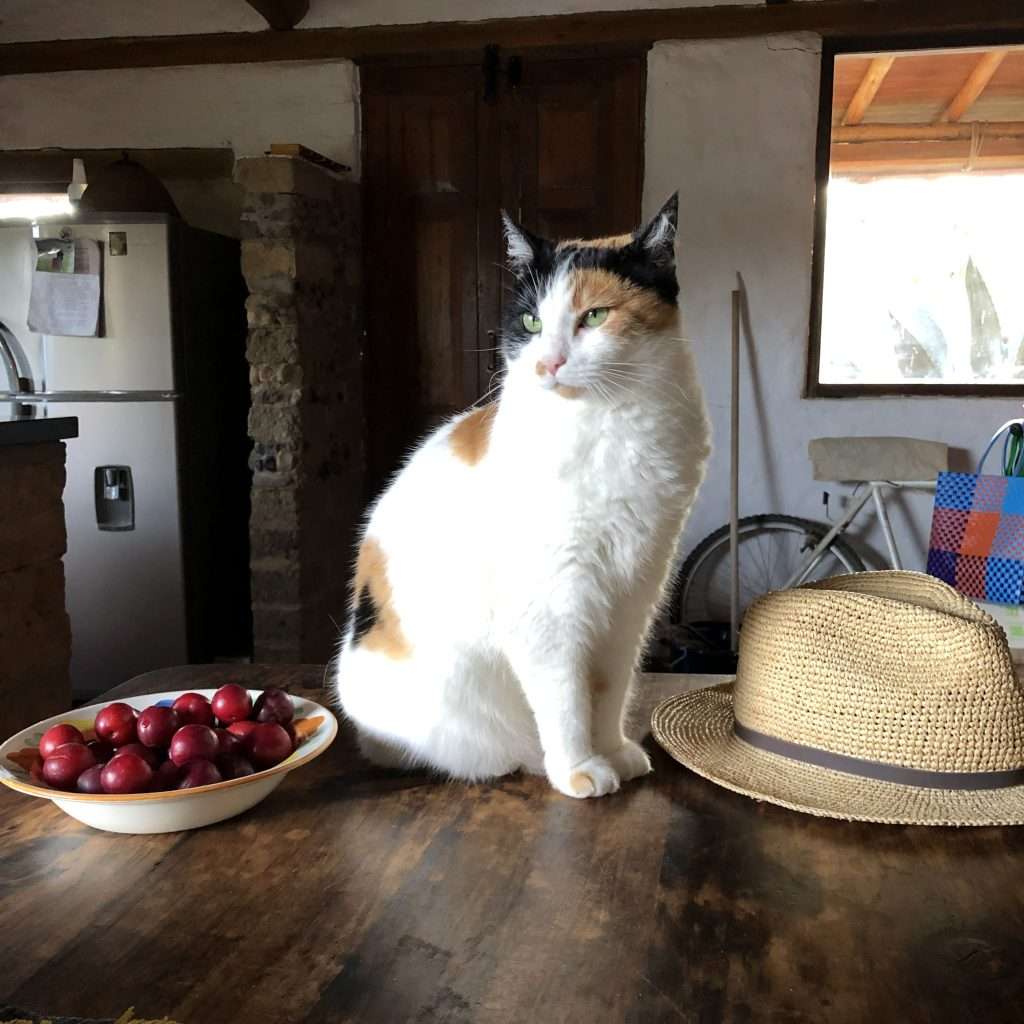
A dark and stormy night a while ago, someone put Mila in a bag in front of our house. She was less than one month old, malnourished and sick, and they must have thought she would have a better life with us. She is now a very healthy five-month-old.
MILA’S MISMATCH
Like other dogs, she wants to play, socialize, and learn, as she would naturally in nature with others of her own kind.
All her behavior is natural, understandable, and healthy, and it’s sometimes a mismatch with the environment she is growing up in.
We live in a house. We are humans, and there are no other dogs here. So she steals and runs away with things and wants us to chase her, wakes us up early, wants to chew on our arms and legs and play rough, chews on crunchy things she finds (including furniture and crafts), and doesn’t always want to eat the food we prepare for her.
When we take her to town to play with her good friend, we get to see her more natural behavior. We get to see what she wants from us. They run around, chew on and lick each other, chase each other, play rough, sleep next to each other, and so on.
We understand that her behavior is natural and try to help her as much as we can. We let her run freely in the area around the house during the day. Play with toys and ropes. Sometimes chase her. Let her sleep next to us in the mornings. Take her to town several times a week to play with her friend.
She also seems to understand us a little better. She is surprisingly responsive at times. Allow us to sleep quietly in the morning and come when we are awake. And generally seems more mature.
We are all adapting to this mismatch, as best we can.
THE MISMATCH BETWEEN LIVING SYSTEMS AND OUR CIVILIZATION
This points to a larger mismatch between the living systems of this planet and our global human civilization.
Wildlife lose their habitat because of our civilization. They lose their food. They are impacted by pesticides and toxins. They get disoriented by light and noise pollution. And so on.
The same is happening with whole ecosystems. They too deal with a mismatch between how they evolved to operate, and the conditions they now find themselves in due to our global civilization. They get fragmented, are made into plantations and monocultures, lose vital species, have to deal with toxins, and more.
This impacts the whole web of life that we are part of and depend on.
OUR MISMATCH
We also live with this mismatch.
We have domesticated ourselves and live in an environment that’s very different from that which our ancestors lived in and adapted to, and which we too are biologically and psychologically prepared to be born into.
Through evolution, we are born ready for one world, the one innumerable generations of our ancestors lived in. Through the evolution of culture and civilization, we find ourselves in another.
SOME EXAMPLES
What are some examples of this mismatch?
For Mila…
She plays to learn about the world, interactions, and herself, and to learn to fight and defend herself. That’s why she jumps and wants to play rough sometimes and be chased. If she doesn’t get to spend her energy in the way that’s natural for her, which is to play with others of her own kind, she gets frustrated, and the chewing, stealing, and so on intensify.
Her teeth are growing, her gums are likely sore and itchy, and one of the ways she learns about the world is through her mouth. That’s why she likes to chew on everything and to chew crunchy or soft things to pieces.
She much prefers meat and healthy natural food, not the high-quality pellets the veterinarian initially recommended and we mixed with the meat and vegetables. That’s understandable too. She is programmed to want fresh real food, not processed food, and it’s an example of how she is wiser than us. (Update: We have now switched to all natural whole foods that we cook ourselves, and she is very happy.)
When one or both of us leaves, and she is trapped inside the house or garden or on a leash, she gets distressed. She is meant to live in a pack, and if the pack leaves her, it means she has lost her support and can die. It’s very distressing to her for a good reason.
She is meant to run freely. Instead, she is inside of a house at night, and inside of a fenced area during the day. If we take her out, she is on a leash. It’s very restrictive and must be frustrating for her.
When I work in the garden, and especially when I make holes in the ground for whatever reason, she gets very interested and wants to help and do the same. When other dogs make holes in the ground, it’s usually because they are interested in finding food, and it makes complete sense for her to join. When we do it, it’s often for planting seeds or seedlings, so it’s less helpful.
When we eat, she wants some of our food. Again, that’s completely natural and healthy. She is meant to live with other dogs, and they do share food to some extent, voluntarily or involuntarily. We don’t give her any since we don’t want to encourage that behavior.
She is meant, from the side of nature and genetics, to live with other dogs and run free in nature. Instead, she is without her own kind (apart from when we take her to see them) and she lives with weird primates who live in houses with things that are precious to them and have created a weird civilization out of their imagination and live in that civilization.
For wildlife…
I already gave some examples above. See towards the end of this article for more examples.
For us…
Sugary foods were a rarity for most of our ancestors. Mostly fruits – full of vitamins and energy – have it naturally. (And to a far lower degree than modern cultivated fruits.) Those of our ancestors that sought our and ate sugary foods were more likely to survive, and they passed on that impulse to their descendants and us. That’s why we are drawn to sugary foods. These days, that biological impulse has been hijacked by the food industry. They intentionally put sugars in a wide range of foods just to get us hooked so they can sell more of their products. Even the fruits available today have a very high sugar content. And that leads to all kinds of familiar problems including blood sugar fluctuations, obesity, and malnutrition since this kind of food can take the place of more nutrient-dense foods.
We are nature, and our ancestors lived in nature. That’s why most of us love nature – the breeze, sun, the sound of the rain, a fireplace, lush vegetation, beautiful natural landscapes, and so on. It’s stimulating and refreshing and makes us feel more alive. Living inside houses and apartments, in cities, and with outdoor areas covered in asfalt and grass monocultures with a few trees, is empty for the more primal side of us. It makes us disconnected from our own nature, from the nature we are.
Our ancestors were physically active during most of the day. They would walk, collect food, build a fire (our more recent ancestors), and so on. Most of the time, they moved. These days, we sit still a lot, drive in cars, have washing machines and vacuum cleaners, and so on. We seem to seek out ways to move as little as possible. That too comes with a lot of familiar problems.
Since our ancestors needed to move a lot, and often had limited food, it was important for them to rest as much as possible. That’s why we are wired to seek out rest as well, and that’s likely a big part of the reason we have created a civilization aimed at moving as little as possible. (And why we find ourselves in the bizarre situation of going to the gym.)
Our ancestors, as all mammals, would likely shake to release stress. It’s built into us and is an amazing way to release stress, tension and trauma, restore our system to balance, and find resilience. At some point, we didn’t understand this anymore and decided that shaking, quivering, and tremoring was a sign of weakness or of being “out of control”, so we created shoulds and shame around it. That has removed us from one of the most wonderful gifts of our bodies and from this particular wisdom of the body.
Our ancestors would freely experience a range of emotions, and each one had – and has – a survival function. Anger has energy in it to make changes in the situation. Joy tells us what we want more of. Sadness helps us release habitat patterns in us related to a person or a situation no longer here. And so on. These days, we are taught about “good” and “bad” emotions and that we shouldn’t experience or express some of them. That means that the natural flow of emotions stagnates which can lead to any number of things, including pent-up emotions (that burst out), chronic tension and stress, addiction behaviors, depression, and a general lack of aliveness and resilience.
Our ancestors lived more with the seasons. They would, by necessity, eat seasonally. Their life would be different depending on the seasons. If they lived in a temperate climate, they would likely be far more active during the warm time of year, and rest more during the cold periods.
Our ancestors lived more with the daylight. They got up at dawn, were active for a while, likely took a nap – especially on a hot afternoon, and slowed down and went to bed shortly after sunset. That also means they likely would be awake and up at some point during the night. It’s quite possible that humans naturally have multi-phasic sleep.
Right now, it’s 5 am and I have been up for a couple of hours. I’ll likely take a nap before getting up again for breakfast. I may take a nap early afternoon. And I’ll go to bed early, sometime between 7 and 9 pm. That feels natural to me. It feels good.
Our ancestors had meaningful practical activities. They collected food. Found, built, or maintained shelter. Started or maintained a fire. Prepared food from scratch. Took care of children. Made or repaired clothes. All of these activities clearly made sense. These days, a lot of our activities – especially at work – make less sense. There is more of a sense of disconnect.
Our ancestors didn’t follow a schedule. They followed the seasons, sunlight, and whatever tasks life presented, but they didn’t follow a clock or the weekdays. It was all more organic and tied to natural cycles.
Our ancestors lived in small groups with people of all ages. They knew everyone intimately. They could trust and depend on each other. They knew they had support when they needed it. They divided the tasks between them according to skills, interests, and abilities.
Our ancestors received information and news from their own group, and perhaps a few neighboring groups. These days, we receive news – often heavily weighted towards disasters – from the whole world.
Our ancestors learned from each other, and they learned by doing. These days, we put children in schools with a large number of other kids their same age (bad idea), and it’s all far more disconnected from life. It’s difficult to understand what purpose it has to learn these things. Most of it is not practical. It’s coercive. Schools tend to snuff out the natural passion for learning that children have.
Our ancestors were intimately familiar with their natural environment. They knew it from daily life and experiences, and they learned about it from their elders. We are often far more disconnected from our natural environment. What we know is civilization – our house or apartment, a small garden, screens, cars, the workplace, and so on.
Our ancestors saw themselves as nature. We tend to see ourselves as separate from nature. Nature is out there somewhere, often in the form of manicured lawns or parks or small segments of plantation forest. We are something different. Or, at least, we imagine we are. We cut ourselves off from ourselves as nature.
Our ancestors likely saw the sacred everywhere. It made sense to them to have a reverent relationship to nature, and all is nature. We tend to see the sacred “out there” in the sky, or a sky god, or in the afterlife, or nowhere at all.
HOW CAN WE REDUCE THIS MISMATCH?
How can we reduce this mismatch? I’ll focus on us humans here. See other articles for how to reduce the mismatch for wildlife and ecosystems. See also more info at the end of this post for info on how to reduce the mismatch for dogs, wildlife, and ecosystems.
What can we humans do to reduce the mismatch for ourselves?
(a) We can’t change our biology.
Even if we could, it wouldn’t make sense. The practical wisdom in our biology goes far beyond the wisdom of conscious thought.
Thoughts cannot begin to touch the immensely complex wisdom embedded in our biology.
(b) We can change how we live our life and the worldview we live from.
What am I doing to explore this?
If I notice an internalized should or stressful thought, I take a closer look. Where does it come from? Does it make sense? What makes more sense to me? How is it to live from that?
I notice and inquire into stressful thoughts and identities. Many come from culture and civilization, and it’s helpful to recognize them and find what’s genuinely more true for me and see how it is to live from it.
I am aware of the domination mindset that became prominent with the agricultural revolution. I look for the ideologies that come with it, how they play out in our culture today, and how I inevitably have internalized these. This makes it easier to relate to them more intentionally and choose something that’s more partnership-oriented.
I explore how to live from more life-centered and partnership-oriented worldviews, including the Universe Story, Epic of Evolution, Deep Ecology, systems views, integral models, and so on.
I invite and allow my body to shake to release tension, stress, and trauma. (Tension and Trauma Release Exercises / TRE.) This brings me in contact with the wisdom of my bodymind from long before civilization. It brings more resilience.
I do other practices as well, including heart-centered practices (tonglen, ho’o), body-centered practices (Breema, tai chi, qigong), basic meditation (notice what’s here is already allowed and notices), and so on. This helps bring me more in contact with the natural wisdom of my system.
I spend time in nature. I notice myself as nature. I eat local and organic and low on the food chain, as much as possible.
I follow my natural sleep cycles as much as possible, including going to bed around sunset and waking up around sunrise (depending on the latitude and season).
I limit and curate my news and media diet and only receive news through reading. (Mostly, I read NRK, BBC, The Guardian, NPR, and a few other sources.)
I follow my inner guidance and knowing as much as possible, including in small everyday situations and choices. (I say to myself: I can do it if I want, and I want, and notice how my body responds. Then I say: I can do it if I want, and I don’t want, and notice how my body responds. I chose the one that feels like a relief and gives peace.)
I am fortunate enough to live in a small house in nature, and am developing a food forest and am involved in the reforestation of this land. We live close to a small village with an international community of people engaged in similar work, and there is family here.
Read More