Outline of a Holistic Worldview: Ecospirituality, Sustainability, Ecopsychology & Deep Ecology (1997)

This was originally written in 1997 and published on my first website. I retrieved it from the archived site on the Internet Archive. The original wording, spelling, and punctuation are preserved. The only changes are the merging of the original linked pages into one article and the addition of heading structure for navigation.

Ecopsychology, Ecospirituality, Deep Ecology, and Health is a shorter companion piece from the same year.

A BRIEF NOTE

It’s interesting to look at these articles now. I remember my enthusiasm at the time, my wish to continue writing about these things, and maybe eventually teach at a college or university. That did not happen, partly because of going against my clear inner guidance that same year (going to Wisconsin and abandoning just about everything important in my life) and partly because of my health.

I also see an interesting dynamic. After the oneness shift, my mental aspect tried to make sense of it. It sought out worldviews that matched the immediate noticing of oneness and all as a seamless whole. That’s mainly what these articles are about – making sense of oneness. Re-educating the mental field so it is on board with what’s noticed in immediacy.

These days, that’s less of an interest. Maybe those years did the trick, at least enough for now.

Welcome

Welcome to this outline of a holistic worldview.

Feel free to read this collection of thoughts and text fragments in a non-linear fashion. Each fragment should to some degree reflect the whole of the worldview they are born from, and at the same time flesh out and give substance to a part of this whole.

Note that this is only one of an endless number of possible and equally valid and useful worldviews – each fitting nicely in with one or more of the multitude of possible world experiences. It does not reflect any “absolute truth”.

Feel free to let it inspire and challenge to own reflection.

Introduction

This Text

This “Outline of a Holistic Worldview” is a collection of texts meant to be for inspiration and challenge. We all need challenges to our habitual ways of experiencing our world – to stay flexible, open to new experiences, and open to new and more appropiate ways of organizing our experiences. This is one contribution in that direction.

These texts are by no means representative for all ecospiritual views, and barely so for a minority of them. If there is anything here that seems to be of value, it can be attributed to the wisdom of the universe being expressed through people I have shamelessly stolen from. It can also be attributed to direct experiences of the Universe – as it has arisen within and without of myself. All that is obscure, loopsided, muddled and not grounded, can be attributed to my own obscurations.

As diversity appears to be of immense value both in ecological and social systems, I do sincerely not wish these views to be adopted by all or even a majority. What I do hope is that it will inspire each one that take time to read some of this to reflection, to modification and formation of own views. Even, or maybe especially, if they are very different from those expressed here.

A Note

Please note that some texts are written from a traditional human perspective, and some from the so far more unusual perspective of the larger whole. Some are written in two versions, giving examples of both perspectives.

This will hopefully give a feel for the difference between the two, and a sense of the value of them both.

The content is often the same, but the perspective, and thus the experience of its meaning, differ.

This Perspective

The perspective outlined above is only one of an endless variety of possible world views, models or maps of existence.

As any other map, it is wrong.

It is based on an incomplete experience of the world, and in addition is an incomplete reflection of this experience. The world is always more and different from our experiences and maps of it.

At best, this perspective can be a guide for how to perceive and act in the world. It can be an aid of preliminary value until new experiences and new situations demands a different map, more appropriate for the new situation.

Read More

Natural resources belong to “everyone” – all humans or all life?

I listened to a video where an economist was references who saw natural resources as belonging to everyone.

I completely agree. Except, typical of the eccentricities of this civilization, the economist referred to only humans when he said “everyone”.

Natural resources belong to everyone – to all of life.

Natural resources belong to this living seamless system we are all local and temporary expressions of.

They are created by and for this dynamic web of life.

Again, typical of this civilization, some may see this as naive or idealistic. What’s naive and idealistic is to see human as separate from this system, and natural resources primarily for human use. That’s short sighted, out of alignment with ecological realities, and ultimately ecocidal and suicidal.

How do we create a system that not only acknowledges that natural resources belong to all life, but protects them for the benefit of all life?

Here is a start: Protect the interests of non-human life, of the wider web of life, in law. Appoint advocates for this wider web of life. Make it enforceable and enforced.

Read More

My nature noticing itself, and finding views that match

In my teens and for a couple of decades, I was passionate about systems views, holarchies, integral models, Taoism, Buddhism, Christian mysticism, and so on.

Why? Because these views matched my experience. They fit what was revealed in the oneness shift when I was sixteen.

ONENESS SHIFT

The consciousness I am woke up to itself. It happened on a winter day when this human self was walking along the gravel road to our house, looking up at the starry sky and with a big wind going through it all.

To myself, I am consciousness, and the world as it appears to me happens within and as the consciousness I am. This consciousness, and the experience of the world, is what mystics across cultures and through time have described, often cloathed in the language of their culture, time, and tradition.

The consciousness I am is one, it’s a seamless whole. The experience of time and space happens within it, any ideas of boundaries happen within it. And so on.

WORLDVIEWS

So it makes sense that I explored worldviews and approaches that, as much as possible, match this oneness I find myself as.

First, it was systems views through Fritjof Capra’s The Turning Point, and I also loved Taoism. Later, I explored Buddhism since that’s what I could find, and I also explored the Christian mystics and mystics from anywhere and any time.

I find that my worldviews mirror me, and really ANY worldview is a mirror for me. I can find what it points to here. It seems that any story from within any worldview is something I can turn around to apply to myself and find examples of how it’s true.

In my case, the worldviews I resonate with clearly mirror me. They mirror the oneness I find myself as, although they are all quite imperfect as well. They are the beginnings of worldviews that far better can reflect oneness and the immense simplicity and complexity of oneness.

WE ARE INEVITABLY CONSCIOUSNESS

When the shift first happened, my human self interpreted it in terms of God. All of existence without exception was revealed as consciousness, Spirit, God, and so on. The nature of all is consciousness and God. God seems to want to explore itself in as many different ways as possible, and one of those ways is by temporarily and locally taking the form of this human self, and even – for a while – taking itself to fundamentally be this human self.

These days, I like to explore (what I think of as) the small view on awakening which essentially says the same but frames it slightly differently.

Here are some points:

(I) No matter what, to ourselves we inevitably are consciousness. No matter what we fundamentally are from some outside third-person worldview, we have to be consciousness to ourselves. Consciousness is not some kind of appendix or add-on in our own first-person experience.

(II) We can find ourselves as consciousness. We can most easily find it through pointers and guided looking, for instance through the Big Mind process or the Headless experiments.

(III) The world, as it appears to us, happens within and as the consciousness we are. That too is inevitable. The world, to us, is consciousness, whether we notice or not.

(IV) I can’t say anything for certain about the nature of all of existence. I can say something about my own nature, as it appears to me, but I don’t know if the nature of all of existence is the same as my nature. It has to appear that way since it, to me, happens within and as the consciousness I am. but I don’t know for certain. This opens for compatibility with a range of worldviews from materialism to seeing the whole of existence as consciousness, Spirit, and God.

(V) The big view of awakening is certainly also possible. The nature of all of existence may well be the same as my nature, it may all be consciousness taking what we experience as material forms.

(VI) The small and big views on awakening are complementary. They are compatible, fill each other in, and I like to find fluidity between the views. The small is honest, sober, and compatible with a range of worldviews including materialism. The big is inspiring, fits the language of spirituality and mystics, and is – if I am honest – more likely to be accurate in the big picture.

A deep partnership approach: Valuing partnership and domination cultures and making use of what works

I have written about the partnership versus the domination approach, and there is a deeper form of partnership orientation that I thought I would highlight here. I’ll do it in the context of growing food since we are developing our own food forest these days and it helps ground the abstractions in something practical.

A PARTNERSHIP APPROACH TO FOOD GROWING

A partnership approach seeks to work in partnership with nature.

We recognize ourselves as nature, and that what happens with nature happens to us.

We use methods informed by ecology and science. We mimic natural ecosystems.

We create polycultures and rely more on perennials. We seek to build healthy soil. We don’t rely on toxins or chemical fertilizers. We find a variety of income sources from our land.

We create a system that self-maintains and, over time, requires less input of resources and work. We work with systems that create more abundance over time. We work intentionally with the inherent intelligence , wisdom, and dynamics of ecosystems built into it through evolution.

We seek win-win solutions that benefit us, ecosystems, wildlife, and future generations.

If we have animals, we seek to give them a good and natural life as much as possible.

A DOMINATION APPROACH TO FOOD GROWING

A domination approach comes from a view of separation.

We see ourselves as separate from nature. We see nature primarily as a resource for us. We see nature as infinite in resources and capacity to absorb civilization’s waste. We emphasize a narrow view of productivity.

We use monocultures. We use toxins and chemical fertilizers. We see soil as primarily for holding the plants up. We emphasize annuals.

We have a system that requires a steady high input of resources. We often rely on one source of income.

We work against many of the processes of nature, and try to compensate for it by using pesticides, chemical fertilizers, and so on.

We use a zero-sum approach where what benefits us short term (food, money) is harmful for ecosystems, wildlife, and future generations.

If we have animals, they often live a life of suffering. They suffer for our narrow benefit.

ALWAYS SOME OF BOTH

There is always some of both.

Even if we generally use a partnership approach, there is some form of control and management. We plan, plant, regulate, manage, make interventions, harvest, and so on.

Even if we generally use a domination approach, we inevitably have to work in partnership with nature. Otherwise, it won’t work. We rely on and have to take into minimal consideration the dynamics of plants and nature.

A DEEPER FORM OF PARTNERSHIP

If our view of partnership is superficial and one-sided, we miss out on something essential. We are missing out on the partnership with the rest of our world, including the gold found in domination cultures.

In this case, we are missing out on the practices, technology, and insights that come from agricultural practices in our Western domination culture.

There is a deeper partnership approach. That is to find value in the whole spectrum and make pragmatic use of whatever works whether it comes from a domination culture or not.

This, of course, require discernment. Although it requires a bit more work than excluding it all, it works better, is more aligned with reality, and the rewards can be high.

VALUING THE POLARITY AND THE DYNAMICS WITHIN IT

It’s also worth noticing that putting different value judgments on each end of a polarity is common in domination cultures. It’s a way to create the appearances of separation and justify domination: Humans are better than animals. Men are better than women. Whites are better than others. Heterosexuals are better than LGBT+.

If we exclude the value of the domination culture and what comes out of it, we are doing the same. We are joining in with one of the less savory features of domination culture.

A deeper partnership approach is to find value in the polarity as a whole, the dynamics within in, and the roles it seems to play in the larger system.

That doesn’t mean to wholesale adopt what comes from domination culture. It just means to see the value in it, and make use of some of it whenever it makes sense.

VALUING DOMINATION CULTURE

With agriculture came an emphasis on domination culture, and with the domination culture came social hierarchies, kingdoms, elaborate religions, art, science, technology, and everything else that’s part of our civilization.

It’s easy for me to find value in this. I love much of the art, music, architecture, science, and technology that has come with this domination culture – the idea of separation and domination.

I love many of the insights that come with it – the Universe Story, the Epic of Evolution, systems views, integral models.

I love the struggle and dynamic between domination and partnership orientations. It’s a good story that goes as a thread through the recent millennia of human history.

I love identifying and finding alternatives to some of the more detrimental aspects of domination culture. There is an enjoyment there, even if I sometimes also feel frustrated, scared, angry, hopeless, and so on.

MAKING USE OF ELEMENTS FROM DOMINATION CULTURE

We can make use of elements from our modern domination culture within a partnership context.

What are some examples when it comes to growing food?

We can clearly benefit from the science and knowledge that comes out of our Western domination culture. We can benefit from the science of ecosystems, climate, water cycles, plant growth, interactions between plants, soil health and microbiome, and so on.

We can make use of modern testing of water quality, soil health, and so on.

We can use elements from modern agriculture, including drip irrigation, shade cloths (for instance, if the food forest is young), and more.

We can use plants developed for specific purposes, including vetiver which is a hardy non-invasive grass that helps prevent erosion (until other plants are better established).

We can make use of all the approaches developed within and as a response to modern agriculture, including regenerative agriculture, permaculture, syntropic, and agroforestry.

We live in a world created by our domination culture and make use of the internet for connection and information, shipping and transportation, cars, municipal water and electricity, and an endless amount of other things that makes our lives easier and more convenient. This makes it much easier to develop a food forest or other partnership oriented systems for growing food. (While also often being destructive to nature since it’s all part of a system that assumes infinite nature.)

We can make use of frameworks like systems views, integral models, and similar.

We can be inspired by the Universe Story and the Epic of Evolution which comes out of modern science.

EVOLUTION OF THIS LIVING PLANET AND UNIVERSE

This is all part of the evolution of this living planet and universe, and we are temporary and local expressions of this seamless system. Domination and partnership orientations are just two of the many ways that Earth, the Universe, and existence expresses, explores, and experiences itself.

Everything is fleeting so let’s make the most out of what’s here now. And what’s here now is the opportunity – for those of us so inclined – to be consciously aware of ourselves as expressions of these larger systems and a part of the larger creativity of these systems.

Our creativity is a local and temporary expression of the creativity of these larger systems – this living planet, this universe, existence.

We can chose to become conscious participants in this creativity, in the self-exploration of existence, and in working towards a future with an ecologically sound civilization.

If we are able to create that, it will be a stepping stone to things we can’t even imagine.

NOTES

I am aware of the Spiral Dynamics model as I write this, and often like to start at lower levels and move up. In this case, I ended with a bigger-picture view of it all. See below for an AI analysis of the different parts of this text in a Spiral Dynamics context.

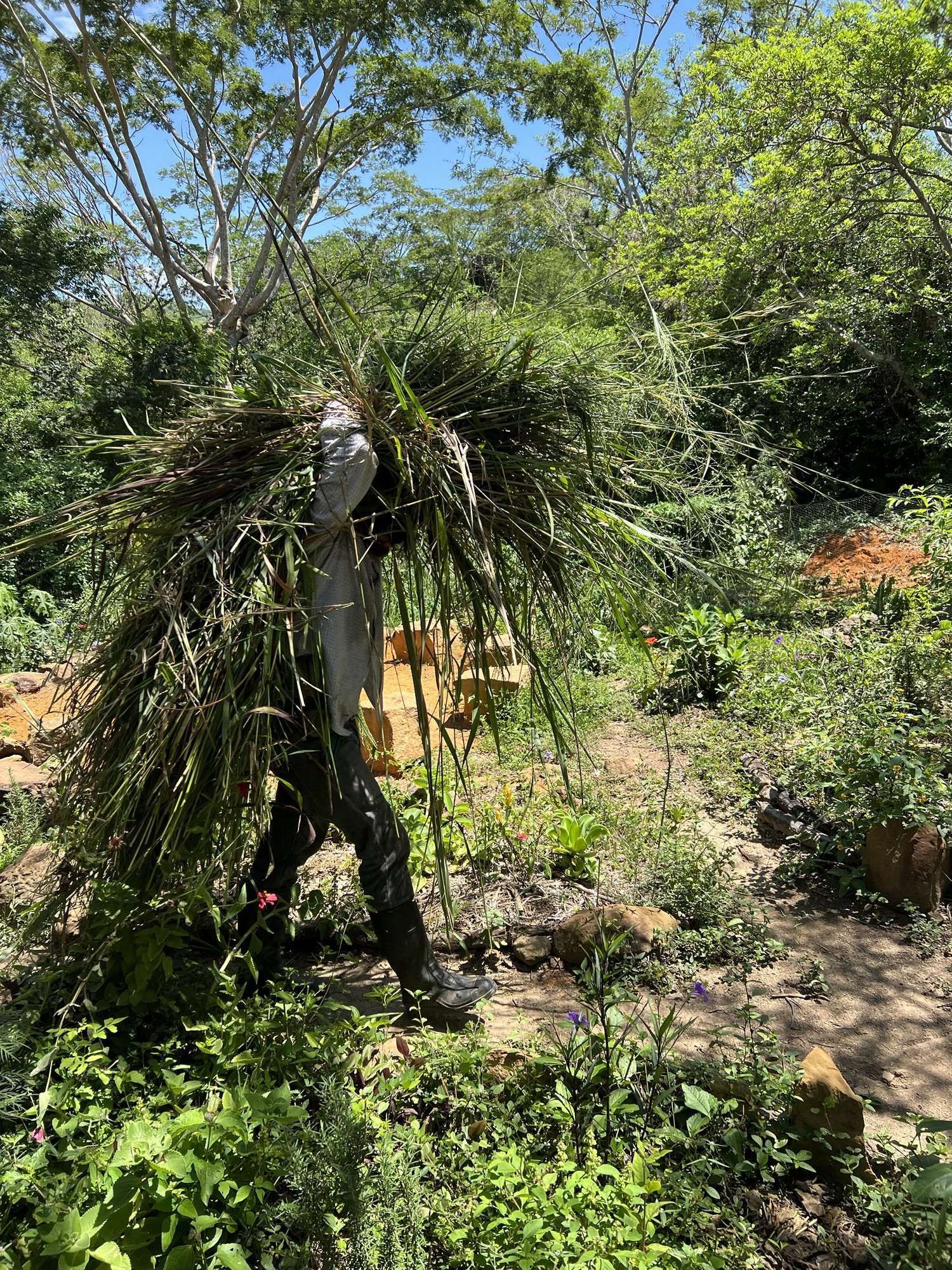
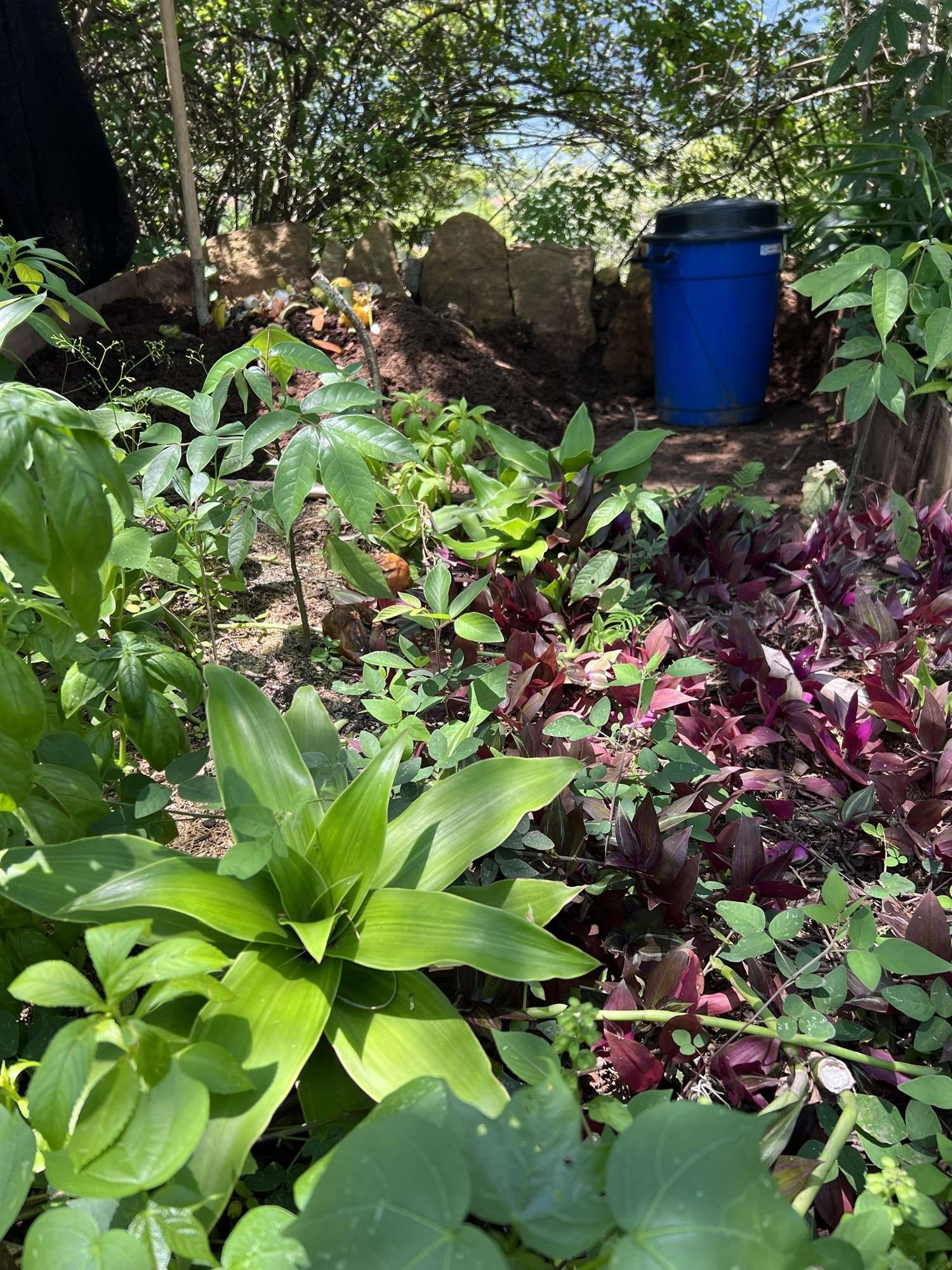
The photo is a view from Finca Milagros where we have our regeneration and food forest project.

Read More

The web of life: The real context for our lives and everything we care about

I have written about this several times before (including in my teens), although I keep revisiting it to help myself process it.

It’s pretty simple:

WE ARE NATURE

This living planet is a seamless system. It’s nearly infinitely abundant if allowed to be, and it also has limits.

We are a part of this living planet. We are nature. We are local and temporary expressions of this living, dynamic, adapting, evolving, system.

Our life and everyone and everything we care about is part of this living system. We are, and all is, dependent on the health of this living system. What happens to nature happens to us and all we care about.

WE ARE IN GLOBAL ECOLOGICAL OVERSHOOT

We have an economic system – and a civilization in general – that assumes separation and infinite nature. We assume we are separate from nature, and that nature has infinite resources and infinite capacity to absorb the toxins and waste of our civilization.

This assumption, combined with our numbers and technology, means we are in a global ecological overshoot. We use more resources than Earth can replenish. This is similar to living off money in a savings account. It looks fine for a while, and when we reach bottom, our lifestyle comes crashing down.

In this case, our lives may come crashing down too.

We know how to reduce our collective ecological overshoot. We know how to live well, and more than well, within the limits of this planet, and we know how to support the living systems in creating more and more abundance. There is no lack of attractive alternatives. The question is our collective will.

THE REAL CONTEXT FOR OUR LIVES AND CIVILIZATION

This is the real context for our lives, our civilization, and everyone and everything we care about.

In a sane world, it would be the conscious context for all our activities – economy, education, growing food, energy, art, music, movies, culture, news and media, and so on.

Our economic system would be aligned with ecological realities and set it up so what’s easy and attractive to do is also ecologically sound and supports life and the lives of future generations.

Our education would place ecology as the context for everything and our first priority.

Our news and media would see ecology as the context of everything, which it is, and prioritize it over other topics.

WHY IS IT NOT THE ONE OVERARCHING ISSUE FOR ALL OF US?

Why is it not like this?

We know that the living systems of this planet are unraveling because of the activities of our civilization.

We know we are nature and that we – and everyone and everything we care about – are 100% dependent on the health of the larger living systems we are part of.

We know we need profound changes to become a more ecologically sound civilization.

We know solutions that will benefit and create a higher quality of life for everyone.

So why don’t we collectively do what we need to do in order to survive? Why do we not do what’s needed for our descendants to have a good, or even decent, life?

SOME REASONS WHY

Some may…

Think we still have time. It’s not urgent. If politicians, the media, and my friends and neighbors don’t treat it as urgent, it must not be urgent. (We don’t have time, we are reaching critical tipping points.)

Think others will do it. Politicians, corporations, the market, scientists, or future generations will do it. I can just live my life as before and leave it to them. They know better anyway. (This is about all of us, we cannot expect others to do it.)

See it as a sacrifice. To make these changes, we’ll need to sacrifice so it’s best to wait until it’s necessary, or see if it will be necessary. (In reality, the real solutions are win-win-win solutions that improve the quality of our lives.)

Assume it will impact others, not me. It will impact those who don’t have much resources to prepare, adapt, and move. It will impact the poor in the world, not me. (Yes, it will first impact the poor, and then everyone including you and your children.)

Think nature is out there, as a kind of appendix or luxury, and I am here. What happens to nature doesn’t impact me much. They are so detached from reality, and so far into the imagined separation, that they don’t realize that we are nature and that what happens to nature happens to us.

Think there will be a technological solution. This is another version of “others will take care of it” and it’s misguided since what’s required is a profound and deepening transformation of our civilization, in all aspects of life and thought.

Think we just need to tweak something here and there. They don’t understand how serious the situation is and the profound changes required to do something about it. They are in denial.

Have other priorities. They see other and more immediate things as more important: Work, relationships, children, entertainment, enjoyment. They don’t realize that the web of life is what makes it all possible and is, whether we notice or not, the main priority. If we care about anything, we care about the web of life we are part of, whether we notice or not.

Don’t trust science and scientists and the ones concerned about this. For whatever reason, they don’t trust the ones who have decades of their lives to understand what’s happening with the world and what they have found and tell us about. They think that their views are equal to the views of experts.

Misdiagnose the problem. They see politicians, corporations, or greed as the problem. They overlook the systemic reasons for the situation we are in. They overlook that we have a civilization and economic system that assumes infinite nature.

Feel blamed and guilty so go into reactivity, denial, and blame. They blame themselves, are uncomfortable with it, and react to it in a variety of ways. They don’t realize that the problem is with our system and our worldview and we are all in the same boat. By living in this system, which just about all of us do, we participate in the destruction of the web of life. That’s inevitable and it applies to all of us, no matter whether we recycle or take the train or whatever we do or don’t do.

Need to focus on surviving from day to day. They don’t have extra resources to consider these things, or at least do something about it. (This is one of the self-regulating and self-preserving dynamics of our current system. The more people who live in this way, the fewer people who have the resources to question and try to change the system.)

Feel that these concerns don’t fit their identity and image. These are the concerns of hippies, treehuggers, newagers, liberals, and generally feeble-minded people. It’s not for me. I don’t want to be like them. I don’t want to be in the same category as them. (This is something that impacts all of us equally, and all of our children, independent of whatever labels we put on ourselves and others.)

SOME SOLUTIONS

Emphasize that…

This is a systemic problem and we are all part of the problem and potentially the solution. It’s not about blame or guilt or someone being better than anyone else. We are all in the same boat here.

We are nature. What happens to nature happens to us. (Nature is not something “out there”, it’s equally in here and what we are and live.)

We don’t have time. The situation is critical enough so we need to do something now. We cannot wait for the future or for someone else in the future to do it.

We are all part of the solution if we choose to be. This is not about others doing it. This involves all of us. Nobody is left out.

We already have win-win-win solutions. It doesn’t have to be a zero-sum game, the way it has often been presented. Food forests are an example of solutions that produce an abundance of food, greatly help wildlife and our ecosystem, and are profoundly enjoyable for us to experience and be part of.

Since it’s a systems problem, we need systems solutions. We need to transform our whole civilization to be more ecologically informed, aligned, and sound. There is not just one way to do this. We can all contribute and find our own flavor.

A FEW OTHER PERSPECTIVES

I have written about other sides to this in other articles: What we can do as individuals. Using the world as a mirror (projection/shadow work). Recognizing that we are all part of this much larger living system. And so on.

Supporting the healing processes of the body

I got an injury followed by inflammation earlier tonight, and someone suggested putting ice on it.

I chose to not do it. I cleaned the wound with clean water and a special soap for that purpose, I am leaving that part open to the air, and am allowing it to do its own thing. This has been my general approach since early in life, at least for less serious injuries like this one. (These days, I also use neurogenic tremors and Vortex Healing to support the healing process.)

The body has evolved healing processes over millions of years. So why work against those processes?

INFLAMMATION IS A NATURAL HEALING PROCESS OF THE BODY

In the case of inflammation, it’s the body’s way of improving circulation to the areas, and with it better access for a higher number of immune cells, more effective removal of whatever is not needed, and so on. It’s also a signal to slow down and rest for a while, and avoid putting too much strain on the injured part of the body.

By icing, you may remove some symptoms and discomfort, and you also work against the self-healing process by creating contractions, reducing circulation, and reducing the number of immune cells accessing the area.

The icing type of advice seems to be the product of a worldview that’s inherently suspicious of nature, doesn’t appreciate the wisdom of the body, focuses on treating symptoms (even if they are symptoms of the healing process), and assumes humans know better even if science is very young and we know very little.

In this case, it even goes against what we (think we) know and understand about how inflammation works. Of course, the body can and will heal itself even if we ice, but I prefer to avoid it.

PARTNERSHIP VS DOMINATION APPROACH

Our body and mind have profound healing abilities, built into us through millions of years of evolution. It makes sense to support and work with these processes.

This is the difference between a general partnership approach and a domination approach.

Our culture has mostly a domination orientation, which is reflected in our medicine. We have a medical system that focuses on (often toxic) medication, surgery, and strong interventions and has less emphasis on prevention and supporting the body in healing itself through diet and other lifestyle changes.

A MIX OF THE TWO

There is always a mix of the two, and fortunately, there is more understanding of the benefits of a partnership approach these days. Some examples are the focus on gut microbiome health, immunotherapy, phage therapy (still mostly used in former Soviet countries), and of course the role of diet and activity.

I use approaches on the domination side if necessary, especially if I have a serious condition. And I always prefer the partnership approach, especially for prevention, treating less serious ailments, and as a complement to conventional (domination type) treatments for serious conditions.

I assume that we will collectively continue to develop more effective partnership approaches to health and illness, including through integrative and functional medicine, and more specific treatments like immunotherapy for cancer.

A PARTNERSHIP APPROACH TO HEALING THE MIND

All of this also goes for finding healing for the mind. Here too, I prefer partnership approaches. I rest in noticing my nature which creates a context that seems to invite healing for the mind. (Basic meditation can be healing over time, especially combined with therapy.) I invite and join in with the natural trembling dynamics of the body to release stress. (TRE.) I find what I really want within surface wants. I find what’s genuinely more true for me than stressful beliefs. (Any thought held as true is stressful.) I befriend scared or reactive parts of me, listen to them, thank them for protecting me, and so on.

Read More

Our ecological crisis and what could be

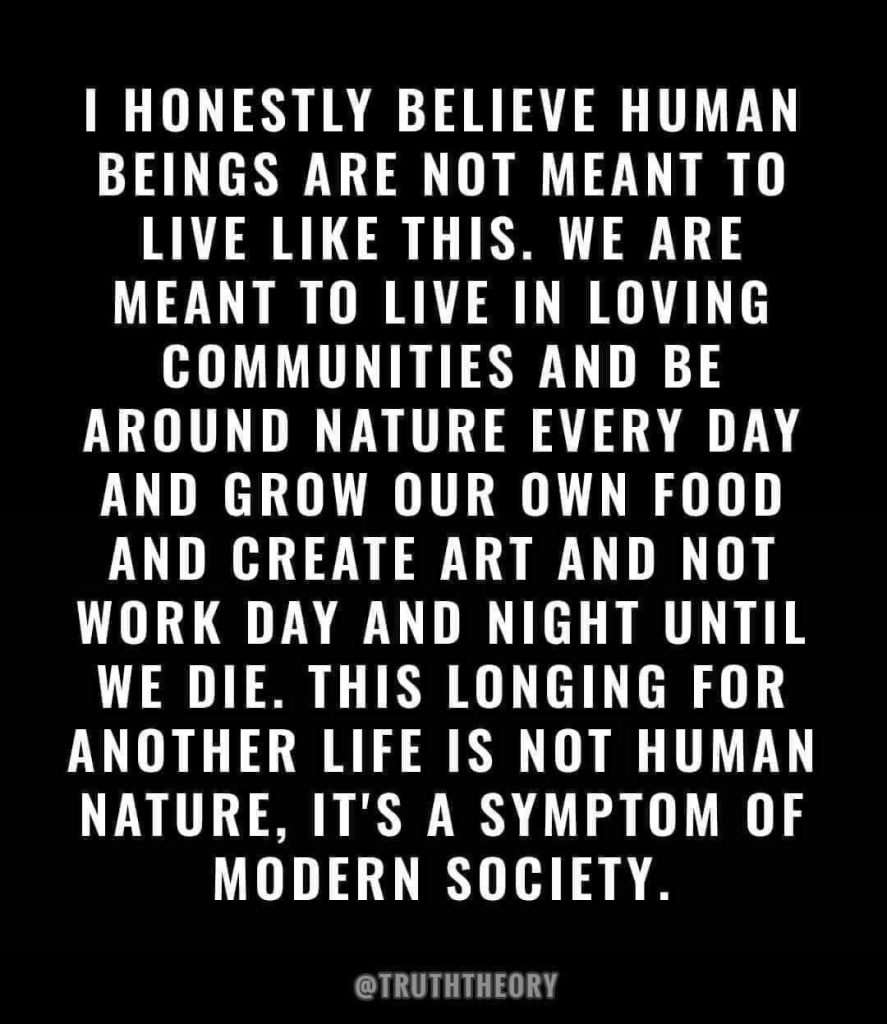
I saved a few images that came through my social media feed this morning and thought I would say a few words about them.

The cartoon above captures the general views I have seen among those concerned about ecosystems and nature and how these have changed over the last few decades.

Since my teens, I have been into systems views and knew that we needed a thorough transformation of our whole civilization to survive. Then and for a while, I had optimism. I thought we would collectively understand and make the changes necessary.

These days, I am not so sure anymore. I am not sure if we’ll ever find that collective will. It seems more likely that life will make the changes necessary – with or without the collaboration of whatever is left of humanity.

In our individual lives, life will decide for us if we wait too long. The same may very well be the case with Earth and us. We are waiting for too long, and Earth will make decisions for us. Whether that leads to a world inhabitable by humans or not is something we’ll see.

Science is amazing. It’s baffling how much we know about the world through science, considering how young modern science is, and considering that we are just beginning to scratch the surface in terms of understanding.

Something we know from science is that (a) we are in a global ecological overshoot, (b) this will lead to the unraveling and collapse of our current ecosystems, and (c) since we are part of and depend on Earth’s living systems, what happens with Earth happens with us.

This is by far the major issue today. It’s the one overarching issue.

Everyone we care about and everything we care about – whether it’s celebrities, sports, politics, human rights, or whatever it is – depends on these living systems we are part of.

So why is it not the main issue in our public discourse? Why is it not the main issue in our everyday conversations? (It is for some of us, including me.) Why is it not our main priority in any and all decisions we make, including who we vote for? Why is it not the context for any and every discussion about any other topic?

I have written about some of the likely reasons in other articles: We mistakenly think… we still have time, others will take care of it, it’s a problem for future generations, it will happen to others, we are insulated by our privilege, we’ll find a technological solution, we just need to tweak a few things here and there, it will involve too much sacrifice, it will go against my cherished identity, I am just one so can’t do anything, it’s easier to pretend it’s not happening, and so on.

Yes, colonialism indeed rewrote the story of nature for the colonized, at least to some extent depending on how much of what they had was lost due to genocide, cultural eradication, laws against speaking their languages and following their traditions, and so on.

I would go further back in time, to the agricultural revolution. Before the agricultural revolution, we were all indigenous. We likely saw the sacred in everyone and everything, and generally had more of a partnership orientation with ourselves, others, and the world. With the agricultural revolution, some amassed wealth and others did not, so to justify the more dominant relationship with nature and other people, the ones with wealth images ideologies than then were adopted by just about everyone.

These are imaginations of separation: Humans are separate from nature. Nature is here for our use. Nature is infinite in its resources and capacity to absorb waste from human activities. If you are lower in the hierarchy, it’s your fault. (Lack of character, wrong ethnicity, bad karma, or something else.) You’ll reap your rewards in the afterlife. (So don’t rock the boat now.) Pretend to believe absurdities told to your secondhand, and you’ll be saved. We understand something by taking it apart to its smallest parts. A thought can be true, and exclusively true so alternate views are wrong. Non-human beings don’t have cognition, emotions, and so on, or – at least – it’s so different from ours that we can still justify imprisoning, torturing, and eating them, or destroying their habitat. If we win, someone or something else must lose. And much more.

Colonialism inflicted this domination culture onto the colonized, that’s true. But the colonizers inflicted this on themselves millennia earlier, at some point after the agricultural revolution. We inflicted it on ourselves, and it’s time to heal and find a more healthy relationship with ourselves, others, and the web of life.

Yes, that’s true. We evolved to live as our indigenous ancestors. We evolved to live in small and mostly egalitarian groups. We evolved to live in and as nature. We evolved to see ourselves as nature. (Since that’s obviously what we are.)

With our food forest and regeneration project in the Andes, I feel I am coming closer to this. I work in partnership with nature. I live in nature. I am nature helping itself regenerate.

We can have this world. At the very least, it’s easy to imagine it. It’s easy to imagine a world where most of us live in a partnership culture, where we have good social safety nets, where people have access to education and health care, where our economic system takes ecological realities into account, where we grow food in partnership with nature in ways that heal the soil and our ecosystems and provides habitat for wildlife. We can have a world of abundance. We know how to do all that. It’s within our reach.

The only question is our collective will. Are we collectively smart enough to choose this world?

Our ecological crisis: Distractions and misconceptions, what we can do, and food production in partnership with nature

I have written about this before, but thought I would revisit it briefly.

When I look at the public discourse in general, and especially the public discourse about our ecological situation, I see a lot of distractions and misconceptions.

THE IMPORTANCE OF THE LIVING SYSTEMS OF THIS PLANET

The main misconception is the importance and role of the living systems of this planet.

In the public discourse and in the media, it’s often prioritized after a long list of other issues, and it’s often framed as one of many topics.

I assume this is because of our idea that we are separate from nature and have a dominant relationship with nature. This makes us feel insulated from what happens with the planet, and we also secretly think we can control and manage it, whatever happens. This is a typical Western, and increasingly global, imagination. Ultimately, it’s an ecocidal and suicidal imagination.

In reality, the condition of the living systems of this planet and our relationship with it is the one topic that encompasses everything else. It’s the context for our lives and everything we care about. We can’t talk about anything without also talking about that.

We are nature. What happens to this living planet happens to us.

If we were more aligned with our ecological reality, it would not only be our priority, it would be the frame for every other issue and topic.

GLOBAL ECOLOGICAL OVERSHOOT VS CLIMATE CHANGE

If the media and politicians focus on ecology, it tends to be climate change. The petroleum industry has known about climate change for decades and has also been successful in its strategy of sowing doubt and creating confusion which contributes to inactivity. Both are well documented.

I remember a conversation I had with a teacher in high school in the ’80s. During a break, he wanted to discuss whether there is human-created climate change or not. I said that in the big picture, it doesn’t matter. We need to make the same changes anyway. It’s a distraction.

That’s how I still see it.

Yes, the activities of our civilization have nudged our planetary system in a direction where it retains more heat, which has massive consequences.

Science shows us that, and it’s also easy to understand: We have a thin atmosphere. We are 8+ billion people with powerful technology, much of which releases certain gasses into the atmosphere that we know let through light (sunlight) and retains heat (what much of sunlight converts to when it hits matter).

That combination inevitably creates a greenhouse effect, and it can create a runaway greenhouse effect.

But since there is confusion about this, let’s not use that as our main focus or argument for the need for profound change. A much better argument is our collective ecological footprint.

This living planet is unable to replace as much as we use and deal with the waste we create. We are in a global ecological overshoot. This is similar to living off a savings account with less coming in than we spend. At some point, we reach the bottom and our lifestyle comes crashing down.

What we see in the world today is our ecological savings account going down fast. When we reach the bottom, which is fuzzy in this case, not only will our lifestyle come crashing down but our lives may crash down with it.

That’s not hyperbole. That’s simple logic. If we continue as before, there is no other way it can play itself out.

WHAT’S THE CAUSE OF OUR ECOLOGICAL CRISIS?

Before we can successfully deal with a problem, we have to have some level of understanding. We need to diagnose it correctly. So what’s the underlying cause of our current ecological crisis?

Why are we in a global ecological overshoot?

Some seem to blame corporations and politicians. Say that was true: Who voted for the politicians? Who supports the corporations with their money? It’s us.

This is a systemic problem. We have a civilization built on the idea of separation and domination.

We are separate from nature. We are more important than nature. Nature is here for our use. Nature is infinite. It’s our right to dominate nature. The sacred is “out there” in the sky, in a sky god, in the afterlife. Humans have souls and other beings don’t. We understand things better by taking them apart, by separating them from all the other things they belong to.

Every aspect of our civilization, including the minds of individuals, reflects this worldview. We have all internalized it, at least to some extent.

The origin of this worldview, at least in its modern form, is likely the agricultural revolution and our newfound ability to amass wealth and control land, plants, animals, and some humans. Before then, we were all indigenous. We lived in small groups. Were more or less equal, apart from in experience and knowledge. Saw ourselves as nature. Saw the sacred in everyone and everything.

That’s the deeper reason for our ecological crisis. It’s the predictable outcome of such an orientation, especially combined with large numbers of us and advanced technology.

We are all part of this system. Even if we recycle, eat vegetarian, avoid toxins, take bus and train, and so on, our lives are still destructive for the living systems we are part of. It’s inevitable since we live within this system.

It’s not about corporations or politicians. It’s about all of us.

It’s not about greed. It’s about a system based on fundamentally flawed assumptions about reality.

THE MISMATCH BETWEEN OUR GLOBAL SITUATION AND WHAT WE EVOLVED TO DEAL WITH

We evolved to live in small groups and deal with our immediate surroundings and relatively short timespans. At most, we needed to think one or a few seasons ahead.

These days, our challenges are global and play themselves out over decades and centuries.

Our bodies and minds have evolved to deal with the world of our relatively distant ancestors, and we are born into a very different world.

I suspect this is a big part of why we collectively are not even close to taking this seriously enough or doing enough about it. Collectively, we are distracted by anything and everything else, we are mostly focused on fragments of the bigger picture, and we operate on relatively short timespans.

A FEW MORE DISTRACTIONS

I thought I would mention a few other distractions and misconceptions.

(a) Some think we’ll find a technological solution. Technology will be part of the many solutions, but it’s not enough in itself, and it’s not even what’s most important.

What’s most important is our collective will. Will we find a collective will to make the needed change? Will enough of us recognize that the problem is systemic and that we need a thorough transformation of every aspect of our civilization?

(b) Some think it’s not that serious.

This is about the living system we are all part of. The living system we fully depend on for our existence and quality of life. The living system we are fleeting and local expressions of. The living system that not only gives us our life but everyone and everything we care about. What can be more important than that?

(c) Some think others will do it.

We are all part of the problem. This is about all of us. If we don’t make changes in our own lives, how can we expect a change?

(d) Some think we still have time.

What we do today has impacts decades, centuries, and even millennia into the future. Some of it has impacts forever, for instance with extinctions of species and whole ecosystems. We cannot wait.

Also, we are already far into this global ecological crisis. It’s already unfolding all around us and within us (plastics and toxins in the bodies of all living beings including ourselves). We cannot wait.

WHAT CAN WE DO?

We can start by…

… educating ourselves about ecology, sustainability, life-centered solutions, etc.

… identifying and questioning our worldview, finding what’s more aligned with our ecological reality, and exploring living from that. I find the Universe Story, Epic of Evolution, systems views, integral models, deep ecology, ecospirituality, and Practices to Reconnect inspiring and helpful.

… finding like-minded communities and individuals. It’s easier to make changes with the support of a community. It’s inspiring, we share experiences and knowledge, we can help each other in practical ways, and so on.

… living some of the solutions in our own life. Make it real to you by making it real in your life. By doing so, we create momentum, become part of the solution, and give ourselves hope.

… and making sure there is some balance between (a) focusing on and learning about the problems (useful up to a point), and (b) focusing on, learning about, and living some of the solutions. If we focus too much on the many challenges in the world, it can lead to frustration and burnout. If we focus one-sidedly on what appears as solutions, we may engage in solutions that are less grounded in reality.

PARTNERSHIP WITH NATURE

Since most of our collective challenges come from an orientation of separation and domination, the medicine is found in an orientation of connection and partnership.

There is inevitably always some of each, and these days, we need an infusion of the latter.

This can be applied in all areas of society and our life.

FOOD PRODUCTION FROM DOMINATION VS PARTNERSHIP MINDSETS

I am mostly focused on food production and regeneration these days, which are major pieces of the puzzle.

Modern food production comes from a domination mindset, with monocultures, dependence on huge energy inputs, use of chemical fertilizers and toxins, depletion of the soil, destruction of wildlife habitat, suffering of domestic animals, poisoning of insects, birds, animals, water, soil, and air, and much more. It’s food production from a zero-sum mindset where a small temporary gain (food) comes at the expense of massive ecological destruction.

The soil, ecosystems, and our health become worse over time. It’s a downward spiral.

Food production from a partnership mindset is different. It’s typically polyculture, uses non-toxic methods, includes as many natives as possible, focuses on and improves soil health, provides wildlife habitat, and more. It comes from a win-win orientation where we seek solutions that provide food for us and the wildlife, improve the soil and ecosystem over time, and provide habitat for a diversity of wildlife.

The soil, ecosystems, and our health becomes better over time. It’s an upward spiral.

We are developing a food forest on our land in the Andes. Large areas will have only or mostly natives, with as much diversity as possible, and as many food-producing plants as possible. The areas closer to the houses will have a diversity of native and non-native (non-invasive) food-producing plants. We focus on building healthy soil with mulch, manure, microorganisms, and so on. We want as much diversity as possible. We plant 95+% perennials.

As this food forest matures, it will become more and more self-sustaining and our work will mostly consist of harvesting, some maintenance, and continued diversification. Over time, it enhances soil health, reduces erosion, and provides habitat for more and more species.

It becomes better with time because we work in partnership with nature.

Some will say that we need modern monocultures to produce enough food for everyone, but that’s clearly not the case. It’s an example of brainwashing from those who benefit from it.

In the big picture, it’s not true since modern agriculture is so destructive to life.

Even from a narrow perspective, it’s not true since polycultures can produce as much if not more than modern monocultures. This is especially true for perennial polycultures like food forests. As they mature, production increases, inputs go down, and the return on investment continues to go up.

HOW WE CAN SUPPORT OUR LOCAL ECOSYSTEMS

We can all do something to live this partnership orientation with nature.

We can find local organic farms and buy directly from them. If we can’t get everything from local farms, we can buy organic as much as possible.

If we have a garden, we can make it into a nature garden that replicates the local ecosystem where we live. This will benefit the wildlife and ourselves and can be an inspiration to others. We can start small, even just in a small corner of our garden, and then expand as we get more experience.

We can join a community project. For instance, planting native trees or wildflowers in a park, along a river, or in any public area. If there is a larger regeneration project in our area, even better.

We can join a community garden, use organic methods, and mix in native flowers to support the pollinators.

We can talk with local organizations and governments to see if they are willing to set aside some parts of public areas for wildflowers. It can start small, as an experiment, and then go from there.

What’s radical? To live to support life? Or the opposite?

What’s radical?

Is it to live with concern for all living beings and future generations? To seek win-win solutions that work for us, the living systems we are part of, and future generations?

Or is it to live in the opposite way? To actively support a system that’s inherently destructive to life?

RADICAL OR NOT?

What’s radical depends on our perspective.

I’ll take myself as an example since it’s what I am most familiar with.

In one sense, I am not radical at all. I look pretty normal. I have gone through the usual education. I own a house. When most people talk with me, I probably don’t seem very radical. I know how to present myself so I don’t seem very radical.

In another sense, my life and views are pretty radical. It differs in significant ways from what’s typical in our culture and civilization. Seen with the eyes of the mainstream, it’s pretty radical.

I bought a large piece of land to protect it from development. I am developing a food forest. I have abandoned paths in life that would have been far more profitable. I eat mostly vegetarian and drink very little alcohol. I love the Universe Story, systems views, integral approaches, deep ecology, indigenous views, and so on. I look for and question assumptions I seem to operate from and try to leave no stone unturned. To some, all of this is somewhat radical.

My main concern is our global ecological overshoot, and I see a thorough transformation of our whole civilization as the only solution. Very few political parties go that far, so this is pretty radical.

I find myself as what the world, to me, happens within and as. I find myself as consciousness, and the world, as it appears to me, happens within and as the consciousness I am. This is the reverse of how most consciousnesses operate, and few are interested in it, so this is also pretty radical.

There are contexts where this is not radical. From an ecological big-picture and deep-time perspective, it’s not radical. It’s life-centered. It takes the needs of future generations into account.

WHAT’S RADICAL IS OUR CURRENT SYSTEM

Within this context, what’s radical is to support and defend a system that’s inherently destructive to all life, including ourselves.

Our current system assumes infinite natural resources, and an infinite capacity of nature to deal with the waste of our civilization. It does not take ecological realities into account. We are in a global ecological overshoot where Earth is not able to replenish what we take from it. This is ecocidal and suicidal.

This is radical. It’s out of alignment with reality, it’s destructive to life, and it’s ultimately suicidal.

What’s radical is to support an ecocidal and suicidal system, and that’s what most political parties and most people do.

WHAT’S RADICAL CHANGES WITH TIME AND CULTURE

What we see as radical changes with time and culture.

In old Greece, it would be radical to suggest that women and slaves should participate in democracy. Today, it’s a given that all citizens should be allowed to participate. (At least, if you live in a democracy.)

Just a couple of hundred years ago, it was radical to suggest that slavery was inherently unethical, cruel, and damaging for everyone and society. Today, that view is the norm.

Some generations back, the idea of universal healthcare and social safety nets would be seen as radical. In most industrialized countries today, it’s the norm.

A few hundred years ago, suggesting that the sun is the center of our solar system would be radical. Today, it’s the norm.

Just two or three generations ago, suggesting that LGBT+ life was as normal and as acceptable as hetero life would be seen as radical. (It was even considered a psychological pathology.) These days, it’s a norm in most modern societies.

Some generations ago, concern about the welfare of non-human beings was seen as radical. Today, it’s the norm to at least have a minimum of protection for the welfare of non-human beings. (Although many of them still live in immense suffering.)

A few generations ago, humans were seen as special and inherently different from all other kinds of beings. Today, at least in science, we know we are very similar to other beings. We share most of our DNA even with oak trees. (Our culture as a whole has not yet caught up to this insight.)

A WORLD WHERE A LIFE-CENTERED ORIENTATION IS MAINSTREAM

It’s easy for me to imagine a world where a more life-centered orientation is mainstream.

It’s a world where nature has rights. Where non-human beings, ecosystems, and future generations have the law on their side and legal representation.

It’s a world where food is grown in partnership with nature. It’s grown in ways that enhances and enriches our local, regional, and global ecosystems. It’s grown in polycultures, and without industrial chemicals and toxins. Nourishing the soil is recognized as essential for good food production. Food forests are common, both on smaller scales around people’s homes and larger scale for whole communities.

It’s a world with deep democracy, where we have instant runoff voting, multi-party systems, citizens councils and more, and the voiceless – non-human beings, ecosystems, future generations – have a real voice in governance, businesses, and society in general.

It’s a world where the basics are universally taken care of, not only in our own countries but globally. At the very least, there is a real effort to take care of the basics needs of everyone (water, food, shelter, healthcare, education) since this creates a society that works better for everyone. It reduces crime and unrest, it allows us all to benefit from the gifts of more people, and it helps everyone feel safer (less operating from survival mode) since we know we may need that support at any time.

It’s a world where our systems take ecological realities into account, including our systems of economics, production, transportation, education, and more. They account for ecological footprints and a finite Earth, and prioritize what gives and enhances our life which is a thriving diverse ecosystem. It’s a system where what’s attractive and easy to do is also what’s ecologically sound.

It’s a world that prioritizes regeneration and rewilding on all scales – in our gardens, public spaces, where we grow our food, and in the areas set aside for wilderness. If we did this, it would greatly remedy our massive ecological problems. It’s a solution where we all win in multiple ways, also because it’s an enjoyable process and we enjoy being in or near diverse and vibrant nature.

It’s a world where life-centered worldviews are common. We see ourselves as nature. We use systems views and integral models to understand life, ourselves, and the world. We see the sacred in everyone and everything. We call reality – existence as a whole – God. (And don’t assume we understand or know very much about it.) We use and develop approaches similar to the Universe Story, Epic of Evolution, Deep Ecology, and similar.

It’s a world where we generally use more of a partnership approach to ourselves, others, and life. We work with what’s here more than we work against it. We know that sometimes, domination elements are needed to get things done, and we seek to do it as consciously as possible.

It’s a world where awakening is understood in a grounded way and is an ordinary part of the culture. People generally know about it, and it’s commonly included in academic studies and discussions. It’s understood that to ourselves, we are fundamentally consciousness, and the world, as it appears to us, happens within and as that consciousness. That’s the most basic way to understand it, and there is a range of contexts we can understand it within, depending on what seems helpful or interesting to us.

Read More

Jaiya John: When you think you are your own separate, independent, self-made tree and not the forest, you care less when other trees are burning

When you think you are your own separate, independent, self-made tree and not the forest, you care less when other trees are burning. This is a fatal problem of mistaken identity, colonized forgetting, and conditioned belief in your insulation from harm. You are always the forest. Indigenous ways.

– Jaiya John

We are fleeting and local expressions of this living system we call Earth, and the much larger evolving system we call the Universe or Existence.

What happens to the larger systems we are part of, as well as the smaller systems that are part of us, happens to us.

WHAT HAPPENS TO THE LARGER WHOLE HAPPENS TO US

We may think that in society, what happens to others don’t harm us but it does.

We may think that harm to ecosystems and non-human beings don’t harm us, but it does.

It harms us because we are all expressions of the same dynamic living systems, and what happens to a part happens to the whole. Harm to other people, non-human beings, and ecosystems harms the web of life we are all part of, and that harms us whether we notice or not.

The larger the scale of this harm, the more obvious the harm is to ourselves, as we are seeing now with our global ecological crisis and the inevitable coming mass migrations. We are all impacted already, and it will only be more obvious.

Similarly, the more the larger systems we are part of come alive, the more we come alive.

It harms us to be complacent to or support the harm since the world is our mirror. The way we relate to the world – to others, to ecosystems, to life – is how we relate to ourselves. If we live from intolerance, scapegoating, bigotry, blame, victimhood, and so on, that’s how we treat ourselves and that’s the world we create for ourselves to live in.

If we learn to live from more kindness, curiosity, and a partnership orientation, that’s how we relate to ourselves and our experiences.

WE ARE NEVER SELF-MADE

We are never self-made. Whatever is in my life comes from somewhere else.

I grew up in a middle-class family in Norway so the road was paved for me to get a university education. I grew up with lots of books so it was natural for me to read. I grew up with a family that loved nature, so it was natural for me to love nature. Any ideas that goes through my mind comes from somewhere else, both the stressful and the more life affirming ones. My curiosity, passion, motivation and so on is not self-made, it comes from somewhere else. (I don’t know where.)

Everything in my life comes from somewhere else. My life depends on the whole evolution of this universe, this planet, humanity, and this civilization. It depends on the whole of existence.

None of this would be here otherwise.

INSULATION FROM HARM

When we live from an imagination of separation, we can also imagine we are insulated from harm when others are harmed, whether they are people, non-human beings, ecosystems, or this living planet as a whole.

Nothing could be further from the truth. The health and well-being of the whole colors our own health and well-being in innumerable ways.

Why are we collectively not doing nearly enough to deal with our global ecological crisis? This assumption of separation and insulation from harm is likely a big part of it. We think it happens over there, to someone else, to future generations. They can deal with it.

We don’t realize how it impacts us now, and how we are impacted by the destruction happening all over the world even if we tell ourselves we are not.

TRUMP AND A CULTURE OF DOMINATION

In the US today, with the election of Trump, this quote may be especially relevant. Trump wants to sell of publicly owned nature to mining and petroleum companies. He wants to reduce or eliminate regulation of industry, use and release of toxins, and release of greenhouse gasses. He wants to minimize and destroy the already flimsy social safety nets in the US. He wants to cut taxes to the already very wealthy and put the cost on ordinary people. He wants to mass deport immigrants who pay taxes and do jobs others don’t want. He wants to implement policies that harm minority groups.

This harms everyone. It harms everyone to live in this kind of “burn it all to the ground” society that does not respect human rights or the right of nature, that scapegoats and harms minorities, that removes the social safety nets that makes society safer for all of us, that encourages further destruction of our ecosystems and the life support systems we all depend on.

MISTAKEN IDENTITY

As the quote says, this is a fatal problem of mistaken identity. This mindset of “what happens to others don’t matter for me” comes from a worldview of separation and alienation. It’s very much a trauma response.

Likely beginning with the agricultural revolution, we have created an imagination for ourselves telling us we are separate from nature, we are separate from others apart from a few in our in-group, we are special and different from other forms of life, we have soul and others do not, the sacred is out there in the sky or the afterlife or a sky-god and not anymore in all beings and all there is, we understand something best by taking it apart to its smallest parts, a thought can be absolutely true, if one thought is true another is not (either-or thinking), if you pretend to believe something weird you can’t check for yourself you’ll be saved, you’ll get your reward in the afterlife so there is no need to change the system to make a better life for yourself now, and so on. These imaginations were likely created to justify the domination and social inequality that came with agriculture, and they have been developed through the centuries to continue justifying it.

This worldview, and the domination culture that comes with it, creates and depends on trauma. It creates and depends on collective and intergenerational trauma.

It is very much a primitive, barbaric, and savage worldview and culture. It’s the mindset of empire and colonialism. (The irony is that people with this mindset have traditionally seen partnership-oriented cultures, including Indigenous cultures, as just that.)

WHAT WE CAN DO

We can learn to recognize this mindset, where it comes from, and what effects it has. We can learn to see through it. We can learn to recognize it as the imagination it is.

We can also explore and explore living from more life-centered mindsets and worldviews. We can recognize ourselves as nature. We can recognize this living system we call Earth as one seamless dynamic system that we are local and fleeting expressions of. We can create and live from more of a partnership culture in ourselves and our lives.

This may not happen on a larger scale, at least not yet, but we can do it in our life and that’s amazing. It may not change the world in an obvious way, but it changes our world.

Indigenous rights & our global ecological crisis

I love this, and it brings up a lot for me.

The pasty white guy rolling his eyes, representing colonialism and the descendants of colonialists still benefiting from the original theft of land and natural resources.

The Indigenous using the power of their tradition to stand up for themselves and what’s important to them.

The unimaginable horrors inflicted on the indigenous around the world, mainly by white Europeans, and the immense suffering that came from it. The theft, lies, rape, destruction of nature, and much more.

Colonialism is still going on, often through multinational corporations with the support of governments and the neo-liberal ideology, and the descendants of colonialists holding onto their privilege.

DOMINATION AND PARTNERSHIP CULTURES

Before the agricultural revolution, we were all indigenous. We lived in small egalitarian groups and from what nature provided. The global ecological crisis we find ourselves in today is an outcome of the agricultural revolution, including the worldview and mindset that came with it.

This is a worldview of separation and domination, imagined, promoted, and developed to justify the new gap between the wealthy and the rest, and the domination inherent in agriculture, husbandry, and having people working for you.

All cultures, worldviews, and mindsets have a mix of partnership and domination orientations. That said, and in general, agricultural cultures are on the domination side. Indigenous cultures are on the partnership side, although the ones with agriculture tend to a little in the direction of domination. Empires tend to be further over on the domination side. (We see that in the US today.) And some modern agricultural cultures, like the Nordic countries, tend to be a little more over on the partnership side.

The agricultural worldview of separation and domination, combined with our explosion in numbers and technology, has created the global ecological crisis we now find ourselves in.

THE IMPORTANCE OF INDIGENOUS RIGHTS

That’s one of many reasons it’s important with Indigenous rights.

They are human as anyone else and deserve it.

They have been marginalized, suppressed, killed, and more for centuries. It’s time to right that wrong, as much as is possible.

They were here first. They were first everywhere.

They are often far down on the list of marginalized groups to be included and given a voice in society. To me, it seems they are often prioritized near the bottom.

They have insights, knowledge, and perspectives crucial for us today. They are medicine for many of the problems inherent in the Western culture, which is now – to a large extent – a global culture.

WHY ARE THEY STILL MARGINALIZED?

Why are the Indigenous still marginalized?

There are many answers.

In most places, the Indigenous are not as many as the colonizers and other immigrants.

They have fewer resources because their land was stolen from them, their culture was suppressed, they have experienced centuries of racism, and they live with intergenerational trauma.

Acknowledging their rights brings up profound questions of reparation, returning tribal lands, the dark history of colonization, the continued privilege of the descendants of the initial colonies, and more.

Giving the Indigenous a real voice in society will shed light on the colonizer culture and its brutality, shortcomings, and ecocidal and suicidal characteristics.

Almost all historically marginalized groups are still marginalized. The system – the social system, the culture, and the mind – has inertia. Even the ones that portions of society actively strive to include are still marginalized in many ways.

THE VALUE IN THE INDIGENOUS PERSPECTIVES

I am not indigenous so I can’t speak with any authority on any of this. Even if I was, I could only speak about my own culture since Indigenous cultures are diverse. So I am sure much of this is missing the mark. But I can guess, and I can also make some guesses about the value in the indigenous perspectives.

They may reflect pre-agricultural views, so they serve as a correction to the post-agricultural worldviews most of us in the world today are familiar with and have internalized.

They often come from more of a partnership orientation – to others, ourselves, nature – instead of a domination orientation. This is what we need to find solutions to our challenges today.

They often see the sacred in everyone and everything. The sacred is here, not out there in the heaven, or the afterlife, or a sky-god.

They often have reverence for nature and the gifts of nature.

They look at wholes as much as the parts, while our Western culture traditionally has focused more on parts and has operated from a fragmented understanding and view.

They know we are nature. We are nature taking these local and temporary forms. What happens with the web of life happens to us.

They may have more of a big picture and deep time perspective. Some may think over generations and at ecosystem and global levels. This is in contrast to the typical small picture and short-term thinking of Western civilization including businesses, politicians, and most organizations.

They have experience with decolonizing the mind and seeing through the ideologies of domination cultures. That’s valuable for all of us doing the same.

These are just some of the ways Indigenous perspectives can be medicine for our Western and now largely global worldview.

Rethinking food production: from domination to partnership with nature, and using the best of what’s gone before

In our food forest, we use a partnership approach with nature.

To me, it’s a reminder of how our worldview shapes our relationship with nature and growing food.

GROWING FOOD ON A SPECTRUM FROM PARTNERSHIP TO DOMINATION

It seems that we can approach food growing on a spectrum from partnership to domination, or maybe we should say partnership and control. There will always be some elements of each.

At one end of the spectrum is what some Indigenous do and have done, which is to encourage food-producing plants in forests. (Or whatever ecosystem they live in.) These forests will look natural to outsiders, but they are nudged in the direction of producing more food for humans while still remaining quite natural and full of life. This is food growing in conscious partnership with nature.

At the other end of the spectrum is our modern agriculture. It has allowed us to increase our food production dramatically, and the science related to modern agriculture has a lot of value to us.

On the other hand, it has downsides that are becoming increasingly obvious. It’s a system that mostly grows monocultures and is dependent on chemicals, toxins, and constant input. It’s highly energy intensive, depletes the soil, causes soil runoff, creates ecological deserts, removes habitat for wildlife, poisons living beings including us, and is a big reason for our insect apocalypse.

In the middle are traditional forms of agriculture found around the world. These come from a mindset of domestication – of the land and animals, although they don’t have such a big impact as modern agriculture.

THE AGRICULTURAL REVOLUTION

It’s tempting to imagine that our worldview – of partnership or domination – comes before the type of food growing we prefer. After all, that’s how it tends to be these days. Historically, it was likely the other way around: with the change to agriculture came a new worldview.

Before agriculture, we were all indigenous. We all lived in mostly egalitarian groups. We didn’t accumulate much apart from experience, knowledge, and wisdom. We likely saw the sacred in nature and everything. We saw ourselves as part of the web of life. We saw ourselves as nature.

With agriculture came a worldview of separation and domination. Some started to accumulate wealth while others did not, either because they couldn’t or wouldn’t. To justify controlling land, animals and humans, and to justify this inequality, the wealthy developed a range of imaginations: Humans are separate from nature. Humans are more valuable than the rest of life. The sacred is out there in the sky and a sky god. Social hierarchies reflect a divine order. Only humans have soul. Nature is primarily here for us. Nature is a resource for us to use as we wish. If you are lower in the social hierarchy, it’s your fault (lack of character, bad karma). You’ll get your reward in heaven. (No need to try to change an unjust system.) Thoughts can reflect a full, final, and absolute truth. If one thought is true, other perspectives must be false. If you win, I lose.

In modern times, this was taken even further: We understand something best by taking it apart to its smallest parts. Only humans have an inner life with cognition, emotions, and a wish to avoid suffering. It’s fine to imprison and inflict immense suffering on non-human beings as long as it serves us. Nature is infinite. We don’t need to account for a finite Earth in our economic system or how our civilization operates. The living systems of this planet is “environment” and not something we are inherently part of.

WIN-WIN VS ZERO-SUM

One expression of these two worldviews – and these two ways of growing food – is a win-win versus a zero-sum orientation.

A partnership approach seeks win-win solutions. When we are growing our food forest here, it’s a win for nature and wildlife (diversity, habitat), it’s a win for us (food, multiple sources of income), it’s a win for future generations (get to enjoy the food forest).

A domination approach sometimes operate from a zero-sum mindset. They seek solutions that are a short-term win for themselves and a loss for nature, future generations, and the health of all of us today.

HOW THE DIFFERENT SYSTEMS CHANGE OVER TIME

One expression of this is how the different systems change over time.

For instance, food forests require some investment upfront in terms of learning, planting, and maintenance. Over time, it takes more and more care of itself. The soil health improves, there is a thicker layer of mulch to retain moisture, there is more diversity, the different forest layers are more filled in, and the production – of food, flowers, seeds, seedlings, and so on – increases. There is more and more surplus for wildlife and humans. Nature does the vast majority of the work so there is an increasing return on investment.

In contrast, modern monocultures tend to go in the other direction. It’s dependent on chemical fertilizers and toxins. They often rely on annuals. The soil gets more and more depleted. The ecosystem gets more and more damaged. At best, the production stays the same with the same input requirements. In the bigger picture, this system is destructive.

ALWAYS SOME OF BOTH

There is, of course, (nearly?) always some of both.

There is always some kind of partnership with nature, otherwise nothing would grow.

And there is always – if not domination – some control. We decide what to plant where. We add plants into an ecosystem. We plant a selection of natives. We improve the soil with compost, manure, and mulch. These are all interventions from our side.

The question is where on the spectrum our approach falls. Is it closer to the partnership end or the domination end?

A DEEPER PARTNERSHIP APPROACH

We can see that spectrum as having a “good” and “bad” end. Partnership is good, domination is bad. (Or the other way around.) That actually reflects a domination mindset.

There is a deeper partnership approach that works in partnership with nature AND what’s of value across the whole spectrum.

WHAT’S OF VALUE IN MODERN AGRICULTURE AND SCIENCE

What’s of value in the domination orientation to growing food? What can we learn from modern agriculture? From the last ten thousand years of growing food after the agricultural revolution?

Here are some possibilities:

General knowledge from modern science, including about plants, interactions, soil, succession, water cycles, and ecology.

Soil science – learning about the structure and life in soil from modern science.

Soil testing – to get an idea of how the soil changes over time and with different practices.

Irrigation systems – making use of modern irrigation systems like drip irrigation. This is often a more efficient use of water.

Integrated Pest Management (IPM).

Climate modeling – to make educated guesses about how the climate in our local may change and plan and plant for it now.

Nutritional science – to plant for a balanced diet.

Understanding of interactions of all the different elements in the ecosystem – plants, soil microbiome, and so on – from science.

Understanding of natural succession – from pioneers to a mature ecosystem, and planting and planning with this in mind.

Mapping and data collection.

Scaling and markets.

Using AI for information and ideas. (I use AI for information and to generate lists of possible plants for the food forest. This has to be checked, of course.)

Understanding wildlife and creating an ecosystem that best supports wildlife.

THE BEST OF BOTH WORLDS

How can we transition into a system of growing food that takes a deep partnership approach? One that works more in partnership with both nature and history?

We need good examples, and we already have them. Many are growing forest gardens and food forests around the world, using Permaculture and other approaches. There are good examples of diverse and ecologically sound agroforestry. In general, there are many good examples of organic polyculture systems. Organic farming, in general, is well known although they sometimes use more of a monoculture approach.

We can emphasize an approach that takes the best of what’s gone before, including modern agriculture. It’s not about replacing modern agriculture, it’s about evolving it in a more ecologically informed direction.

We need to make the information available. It is available, of course, but it needs to be included in education at all levels.

Government incentives can help new growers get a start and can support the transition. This is especially important since it can take time to get a good income from growing perennials.

Government programs to help transition would be even better. These programs can help existing farms change to become organic, use polyculture, and better and more ecologically sound practices.

Taxes on food grown in monocultures and with chemicals and taxes are the other side of this. Right now, food grown from a win-win mindset is often more expensive than food grown from a zero-sum mindset, and this can be reversed.

Of course, the main ingredient is our collective will. Without it, it won’t happen.

A NEXT STEP IN OUR CULTURAL EVOLUTION

This is a next step in our cultural evolution.

We have gone from an indigenous partnership orientation with (the rest of) nature, to a domination approach with amazing results and many downsides, and our next step may be to take the best from all of what’s gone before.

There are a few more sides to this I want to mention:

This is all the living system of this planet expressing, exploring, and experiencing itself in different ways. It has tried one approach, through modern domination culture, is receiving feedback, and is reorganizing to adapt. (It may reorganize to create a more ecologically sustainable human civilization, although it may also reorganize so human life is no longer possible.)

If we are to make use of the best of what’s gone before, that includes culture, worldviews, and spirituality.

Indigenous cultures tend to see us as nature. We are part of the web of life. Everyone and everything is sacred – it’s all expressions of this amazing existence we are part of.

We can include this to see ourselves as nature. See all of existence as sacred – as creation, as the body of God, as expressions of the seamless whole of this universe, and so on. Find reverence in our relationship with Earth and all life. See this living planet as a seamless system. See ourselves as the local eyes, ears, thoughts, and feelings of the Earth, the universe, and existence.

This is a deeply meaningful shift that brings in Indigenous wisdom, fits modern science, and can take on different flavors depending on what’s most important to us and what we feel comfortable with.

Read More

Quantum physics and Eastern philosophies

In my mid-teens, I got deeply into systems views, quantum physics, and how they mirror insights from awakening and Eastern philosophies. (Initially through The Turning Point by Fritjof Capra, then The Tao of Physics and Uncommon Wisdom by Capra, and then by working my way through the books he frequently referenced.)

I still find systems views very useful, especially as they are medicine for the typical Western worldview.

I am less sure about quantum physics. It was fascinating at the time, and I loved the parallels between quantum physics and Eastern philosophies. Since I was deeply into science, it helped me mentally bridge the Western and Eastern worldviews, and that was helpful.

Soon, I got a bit disenchanted with it all. For a while, it can be fun playing with worldviews and their parallels, and then it becomes a little too obvious that that’s what it is: Playing with and comparing worldviews. Both are maps of the world. Both are created by the mind. Both are one of innumerable possible worldviews that would fit the data equally well or better, most of which we are not aware of yet. And so on. (I am sure Capra writes about this although I don’t remember.)

I also got a bit disenchanted with what seemed like an attempt by some Westerners to justify and validate Eastern philosophies through quantum physics. Eastern philosophies don’t need validation in that way. They don’t need to be validated by one aspect of Western science, and one interpretation of that one aspect of Western science.

They stand well on their own. Parallels are not validation, so that kind of validation is impossible. And that particular interpretation of quantum physics is very likely temporary. There are many other maps and models that can explain the data equally well or better, most of which we are currently unaware of. Some of these, very likely, don’t match Eastern philosophies nearly that well.

Although it can be fascinating and worth pointing out, it doesn’t make sense to me to invest in one particular understanding (Copenhagen model) of one aspect of Western science (quantum physics) as a kind of validation (not really) of Eastern philosophies.

Science is all about change. Our maps, understandings, and worldviews are always changing. Eastern philosophies are about something slightly more universal and timeless. Although they too, of course, consist of maps, understandings, and worldviews, and these too are up for revision.

Read More

Our food forest is medicine

Our young food forest is medicine in several ways.

MEDICINE IN A CONVENTIONAL SENSE

It’s medicine in a conventional sense in that it has many medicinal plants. Most of these are edible and also have medicinal properties, many of which are supported by modern science.

Local, organic, and fresh whole food grown in rich soil is medicine. This is the real medicine.

MEDICINE FOR US

It’s medicine for us. We love being here. It’s amazing to wake up to birdsong. It’s amazing to see all the diversity here and all the flowers and insects.

I feel healed by this food forest, the land here, and the regeneration project.

It heals me as much as it heals the land.

MEDICINE FOR THE LAND

It’s medicine for the land.

In the wilderness zone, the regeneration is with all native plants and a certain amount of food-producing plants. Closer to the house, it’s a mix of natives and non-invasive non-natives.

In either case, it helps build soil, create a natural layer of mulch, increase diversity, and make the ecosystem here more healthy, rich, and vibrant.

MEDICINE FOR OUR CIVILIZATION

It’s medicine for our civilization. We have an ecocidal and suicidal civilization built on the idea of separation from nature, nature as primarily a resource for us, and nature as infinite1. It’s an extractive and power-over mindset that came with agriculture and wealth inequality. It’s a mindset that has led to our chemical-dependent monoculture way of growing food that creates ecological deserts, poisons life, and depletes the soil. It’s also a zero-sum mindset where we look for solutions that gain us and not necessarily anyone else.

Food forests are very different. They are diverse. They mimic a natural healthy ecosystem. They provide habitat and food for wildlife. They produce a wide range of valuable products for us, the wildlife, and the ecosystem. They get better as they mature. The return on investment increases and builds on itself over time. They reflect a more ecological and life-centered mindset. They are an example of a win-win-win orientation. Nature wins, wildlife wins, we win, society wins, our civilization wins, future generations win.

FOOD FORESTS ARE MEDICINE

So food forests are medicine in many different ways.

Already, our very young food forest is medicine, and we will hopefully be more so as it continues to grow and mature.

There are many similar types of medicines in the world today, of course, in all areas of life.

NOTES

(1) We are separate from nature. Nature is here primarily as a resource for us. Nature has value only by its value to us. Nature is infinite. The sacred is not here, it’s out there somewhere in the sky with a sky god. We understand something by seeing it in isolation and taking it apart to its smallest components. One end of each imagined polarity is good and the other is bad. Thoughts can tell us something real and true about reality. Non-human beings don’t have rights or the same value or inner life as us. The divine speaks to us through priests. If you are at the bottom of a hierarchy, it’s your fault – through karma, lack of character, or similar.

Indigenous Peoples’ Day & the importance of indigenous and life-centered perspectives

Today is Indigenous Peoples’ Day in the US. For me, it’s a reminder of the importance of indigenous and life-centered perspectives in the world today.

They serve as a vital correction to the mainstream worldview and orientation in the world today. This mainstream worldview has justified treating nature primarily as a resource, which, in turn, has led to the massive global ecological crisis we are now living. Since it also includes a view of nature as separate from us, there is also a remarkable mainstream complacency about this crisis.

THE ORIGIN OF THE WORLDVIEW OF SEPARATION AND POWER-OVER

Where did this worldview and these assumptions come from?

They seem to have appeared with the agricultural revolution about ten thousand years ago, and they were likely invented to justify all that came with the agricultural revolution: wealth inequality, ownership of land and living beings, social hierarchies, domestication of plants and animals, control and use (and abuse) of living systems and living beings, and so on.

ASSUMPTIONS OF SEPARATION AND POWER-OVER

What are some examples of these worldviews and assumptions?

We are separate from nature. Humans have a special status. Only humans have souls. Non-humans are inferior.

Nature is infinite. Nature is an infinite source of resources for us. Nature has an infinite capacity to absorb our waste.

The sacred is out there in a god in the sky.

One end of each polarity is inherently better than the other: Heaven and hell. Light and dark. Spirit and matter. Mind and matter. Men and women. Adults and children. Whites and non-whites.

We understand things by taking them apart to the smallest parts.

Thoughts can tell us the truth. If one thought is true, a different one has to be wrong.

Emotions are good or bad, desirable or undesirable.

If you gain, I lose. (Zero-sum thinking.)

And so on.

MORE LIFE-CENTERED PERSPECTIVES

What are some examples of worldviews that are more life-centered and can help us today?

Systems views. This planet is a living system. We are temporary and local expressions of this living system.

This universe is made up of nested systems (holarchies). We are smaller systems within larger systems, and we contain smaller systems.

We are nature. We are nature thinking, feeling, developing technology and civilization, reflecting on itself, and so on.

Everything is the sacred – humans, non-human beings, nature, this living planet, the universe.

We can find solutions that benefit individuals, society, ecosystems, and future generations.

Thoughts are questions about the world. They are mental images and words to help us orient and function in the world. They cannot give us any full, final, or absolute truth. Realty is always more than and different from our ideas about it.

Multi-generational thinking benefits us now.

All “conscious beings” are consciousness to themselves and essentially the same, it’s only the body and psyche the consciousness functions through that differs.

This living planet that we are all local and temporary expressions of, is itself a local and temporary expression of this evolving universe. We are the local eyes, ears, thoughts, and feeling of the universe. The sacred is in all of it, all the expressions of this living planet, the universe, and existence as a whole.

INDIGENOUS PERSPECTIVES

The examples of life-centered views listed above are not all indigenous perspectives, of course, even if some or all of them may be roughly in the same family. (I am not sure, it’s not for me to say.)

So what are some indigenous perspectives? How do us non-indigenous find and learn from them?

The best is to get to know indigenous people, of course. I follow some indigenous people on social media, and I have read quite a few books written by indigenous people.

One that’s on my list is An Indigenous Peoples’ History of the United States by Roxanne Dunbar-Ortiz, which seems to be mostly the post-colonial indigenous history. On my shelf, waiting to be read, is also Brading Sweetgrass by Robin Wall Kimmerer, along with How to Be Animal by Melanie Challenger (not from indigenous perspective but aligned).

THE RIGHTS & POSITION OF THE INDIGENOUS

This is, of course, not only about the importance of life-centered and indigenous perspectives, although those are crucial for us to transform our civilization to be more ecologically sound and sane.

This is also about the rights and role of the indigenous people around the world. They have been treated in the most terrible ways by agricultural and colonialist cultures around the world, and still are. They have been displaced, lied to, raped, killed, forbidden to use their language and follow their traditions, and more. And their rights still seem far down on the list of priorities of most mainstream societies.

For them to have a strong position in society, to live in the way that is right for them, and have what they see as vital, is not only important for them but for all of us. It’s about their and ours dignity, and – as mentioned above – their perspectives are invaluable to the world today.

Read More

Growing food with poison: The mindset and assumptions behind many of our ecological challenges

How could we have ever believed it was a good idea to grow our food with poison?

– Jane Goodall

If humanity survives, I imagine future generations will look back at our time and wonder that about much of what we do today. It will be about as baffling to them as medical practices of the 1700s are to us today.

The main one is, perhaps, building a civilization on the assumption that nature is unlimited. That we can use unlimited amounts of natural resources, and that nature has an unlimited capacity to absorb the waste of our civilization.

We did it because we could. When the systems of our modern world were developed from the 1500s through the 1800s, we were few enough and had simple enough technology so it kind of worked at the time. Today, with our massively increased population and hugely more efficient technology, it’s fast approaching literal ecocide and suicide.

A lot of the other baffling things – like growing food with poison – come out of this system.

More fundamentally, it comes out of a set of assumptions of which “nature is unlimited” is just one.

We are separate from nature. The sacred is removed from us and nature. Power-over is better than power-with. Humans are at the center of existence and inherently more important and valuable than the rest. We have dominion over nature. The main way to understand is to take things apart. We know how things work. We are inherently more advanced or better than previous generations. European culture and civilization are the pinnacle of human civilization. Men are inherently better or more capable or more valuable than women. We can fill the hole in us through consumption. And so on.

How did this mindset come about? Perhaps with agriculture, the possibility to accumulate wealth, and hierarchy. This mindset justifies hierarchy. It’s in the interest of those at the higher levels of the hierarchy that we collectively buy into and perpetuate this mindset. After a while, nobody remembers anything else so it’s almost “invisible” to us, it becomes the water we swim in.

This can be seen as an evolutionary stage for our civilization and humanity. It helped us to explore ourselves and life in ways we otherwise couldn’t. Through imagining separation, we got to explore everything in a more detached way, and out of that came our modern science and technology.

Of course, many are aware of the mindset of separation and its consequences. For decades, different movements – social justice, feminism, environmentalism, animal rights, de-colonialization, regenerative agriculture, Indigenous rights, rights of nature, and so on – have pointed out problems with this worldview.

These days, our global ecological crisis – brought about by global ecological overshoot – brings us face-to-face with this mindset of separation. It’s clearly not true, it’s not working, and the consequences are becoming dire. We need something else.

What we need is a thorough transformation of the systems of our civilization so they are aligned with ecological realities. We need to take the best of what’s gone before – from both partnership and domination orientations –and create something that’s more ecologically sound.

It’s possible, we have examples, and we know the first steps and life will guide us as we move in that direction. What we need is the collective will to make these changes.

This living evolving planet is a seamless system. Right now, we and our civilization are one expression of the evolution of this system. Through us, this living system has developed the idea of separation and got to study and learn about itself from that perspective. It has limitations and challenges, including the destruction of other sides of itself. It’s giving itself feedback.

This living system will respond and adapt, and the short- and medium-term adaption can happen in a few different ways. One is that we, as parts of this living system, respond, make the necessary changes, and create an ecological civilization. Another is that the system shifts into a state not compatible with human life. It will continue to evolve, without us.

We are temporary and local expressions of this living system. From the perspective of the system, it’s natural and desirable that it expresses itself in always new ways. It’s how it evolves. It’s how it expresses, explores, and experiences itself.

Humans are here as one of many expressions of this living system, and our future will depend on how we respond to our current challenges and opportunities. Will we continue much as before, forcing the system to shift into a state not compatible with human life? Will we create an ecological civilization and continue to explore, and evolve?

How many of us will make it through the current and coming ecological bottleneck? Will some of us survive, and become more conscious participants in the evolution of this living system?

My vision is of humanity as conscious expressions of the larger systems and existence as a whole, using the best of what we have lived, and deepening into a partnership approach to living and continuing to explore, possibly far beyond this planet.

Note: I wrote this from more narrow to bigger perspectives. I realize this roughly may follow the Spiral Dynamic progression from green to yellow and turquoise (?). In general, I find it more interesting to vary between these perspectives.

Read More

What happens as we die?

I have been reading about the recent research into how people experience death (see “The New Science of Death” from The Guardian), and this video with some of the highlights just showed up in my YouTube recommendations.

Their findings fit what has been previously reported, including from people who have had near-death experiences. People dying often report deep relaxation, light, a review of their life, a sense of coming home, and a few more things.

THE WORLDVIEW CURRENT SCIENCE OPERATES WITHIN

Our current science operates within a strictly materialistic worldview, so scientists are expected to interpret this as more or less random things that happen in the brain because of the dying process.

That’s understandable and it has some upsides. It’s grounded in verifiable data, which is important, and it’s a good starting point for exploring other possible explanations.

If these experiences are random results of a dying brain, I have to say that some of what people report seems surprisingly fitting and meaningful, including the life review and a sense of coming home.

THE POSSIBILITY OF CONTINUING BEYOND THIS LIFE

The findings from this research can also be understood within the context of other worldviews.

For instance, the consciousness we are may continue beyond this life.

Research into apparent past life memories is interesting and may be interpreted in that way, although other explanations also fit the data.

Some people seem to have memories from between lives. I am one of those. When I was little, I had vivid and visceral flashbacks to a time before this life: All was consciousness and golden light, and there was a profound sense of all-encompassing love and of being home. I had a longing back to that place throughout my childhood. This too fits with consciousness continuing, although it can be interpreted in other ways too.

CHANGING WORLDVIEWS

Does the consciousness we are continue beyond this life? For me, that’s a question for science, and it has mostly been taboo in Western science because it doesn’t fit the accepted worldview.

Worldviews change. The one we have now will be replaced by another that makes more sense to future generations, and may better fit the data.

It may well be with a future context of worldview for science is more open to the possibility of consciousness continuing beyond this life. It may be seen as one of several possible explanations, and perhaps one that fits the data well.

Read More

Are we living within a simulation? Some answers

A popular topic today1 is whether we live in a Matrix-like simulation or not2.

As usual, there are several answers.

AN EXISTENTIAL QUESTION?

If we take ourselves as primarily this human self or something else within the content of experience, then it becomes a vital and existential question. It becomes a matter of what we most fundamentally are.

Whether we’ll ever be able to find an answer is another question. I somehow doubt it.

OUR NATURE IS THE SAME IN EACH CASE

If we take ourselves as primarily what our experience happens within and as, it may still be an interesting question but it’s not existential in the same way.

Our nature is the same anyway, whether it’s a simulation or not.

To myself, I am what the field of experience happens within and as. To myself, I am consciousness, and this consciousness forms itself into any content of experience.

THE SIMULATION IS ALREADY HAPPENING

As many point out: we already live within a simulation.

The consciousness I am forms itself into any and all content of experience. It creates a simulation of the world, and that simulation is all I ever know.

Said in a more limited and biological way, the brain takes sensory input and creates its world. We never experience the world directly. We experience a kind of synthesis created by our brain based on very limited sensory information.

A POINTER TO OUR NATURE

Do we live within a Matrix-like simulation?

To me, what’s most interesting and useful about that question is that it can serve as a pointer to our nature.

Everything we know may be a Matrix-like simulation. We may not fundamentally be humans at all. That is a very real possibility.

In either case, we know that the world we experience – including this human self – is created as a kind of simulation by the consciousness we are. (Or the brain if we like more biological language.)

What does that say about what we more fundamentally are? This helps us open the door for the possibility that we are not fundamentally this human self or anything within the content of experience, including a doer or observer.

So what are we, more fundamentally?

At a thought level, we may realize that what we are is consciousness – independent of any particular content of experience.

That may lead us to explore it in direct noticing, and explore how it is to live from and as it, and also getting and living from it more viscerally.

MAKING USE OF THE QUESTION

Questions like these can remain an intellectual curiosity. Something we cannot find any conclusive answers to, and they may seem removed from and irrelevant to our daily lives.

I prefer to make practical use of these questions. I know I cannot know the answer to whether I live in a Matrix-like simulation, and it doesn’t matter so much. Other sides of that question are more important to me. For instance, it’s a pointer to and reminder of my more fundamental nature.

DIFFERENT VARIATIONS

I should mention that there are different variations of this question.

For instance, when Chuang Tzu asked his question about butterflies and dreams, he pointed to our nature as consciousness. Night dreams and waking life both happen within and as the consciousness we are to ourselves.

When some today use the Matrix analogy and computer simulations, that’s a more updated version specific to our times and culture. It likely says more about us today than the nature of our world. And it too can be used to point to our more fundamental nature. (I suspect the Wachowski siblings were quite aware of that when they made the movie.)

(1) Among the few of us privileged enough to have the life and relative comfort to consider these things. Most people around the world have more immediate and important things to take care of.

(2) I regularly see articles on this topic even in mainstream media. The most recent one is from NRK in Norway: Flere anerkjente fysikere: Mener det er sannsynlig at vi lever i et dataspill (Several physicists say it’s likely we live in a computer game).

Image by me and Midjourney

Read More

The big problem of consciousness & a simple and elegant solution that doesn’t fit our current worldview

I saw an article in Morgenbladet on consciousness research, Norsk filosof står midt i intens konflikt om bevissthetsforskning. I didn’t find the article itself so interesting, but it is an interesting topic.

A MATERIALISTIC VIEW OF CONSCIOUSNESS

Western science is struggling with consciousness, which is not surprising since it comes from a reductionistic and materialistic worldview.

From that worldview, consciousness is somehow created by the brain. Matter gives birth to consciousness.

It’s almost impossible to understand how that can happen. If you start with matter, just about any view on how it transforms into something as qualitatively different as consciousness seems contrived and unsatisfactory. (Systems views may produce the closest we have to something satisfying, but even that’s pretty contrived.)

A materialistic view creates the hard problem of consciousness. It’s inherent in that particular worldview, not in the topic of consciousness itself.

CONSCIOUSNESS AS PRIMARY

We can take a reverse view.

It’s easy for us to imagine matter within consciousness. It’s what happens when we dream. The world happens within consciousness. It’s also what happens in waking life. The world happens within consciousness. It’s what we are most familiar with. It’s our experience. To ourselves, we are consciousness. To us, the world happens within and as the consciousness we are.

That’s our own experience. What if we take a leap and assume it’s also the case for the world itself? What if existence is consciousness, and matter happens within and as consciousness?

Yes, it’s a leap, and it’s a leap that’s consistent with many traditions in the world. (The mystic ones.)

In this view, what we perceive as matter is a form of consciousness.

LOGICALLY SIMPLE

It’s a logically elegant solution to the big question of consciousness. It’s simple. It’s the obvious solution.

One reason it may seem unattractive is that it’s difficult to test and support with data. (That’s also the case with any materialist views on consciousness.)

Another is that it requires us to abandon a fundamentally materialist worldview, or at least place it in a different context. (Logically, this is not a problem since we collectively shift worldviews through history anyway, but it is a problem for some in terms of habit and familiarity.)

NOT MORE WEIRD THAN THE ALTERNATIVE(S)

This view is also not inherently any more weird than a materialist view. Whether matter or consciousness is primary seems equally weird. If anything, the consciousness-as-primary view is simpler and more logical.

It’s also far less odd than the biggest question: How come there is anything at all? How come there is something rather than nothing? That’s the big question that stops the mind. Anything else pales in comparison.

IF IT’S SO LOGICAL, WHY IS IT NOT TAKEN MORE SERIOUSLY?

If the consciousness-first view is simple and logical, why is it not taken more seriously in academia? Why is it still rare and on the fringes?

I suspect that has more to do with familiarity and what’s considered acceptable than anything else.

Most academics and Western philosophers are used to a materialistic worldview. For them, it’s a leap to seriously consider anything else. (Even if they know that our collective worldviews regularly change.)

The materialistic worldview has existed in academia for some generations, and it comes with taboos. One of these taboos is to question the fundamental assumptions within this worldview. Most people in academia are willing to question a lot, but not the fundamental assumptions inherent in the academic world and modern traditions. It may seem too radical. It may seem too risky for their reputation and careers.

At the same time, I assume they know that any worldview is up for revision and will eventually change. They know that as long there is science, it will inevitably undergo a series of fundamental paradigm shifts. And they know that the ones leading the change will meet these taboos and will face a damaged reputation and ridicule, and perhaps even risk their career.

It’s up to each one if they want to deal with that. Some will. Many won’t, at least not until others have led the way and it seems more safe.

Some may also be concerned that it will open up a can of worms in terms of religious ideas and superstitions. That’s not necessarily true. We can use a scientific approach even if we consider the possibility that all of existence is primarily consciousness. There is no lack of examples, and I hope my writings fall into that category as well (as an example of a layman’s view on these things).

MY HISTORY WITH THIS

Why is it relatively easy for me to consider a consciousness-first view?

It’s partly because I read a lot about paradigm shifts within science in my teens, and also Eastern views on Western science. This was mainly through the books of Fritjof Capra and several of the ones he references.

It’s also because this shift happened with me when I was a teenager. The consciousness I am recognized itself and that recognition went into the foreground and stayed there. To myself, I am primarily consciousness and the world, to me, happens within and as the consciousness I am. (Even more fundamentally, I am capacity for all of that, but that’s another topic.)

Is existence itself consciousness? I cannot know for certain. I have written about the small and big understandings of awakening in other articles, and I like to shift between those two views since each has its place and function. I love the small view since it provides a kind of common lowest denominator for talking about our nature and (ironically in this context) is compatible with a materialistic worldview. I also suspect the big understanding is more accurate. I have experienced too many things that point in that direction. (And I also know it can be understood in other ways.)

CAN NOT KNOW FOR CERTAIN

I love that I cannot know. I love that I cannot know anything for certain.

Thoughts are questions about the world.

They have a practical function only. They help me orient and function in the world.

And if they serve as pointers to anything, they cannot even begin to touch what they point to.

Image by me and Midjourey

Read More

The simplest view

There is a view that explains nearly all of the big questions humans have, and does so in a simple, logical, and elegant way.

That view is that all is Spirit, all is God, the divine, Brahman, Allah1.

The world and all of existence is the divine expressing, exploring, and experiencing itself in always new ways. What we take ourselves to be is a local expression of the divine expressing, exploring, and experiencing itself.

It explains just about all the big questions and does so in a satisfying way.

As a bonus, it also happens to fit our own immediate noticing when we find our more fundamental nature2.

It explains the question of evil, our relationship with the divine, what the meaning of life is, and much more3.

The main question it doesn’t explain is how there is something rather than nothing4. To me, that’s completely baffling. It stops my mind and I cannot find even the beginning of an answer.

It also doesn’t really explain what happens after the death of this human self. To myself, I am the timeless that time happens within, I am what the appearance of birth and death happens within and as. And yet, that doesn’t mean that the consciousenss I am continues after the death of this human self. It may continue and it may disappear with the body. I cannot know for certain. It’s tempting to say that consciousness continues but if I am honest, I have to admit I don’t know and cannot know.

It leaves some things open, which is how it should be. It leaves the things I don’t need to know now open. It leaves it to be discovered at another time, or not.

And, as any view, it’s a question about the world. It’s something for us to explore.

(1) To some with a Western materialistic mindset, it may seem fantastical and unnecessary. And yet, is it any more amazing that all is God than that all is matter? To me, they seem about equally improbable and fantastical, and the former is – in many ways – more logical. (This also has to do with what we mean by God and what images we have of God. I am not talking about the standard Christian or theistic God here.)

(2) I find I am what my field of experience happens within and as. I am the consciousness that forms itself into any and all experiences that happen here. To me, the world is the play of consciousness. It’s lila.

(3) Evil = part of the play of the divine. Our relationship with the divine = we are a part of the larger divine whole. The meaning of life = for the divine to experience itself as and through us and everything.

(4) Some say it’s because of God, but that’s not an answer since God is something rather than nothing. Some also say that it is all nothing, which is technically true in that all appears as consciousness and not a “thing”. That too is missing the point since there are still appearances. When I say “something” I include appearances, anything that’s not a complete absence.

Image by me and Midjourney

Read More

Thinking for ourselves?

I sometimes see people talking about the importance of thinking for ourselves.

What does it mean?

CONVENTIONAL SENSE

I was into it too in my mid-teens, as most teenagers are. (It was a big topic in my middle and high school to the point where it became an ongoing joke.)

It’s natural for us to branch out and explore ideas, information, and worldviews outside of what we grew up with. It’s part of growing up. And it’s good to examine and re-examine our own ideas, assumptions, worldview, and the information we operate on.

What’s typically happening is that we exchange one set of ideas, orientations and sometimes worldviews for another, and one that better matches us and our situation. We adopt views, orientations, and worldviews from other subcultures and sometimes other cultures.

In this sense, it’s not possible to completely “think for ourselves”. It’s always influenced by others and our wider culture and civilization.

EXAMINING THOUGHTS THEMSELVES

We can also examine our thoughts themselves, for instance, through inquiry.

We can learn to identify and examine our thoughts and beliefs and find what’s more true for us. The Work of Byron Katie is excellent for this.

We can also examine how our mental field creates an overlay on the world which helps us orient and navigate, and how our mind associates certain mental field representations with certain sensations. The thoughts give meaning to the sensations, and the sensations lend a sense of solidity, reality, and truth to the thoughts. We can use traditional Buddhist sense-field inquiry to explore this, or modern versions like the Kiloby Inquiries.

Through these kinds of explorations, we can find the nature, gifts, and limits of thoughts, and that can be very helpful. We recognize that thoughts – including our most basic assumptions about ourselves, others, and the world – are questions about the world. They are here to help us navigate and function in the world. They can be more or less accurate in a limited and conventional sense. The world is always more than and different from our assumptions about it, and also less. And thoughts cannot hold any final, full, or absolute truth. That’s not their function.

BIASES

In general, it’s good to be aware of our biases.

Our personal experiences, subcultures, culture, biology, evolutionary history, and so on all color our perceptions, views, values, worldviews, and life.

We cannot escape it, and why would we? It’s part of the richness of the world. But we can be aware of it. We can be aware that everything about us and our history shapes our perception and orientation. We can also be aware of how our biases color some specific views and orientations, especially when we compare ours with those of others.

THOUGHTS LIVE THEIR OWN LIFE

We may find that we are never “thinking for ourselves”.

Thoughts happen. They live their own life as anything else.

We can notice a thought appearing. Where did it come from? Then it goes away. Where is it going? They just seem to happen and live their own life.

This is easiest to notice when identification releases out of content of experience and we notice what we more fundamentally are. (That which any content of experience happens within and as.) When identification releases out of thoughts, we notice they happen on their own and live their own life.

We can explore and get a taste of this through inquiries like the Headless experiments and the Big Mind process.

INFINITE CAUSES

We may find that anything appears to have infinite causes. We can always find one more, and one more, stretching back to the beginning of time and out to the widest extent of space.

In that sense, “we” are not thinking. It’s all of existence thinking locally here in and as this mind.

ALL TOGETHER AND MORE

This all comes to mind when I hear people talk about “thinking for ourselves”.

In a conventional sense, it means to explore and examine and variety of ideas, assumptions, information, and worldviews, and find the one(s) that makes the most sense to me now. This is all always up for revision, of course. It’s good to notice that it’s all coming from somewhere else, we are not really “thinking for ourselves”.

It means to be aware that we have innumerable biases and be on outlook to identify some of them and how they color our perception and life.

It means to examine thoughts themselves. What’s their function? Their gifts? Their limits? What do I find when I examine specific thoughts and assumptions? What do I find when I explore the mental field and how it interacts with the other sense fields, and especially body sensations?

How is it to notice that thoughts live their own life? That they happen on their own?

How is it to notice that they, like anything else, have infinite causes? That it’s really all of existence thinking here, locally?

Image created by me and Midjourney

Read More

David Attenborough: Anyone who thinks that you can have infinite growth in a finite environment is either a madman or an economist

We have a finite environment—the planet. Anyone who thinks that you can have infinite growth in a finite environment is either a madman or an economist.

– David Attenborough in an interview at the World Economic Forum 2019

I love David Attenborough and what he says, although I would say it slightly differently.

ASSUMPTIONS OF INFINITE RESOURCES AND CAPACITY

The problem is not growth in itself, since growth can be defined in many different ways.

The problem is to assume that our planet can provide infinite natural resources to sustain our civilization, and to assume it has infinite capacity to absorb the waste and toxins of civilization.

That assumption is clearly madness. That’s the assumption at the core of the economic system we have today. It’s at the core of the ecological crisis we find ourselves in. It’s at the core of why our current civilization will end. And it’s at the core of the crisis we as humans find ourselves in.

A TRANSITION INTO A DIFFERENT CIVILIZATION?

Will we be able to transition into a different kind of civilization? How many of us will die before we do? How many species will go extinct? How much damage will we see to our life-support systems?

Will we make it all? Will our planet change so much that it’s the end of humanity? (It’s perhaps not as unlikely as many assume.)

OUR ECONOMIC SYSTEM

How did we get ourselves into this situation?

There are many answers.

Our economic system was developed at a time when we could assume infinite natural resources and an infinite capacity of nature to absorb our waste. We were not that many and our technology was not as advanced, so we could live in that fantasy for a while.

Today, the situation is very different. We are far into overshoot. We are using far more resources than the Earth can recreate. We are putting far more waste and toxins into the planet than it can handle.

Just like using money from a bank account, it may look OK for a while, and then there is a sudden crash. We are seeing the beginnings of that crash.

ALTERNATIVES

Our current economic system is just one of many possible.

It’s easy to imagine an economic system that takes ecological realities into account, and many have worked on developing and implementing versions of that.

We have the solutions.

The real question is: Do we have the collective will? Are we going to find it in time to avoid a massive collapse of our civilization?

OUR WORLDVIEW

Another answer is our worldview. We have a worldview that assumes separation – a separation between humans and the rest of this living system we call Earth. We assume a kind of superiority of humans and the right of humans to do what they want with the rest of this living system. We assume no limits to nature and what it can do for us.

We have a power-over orientation rather than power-with. In a power-over orientation, we see nature and sometimes even other people primarily as resources, as something we can make use of for our own benefit. In a limited sense and in some situations, that’s OK. But in our civilization, that’s the primary orientation. In a power-with orientation, we seek cooperation with others and nature. We seek to find mutually beneficial relationships. We seek to live within the natural limits. We seek to live in a way that benefits life as a whole and not just ourselves.

We also have an idea of a sky god, a god that’s transcendent and somehow outside of this universe. That too allows us to see nature as primarily a resource and something to use for our own narrow and often short-sighted benefit. If we saw Spirit in the universe and in Earth and ourselves, it would be very different. In this kind of worldview, we would treat others, ourselves, and nature with more reverence.

THE BIGGER PICTURE

Our civilization will not last. All civilizations come and go. Humanity came and will go.

Everything that comes together falls apart.

Death creates space for something new.

In our case, another human civilization may develop in the place of our current one.

Or humanity may go sooner rather than later, and – given a few million or billion years – another species may develop another civilization.

It’s not wrong or bad. It’s how this universe works. It’s how we came to be here.

The death of stars created most of the elements of this planet that formed themselves into us and all we know. The death of species allowed our species to evolve as it did. The death of individuals created space for new individuals, including us.

We are transitory just like anything else, and something else – equally amazing – will take our place.

The larger whole we are a part of will transform itself into something else.

A suicidal & ecocidal civilization: Finding a more real, grounded, and kind way to relate to it all

All civilizations rise and fall, and ours is no exception.

An interesting twist is that ours is the first global civilization that rises and falls and we don’t know how that’s going to look.

INDEX

What comes together falls apart | A civilization fatally out of alignment with reality | Sudden change | Familiarity with systems dynamics | We have the solutions but do we have the collective will? | What will collapse mean? | What can we do individually? | Collapse acceptance | Power-over vs power-with | What’s my history with this? | Notes

WHAT COMES TOGETHER FALLS APART

How can we know that our current civilization will fall?

In terms of history, it’s because all past civilizations have risen and fallen. It’s what civilizations do and ours is no exception.

In the bigger picture, it’s because everything does. What comes together falls apart.

We can notice it here and now. Every moment, what was is gone and something new and fresh is here. And it happens at more obvious and larger scales, including at the scale of humanity, culture, Earth, and the universe. It will all be gone.

Everything we know – collectively and individually – has come together and will fall apart.

A CIVILIZATION FATALLY OUT OF ALIGNMENT WITH REALITY

We can also look at specifics of how our civilization creates its own fall.

The most obvious may be that our civilization is fatally out of alignment with reality.

We operate on a worldview that’s out of alignment with reality. For instance, we assume and emphasize separation in a world where everything is intimately connected. We assume the superiority and rights of humans over other beings. We prioritize the current generations over Future generations. And, crucially, we assume that the Earth has unlimited resources and unlimited ability to absorb waste. (See more below under “Power-over vs power-with”.)

This is reflected in all aspects of our culture and all our systems. (1)

Let’s look at our economic system.

We have created an economic system that assumes an infinite ability of nature to provide resources and absorb waste, and that our health and well-being is not dependent on the health and well-being of the larger ecological systems.

We made those assumptions because it fits our general worldview, and because we practically could at the time it was developed.

At the time, our population was relatively small and our technology relatively simple so we didn’t receive immediate feedback from nature. For all practical purposes, nature was infinite.

We still use that economic system. The problem is that we now have a much larger population and a far more efficient technology, so Earth cannot keep up.

Globally, our ecological footprint would require two Earths to be sustainable. And for the Western world, our ecological footprint would require around five Earths to be sustainable.

We are also putting more waste into the Earth’s system than it can easily deal with. There are plastic particles and toxins in just about every living being. We are in the middle of an insect apocalypse because we (insanely) grow our good with toxins. Our climate is changing dramatically from all the heat-trapping gasses we release into the atmosphere.

We are in overshoot and we are not doing anything significant to change it.

And that overshoot has serious consequences.

SUDDEN CHANGE

Ecologically, we are doing the equivalent of living on our savings. If we lived on the interests – the surplus produced by the Earth – it would be sustainable. But we are digging into the savings. That looks OK for a while. We have what we need. Then we suddenly realize the harsh reality. We are out of funds.

Our climate is similarly set to undergo sudden change. Any system tries to maintain equilibrium for as long as possible. We put heat-tapping gasses into the atmosphere, the system maintains a kind of stability for a while. And at some point, it shifts into a new state, and that tends to happen quickly. In the case of climate, it shifts into a more chaotic and unpredictable state.

That’s what we can expect with our global ecological system as a whole. In the coming decades, we can expect to see a series of sudden and likely dramatic shifts. These shifts feed into the system to trigger a cascade of other shifts.

What may happen?

Several moderate changes are already happening: More extreme weather. Stronger storms. More drought. Heavier rain and flooding. Crop failures. Species extinction. Mass death of insects impacting the whole ecosystem. Mass human migrations away from areas that become unlivable from drought, flooding, and rising ocean levels (eventually tens of meters). This, in itself, is serious but manageable, at least initially.

We may also see more extreme changes: Changes in ocean currents may significantly impact regional climates. The oceans may die due to rising water temperatures, acidification, and low oxygen levels, and this – loss of oxygen production from plankton, etc. – will seriously impact land life. Forests may collapse in large regions due to drought or they may lose their ability to produce oxygen because of increased temperatures. And so on. These are all things experts in the field say can happen, and will likely happen if the current Earth changes go far enough. If any of this actually happens, it’s not realistically manageable for us. It may not be compatible with human life.

FAMILIARITY WITH SYSTEMS DYNAMICS

If we are not familiar with big-picture thinking or systems theories, we may assume a kind of linear and gradual progression. That means we have time. Things look mostly OK so far, so why change too much too soon?

If we are familiar with overshot and systems views, we tend to see it differently. Then we know that things may look mostly on for a while, then there is a sudden shift, and we are screwed. We don’t have time to wait. Changing things within our current sudden is not enough. We need a deep transformation of our civilization as a whole.

WE HAVE THE SOLUTIONS BUT DO WE HAVE THE COLLECTIVE WILL?

We have the solutions.

We know some (humane) ways to reduce our population. (Educate women, provide economic safety nets for everyone, and so on.)

We have many technological solutions that are part of the puzzle.

We know how to create an economic system that takes ecological realities into account, and where what’s attractive and easy to do – individually and collectively – is also ecologically sound. (We have the big picture and know in what direction to move, and the details will be worked out.)

We have the worldviews necessary for a more sustainable civilization. Some elements may be ecospirituality within each of the major religions, the Universe Story, the Epic of Evolution, deep ecology, systems views, integral views, and so on.

The question is: Do we have the collective will? Will we find it in time?

We are already too late to avoid massive changes to our planet which will impact all of us, so we have minus time in that sense.

Will we be able to create an ecologically sustainable civilization in time to prevent the fall of our civilization? We have to work towards it as much as we can, but it is unlikely.

What we tend to see at the end of civilizations is what we see in the world today: A few who recognize what’s happening, take it seriously and sincerely work towards creating a better and more functional civilization. Many who go into denial, continue much as before, or wait for others to do something. Polarization, infighting, distractions, and the privileged holding onto their privilege even if it’s suicidal. Of course, all of this is common anyway.

There is also a great deal of simplistic misdiagnosis of the situation. Ideas that focus on aspects of what’s happening within the system but not the system itself. Some blame greed, governments, or corporations. Some think there is a technological solution. Some assume it’s mainly about climate change. Some think we still have time because the changes will be gradual and incremental. And so on. All of it is simplistic and myopic. This misdiagnosis reflects and comes out of the worldview that created the situation in the first place. And the misdiagnosis is part of the problem.

WHAT WILL COLLAPSE MEAN?

I don’t know.

What we know is that it will look different from the collapse of past civilizations. They were regional and this one is global. People in those civilizations continued to live their lives, just in a slightly different context. A lot from those civilizations was passed on to other and emerging civilizations. In our case, we don’t have another place to go. We have destroyed our global life-support system to the extent that it may no longer be able to support us, or at least very many of us.

The best scenario may be significant ecological changes, a significant reduction in the size of humanity, and a new emerging civilization – hopefully with some lessons learned. This requires that the more extreme Earth changes – like the death of the oceans – don’t happen.

The worst, from our perspective, is the end of humanity. (Along with many other species and ecosystems.) The Earth’s system changes to the extent that it’s no longer compatible with human life. In this case, the end of humanity happens sooner rather than later. If the changes are as dramatic and rapid as some scientists – and especially those familiar with systems views – think, it may even happen within one or two generations.

In the bigger picture, these are not disasters. This is just what happens. It’s how reality is set up. Things come together and fall apart. Death is the price of life.

WHAT CAN WE DO INDIVIDUALLY?

The question then is: What can we do individually and in small groups?

We can do what we can in our own life.

We can find what we are most drawn to, and do that. Joanna Macy talks about three categories: Stopping actions. Creating and living alternatives. And developing and spreading new worldviews.

In my case, I eat organic and local as much as possible and do a few more things in my personal life. I used to be actively involved in local sustainability organizations. I do healing work for myself and others. I currently have 36 acres in the Andes mountains I am helping regenerate and make into a food forest. (I realize the last one is not everyone can do, and I didn’t expect it in my life.)

We can all find something we are drawn to that’s meaningful and a small part of the solutions. We may not be able to save the world. But we can save our world. We can save ourselves by doing something meaningful.

We can realize that we live within a *system* that’s not ecologically sustainable.

That means that what’s easy and attractive to do is not ecologically sustainable. We all, inevitably, contribute to the destruction of ecosystems, just by going about our own lives. That’s not our fault. It’s inevitable. We don’t need to beat ourselves up for it. (And we don’t need to use it as an excuse either.)

We can find ways to nourish ourselves through our connections with the larger whole.

We can explore the Practices to Reconnect (Joanna Macy), the Universe Story, the Epic of Evolution, Deep Ecology, ecospirituality, systems views, integral views, and so on. Whatever we resonate with.

We can spend time in nature. We can connect with and nourish our physical body and sense-oriented animal self.

We can get familiar with the bigger picture.

Through the Universe story, the Epic of Evolution, systems views, Big History, and so on, we can become familiar with the bigger picture.

We expect what comes together to fall apart.

During the end of a civilization, we expect an amplification of what we generally see in society: Polarization, infighting, distractions, denial, people holding onto privilege, and so on. It’s what humans do.

We also expect some to do the work to create a better functioning civilization.

And we expect to experience grief, anger, hopelessness, and a wide range of emotions as a response to what’s happening.

We can find more peace with death and change.

Change happens. What comes together falls apart.

It happens continuously, which we notice if we look closely. And it happens at a more obvious and larger scale, sooner or later.

Change and death are what allow something new to exist. It’s what opens up space for something new and different. It’s what allows experience. It’s what allows evolution. It’s how we are here. It’s what allows anything to exist at all.

Everything and everyone is born to die.

It’s meant to be. It’s perfect. It’s how this universe is set up.

We can find gratitude.

We can find the gifts in death and change. As I have mentioned above, it’s what allows anything to be at all. It’s what allows us as individuals to be. It’s what allowed humanity and our current civilization to exist.

It’s what opens the space for something new. When our civilization is gone, who knows what will come in its place? Perhaps some humans will survive and create something new, and even something more aligned with ecological realities. And when humanity is gone, who knows what will come in our place? Perhaps the descendants of the octopus will create a new and amazing civilization that would not be possible if we were still here.

We can allow and welcome our grief, anger, and other responses.

It’s completely natural to experience grief, anger, hopelessness, and a range of other emotions in the face of what’s happening with our world. And it helps to make friends with it and even welcome it.

It’s natural. It’s healthy. It’s something we can channel into action.

We are, in a very real way, a local part of the Earth grieving itself. We are the Earth grieving itself.

These are universal emotions. All humans experience it and many or most species likely experience it in one form or another. It’s one of the things that tie us together. Even what triggers these emotions is universal in its essence.

We can find gratitude.

There is a lot to find gratitude for here.

We are an expression of all of existence. We are part of this amazing and beautiful larger whole.

We are alive. We are alive at the peak, in some sense, of our civilization. We have the basics for life and often a lot more. Many of us live beyond what anyone could have imagined in the past, and better than 99.9% of all humans that have lived in terms of healthcare, food availability, convenience and so on.

We are aware of the larger context of impermanence and can allow it to inform us in sobering and beautiful ways.

By viscerally getting impermanence – including of ourselves and all we know – we can find deep and equally visceral gratitude for our life and what’s here now.

We can find kindness towards ourselves.

We can learn to relate to ourselves and our world with more kindness.

That, in itself, makes a big difference.

It makes our life easier, and we are giving ourselves something essential we all wish for. It’s what we often are really looking for when we think we are looking for something else.

It’s something our civilization doesn’t really teach us and something we don’t learn unless we are lucky with our parents and upbringing. So this work is also part of changing our civilization and our individual and collective worldview.

One of the things I do for myself is to aim at being a good parent to myself, especially when thoughts and emotions visit that it’s difficult for me to meet with kindness. And I also use the befriend & awaken approach.

We can find kindness towards others.

We all do our best with the cards we are dealt. When people go into denial, short-sightedness, and so on, it’s their way of dealing with living in this world. A lot of it, or all, comes from fear.

We can be of service.

We can find meaning and joy in being of service, in whatever form that takes for us. Whether it is supporting humans, non-humans, or ecosystems.

We can find fellowship.

We can find others like us. We can find and create communities. We can support each other.

I did this in the past and lost it to some extent (apart from what I carry with me) due to illness and other life circumstances. Now, it may be time to refind and rebuild community.

We can find our nature, if we are drawn to it.

What do I mean by our nature?

It’s true enough that I am this human self in the world.

And if I look more closely, I find that in my own immediate experience, I am more fundamentally what my field of experience happens within and as. I am, more fundamentally, what a thought may call consciousness, and the world, to me, happens within and as this consciousness. This is what mystics across cultures and throughout time have described. (And talking about it this way is compatible with a range of worldviews.)

Just about anything is an invitation for us to notice and explore how it is to live from our nature. And these types of more dramatic and massive change even more so.

Of course, many won’t be drawn to it. But if you are, then there are ways to explore this. The ones I have found that seem most effective are: The Big Mind process. Headless experiments. Kiloby Inquiries. Basic meditation. And supportive practices like training a more stable attention.

What does this do for us? Not much, necessarily. But it does feel like coming home which is a relief. And it does change the context for everything.

COLLAPSE ACCEPTANCE

What does collapse acceptance mean?

It means accepting that what comes together falls apart.

This civilization will come to an end. Human civilization will come to an end. Humanity will come to an end. Each of those deaths will leave space for something else, which could be a new human civilization or new species eventually developing a new civilization.

It also means accepting the possibility of a more imminent collapse than many expect.

It’s a possibility, it’s not inevitable. We don’t know for certain.

To me, it also means using this to fuel our life – our gratitude, zest for life, engagement, connections, and so on. We can use it to deepen our conscious connection with our life, the life of others, and life in general. We can use it to be good stewards of our own life and life in general. It’s immensely precious as long as it’s here.

POWER-OVER VS POWER-WITH

A few more words about worldviews.

The worldview of our civilization (post-agriculture) has a power-over orientation where we seek power over ourselves, others, nature, and so on. We have a transcendent sky-god out there somewhere and not in or manifesting as everything, including ourselves, others, and nature.

That allows us to see nature – and ourselves and others – as primarily a resource and something to use (and abuse). This is internalized in all of us, and we can train ourselves to recognize it and support and emphasize alternatives ourselves and our culture.

The alternative is a power-with orientation where we seek partnership and cooperation with ourselves (different parts of our psyche), others, nature, and the universe. It’s also to see all of existence as sacred, as the divine or an expression of the divine. (This includes ourselves, others, nature, the universe.)

When this is internalized, it leads to a very different life individually and collectively. We’ll still need to use natural resources to support our own life, but we’ll do it from a different place. We’ll do it with more gratitude, reverence, and seek to find ways to do it that supports not only our own life but the larger living system, future generations, and life in general.

Of course, there will still be times when a more narrow view takes over – times of crisis or when we are caught in trauma, and we’ll make mistakes because we don’t know better – but that will still happen within a larger context of a general power-with and immanent Spirit orientation. And there will be systems in place to protect the interest of life – our own and the wider living systems – to prevent the worst anti-life behaviors.

This is not idealism. It’s what’s necessary for our own survival. It’s how we protect our own survival and the survival of our descendants.

WHAT’S MY HISTORY WITH THIS?

I loved nature from a very early age. As a child, I always said I wanted to become a zoologist. (What I really meant was ecologist but I didn’t know that word then.) I loved being in nature. I loved the hiking, skiing, and cabin trips with my family. I loved sleeping under the stars in the mountains of Norway. I loved the nature documentaries with David Attenborough and Sverre M. Fjelstad. I loved Cosmos by Carl Sagan, which had a huge impact on me and – in many ways – changed my life. (“We are the local ears, eyes, thoughts and feelings of the universe. We are the universe bringing itself into consciousness.”)

In my mid-teens, I got deeply into Fritjof Capra, systems views, and the people he references. I also got deeply into Deep Ecology (Arne Næss, a fellow Norwegian) and eco-philosophy, and I got deeply into Jung. I read all the books I could get my hands on from these authors.

Climate change became a big topic in my later teens, in the ’80s, and even then, I saw it as just one expression of the problems inherent in our civilization. We need to make the changes anyway, climate change or no climate change. (Discussing the details about it and whether it’s human-caused or not is a distraction and sometimes an intentional distraction.)

In my twenties, in the US, I read everything I could find about ecospirituality (from any and no particular tradition), ecopsychology, the Universe Story, the Epic of Evolution, and so on. I used the Ecological Footprint a lot in my work with sustainability. (I was the initial paid coordinator for Sustain Dane in Madison, Wisconsin.) I organized several projects where we used the ecological footprint as a central theme, and also several events and workshops (and one longer retreat) where we used the Practices to Reconnect and the Council of All Beings.

These days, I work on a regeneration project (15 hectares) in the Andes mountain. It feels deeply rewarding to help this land become more vibrant and healthy again and support the lives of innumerable beings. An integrated food forest will provide food for non-human beings and humans. And it may also eventually be part of local eco-tourism. We’ll see. Anything can happen.

Read More

Are yokai real? (And a little about AI)

I recently explored what Midjourney would come up with in terms of yokai images, and it brought up some reflections in me.

ARE YOKAI REAL?

Yokai are supernatural entities and spirits from Japanese mythology and they come in great variety.

Is there any truth to the yokai?

The modern mind may say “obviously not” or go into a binary discussion. For me, that’s missing the juiciness of it.

If we go into that binary discussion of whether they are real or not, then the answer is “we don’t know” and “it’s a question for science”.

We can also say that if yokai are real to someone, then they are – for all practical purposes – real to that person. They live within a world where they exist and live their life accordingly.

We can explore what happens when people live within a world where yokai are real. How does it influence and color their decisions and life?

We can explore reasons for why people possibly invented and created stories about yokai. Was it to create a more rich and interesting world for themselves and those around them? Was it to scare children? To try to control the behavior of children and possibly adults? Was it to try to make sense of something that didn’t quite make sense, or where the randomness of life wasn’t a satisfying answer? Or all of those and more?

We can study yokai as possibly a real phenomenon. We can interview people who say they have seen and interacted with them. We can look for patterns. (There is an amazing documentary called The Fairy Faith that takes this approach.)

We can explore possible communication with and guidance from nature spirits. What do we find through interviews and case studies (e.g. Findhorn)? What alternate explanations are there? What do we find if we explore it for ourselves, possibly under guidance from someone more experienced?

We can look at how – to us – we are consciousness, and – to us – the world happens within and as that consciousness. To us, the world appears as consciousness and waking life and night dreams are no different in that way. If we don’t notice this directly, we may interpret it as “spirit in nature” (animism) and as if nature and objects have consciousness. And from here, it’s easy to imagine nature spirits and conscious spirits all around us.

We can explore whether, in any meaningful way, the universe IS consciousness (AKA Spirit, the divine, Brahman, God.) If so, maybe yokai fits more easily into our worldview. They would not necessarily be a surprise or anomaly.

Each of these views, and many more, has validity and invites interesting explorations. And exploring each one and all of them together requires some sincerity and intellectual honesty, which is an interesting exploration in itself.

AI IMAGES & “WOULDN’T IT BE COOL IF THIS EXISTED?”

Then a little about AI.

I wouldn’t call what I and Midjourney come up with “art”.

For me, it’s more of a fun exploration to see what comes out of it. And, for instance, in the case of the yokai images, it’s more “wouldn’t it be cool if these were real sculptures?”.

I create images with Midjourney of things I would like to see in physical reality, for instance, as a real sculpture or painting.

Image: Created by me and Midjourney and really the creativity of humanity as a whole and the universe expressed through and as us.

Life unfolds as me taking charge

Yes, life unfolds and what’s happening locally – including through and as this human self – is an expression of movements within the infinitely larger whole. At the same time, that unfolding can take the form of this human self taking charge and taking the steering wheel in an ordinary and healthy way.

– from Why I have written less lately & a medicine for me

As I mentioned in a previous post, I have a tendency to fold* and it comes from some issues that are still in me. I have an issue of not wanting to be here. Of not wanting to be visible and seen. (Fear of what may happen if I am visible and seen, which is both a family pattern and something I learned as a survival strategy in school.) And of not speaking and standing up for myself. (Fear of what may happen if I do, again as a survival strategy learned in childhood, mostly in response to unhealthy family dynamics.)

So what’s the medicine?

FINDING HEALING AND RELATING TO IT MORE CONSCIOUSLY

One aspect is obviously to explore and find healing for these issues in me, and especially in how I relate to them. Just relating to them more consciously and with more understanding, kindness, and firmness, makes a big difference.

ACT CONTRARY TO THE OLD PATTERNS

Another is to act contrary to these patterns in me. When I notice them come up, I can relate to them more consciously and with kindness and firmness, and also choose to act contrary to them even if it’s uncomfortable and maybe a bit clumsy.

SUPPORT FROM WORLDVIEWS

And yet another aspect of this is seeing how it ties into my worldviews and how I relate to them.

I notice that life and this human self lives its own life. Thoughts, emotions, choices, words, actions, is happening on its own. It lives its own life. That’s accurate enough.

My mind then reflects it into mental representations, which is natural and, in many ways, useful.

Then there is a tendency for a part of me to take that and hijack it. It uses it as an excuse to follow and act as those issues in me tell me to act to stay safe. (Stay invisible, don’t speak up for yourself, don’t stand up for yourself.)

So what’s the remedy at that level? One part of the remedy is to see that yes, life unfolds locally as this human self and it is, in a sense, all happening on its own. It lives its own life.

And, crucially, the WAY life unfolds locally can be this human self taking charge and standing and speaking up for himself.

NOTE

* I initially called it “passivity” and it’s passivity in a very specific context. It’s a passivity that happens when I meet resistance from others. It’s more of a folding. Giving up. Even if I know the other person may be coming from their own issue, mistaken assumptions, or missing information. I have done it repeatedly in life, and the consequences have not been pleasant to me.

Climate change or not: We need to transform our civilization anyway

THE ESSENCE: WE NEED TO TRANSFORM OUR CIVILIZATION ANYWAY

There is a simple common-sense approach to climate change:

These are changes we need to transform our civilization no matter what. Human-created climate change or not, we need to shift our civilization into being ecologically sustainable. We need to take ecological realities into account in every aspect of how we collectively live.

We use nearly two Earths’ worth of resources at any moment, which means all of the resources will eventually be depleted unless we make drastic changes. We use more resources than Earth has the capacity to regenerate, and we depend on those resources for our life and survival.

AND SOME ADDITIONAL POINTS

The discussion about whether climate change is happening (it is) and whether it’s created by humans (it is) has little to no practical relevance in this context. It’s a distraction and a side track.

That said, I will pretend it does mean something in the following points:

It makes sense to follow the precautionary principle. If something has potentially serious consequences, we need to take it seriously. We need to prepare for it. We need to act as if it’s going to happen. That’s what we do in other areas of life, so why not with something as potentially disastrous as climate change?

Experts in the field all agree: (i) We are in the middle of climate change. (ii) It’s created by human activities. And (iii) it likely has severe consequences for our civilization. In other areas of life, we listen to and generally trust experts, especially when they all say the same. So why not also here?

The ones disagreeing are typically not experts in the field, they are amateurs. Many are on the payroll of the oil companies. And we know that the oil companies have had an intentional disinformation campaign going for decades. So why trust what they say?

The changes in climate we currently see closely fit predictions from the early climate change models from the 1970s. They fit what we expect to see if (i) there is climate change, (ii) it’s human-created, and (iii) we don’t do much to change it. It does not fit natural cycles explained by solar activity etc. It does not fit what we would expect if it was natural and not created by civilization.

Although the climate is immensely complex, the basic principles of climate change are simple. Even a child can understand and observe it, and people predicted it more than a hundred years ago. In a greenhouse, short waves (light) enter through the glass, hit a surface and become longer waves (heat), and that heat is partially trapped by the glass. There is a net gain of heat. And greenhouse gasses do the same. Short waves (sunlight) pass through our atmosphere, hit a surface and become heat, and the greenhouse gasses trap the heat. Just like a greenhouse heats up because of the glass, the atmosphere and planet heats up because of greenhouse gasses. Our civilization produces a lot of greenhouse gasses and changes the composition of the atmosphere. What we are seeing is exactly what we would expect to see.

NOTHING NEW

This is not a new or uncommon way to look at it.

To me, it’s just common sense, and I have seen it this way since my teens in the ’80s. I remember a conversation with a teacher about this in my high school where I pointed out that climate change is irrelevant since we need to make the same changes anyway. (He disagreed and I probably remember it since it seemed odd to me.)

CLIMATE CHANGE DENIAL TAKES DIFFERENT FORMS

For whatever reason, there is still a lot of denial around this.

In the past, some denied climate change is happening but that’s not possible anymore. (Unless you want to deny the climate data and what you can see around you with your own eyes.)

These days, some like to deny it’s related to human activity.

Why do some deny that it’s human-created? Because it’s too scary? Or require a deep transformation of our worldview and our civilization? Or because it’s a threat to your identity to admit that scientists and progressives were right? None of those seem a good reason to me.

WHY THE SLOW CHANGE?

Even if most of us agree it’s happening and it’s serious, we collectively don’t do much to change it. We deny its seriousness and that we need a profound transformation in our collective and individual lives.

Why don’t we collectively do enough to change it?

There are many reasons for this.

Systems inherently try to keep stable. Systems stay dynamically stable until they reach a tipping point, and denial is an expression of the system trying to maintain its current (outdated) state. The denial and complacency are expressions of this dynamic inherent in all systems.

Election cycles are typically between two and six years, and addressing climate change requires planning on a much longer timespan – decades and centuries. If politicians do something now, we won’t see the effects until decades later so even if they personally would like to work on it, they don’t have systemic incentives to do so.

We think someone else will take care of it, either other people alive today or future generations.

We think the crisis will happen in the future, so we push the problem onto future generations. (Even if we are right in the middle of it already.)

Many are voiceless in our system. Non-human beings and future generations don’t have an effective voice in our society, in our politics, and in business decisions. The ones who have the strongest reasons to want a change have no voice. (We can give them a voice by appointing advocates for them who have a real say in politics and business decisions.)

We think someone will come up with a simple technological solution, so we don’t need any fundamental changes in our worldview and how we collectively organize ourselves. (We may find technological solutions, but they will never be enough on their own.)

Collectively and individually, we are busy dealing with our day-to-day life and challenges We may end up using most of our resources to deal with immediate climate crisis challenges, and find it difficult to make the real and systemic changes required.

Read More

Life 101: different kinds of validity in different views 

There is some truth to most or all views. They all have, at least, a grain of truth.

MORE OR LESS ACCURATE

A story may be more or less accurate in a conventional sense. They may be more or less grounded in solid logic and data.

In this sense, stories are not equal. The view of someone who is an expert in an area has typically more weight than someone who is dabbling in it. (And if we know little about an area, we sometimes don’t realize how little we know.)

THEY ARE STORIES

A story is always that, a story, with the benefits and limitations inherent in stories.

They are maps of the world, and different in kind from what they point to. (The map is not the terrain, a menu is not the food.)

They are provisional and questions about the world. Any statement has a question mark behind it, whether we notice it or not.

They cannot contain any absolute, full, or final truth. They have a limited validity.

And the world is always more than and different from any story about it.

PROJECTIONS IN TWO WAYS

A story is always valid as a projection, in two ways.

One is the usual way we understand projections: Whatever characteristics we see in others are also here in ourselves. I can take any story I have about someone or a situation or the world, turn it back to myself, and find genuine and specific examples of how it’s valid.

The other is more general. Our mental field creates an overlay on the world to help us orient and navigate. This overlay is made of up mental images and words, and we can call the overlay maps, labels, stories, interpretations, and so on. Our mind projects this overlay onto the world to help us make sense of it.

EXPLORING VIEWS

Any story we come up with has a certain view, and we can identify with that view or not.

When we identify with a view, we create a sense of I and Other. I am the one with the view (created by the view) and the rest of the world is Other.

We can explore these dynamics in different ways. What happens when I identify with a certain view? How do I perceive, feel, think, and act? What character (subpersonality) is created by this view? Is the view true? What’s the limited validity in it? What’s the validity in the reversals of the view?

FINDING OUR NATURE

This exploration can also help us to find and become more familiar with our nature.

Through making a habit of exploring a wide range of views, including the ones I habitually identify with (as) or reject, I get to see that I am not most fundamentally any of these views. I am not most fundamentally any view.

So what am I?

I find I more fundamentally am capacity for the world. I am capacity for any view and any content of experience, including this human self and anything thoughts may tell me I am.

I am what all of this happens within and as.

THE VALIDITY OF VIEWS

So any view is more or less grounded in solid data and logic. It has more or less weight in a conventional and practical sense.

It has the benefits and limitations inherent in any story.

It is a projection in two different ways. One is as a mirror for myself. The other is as a part of the mental overlay my mind puts on the world to make sense of it.

We can explore different views and the subpersonalities in us created by each view.

And we can use this exploration to find what we most fundamentally are not (we are not most fundamentally any view or any content of experience), and what we more fundamentally are (capacity for the world and what the world, to us, happens within and as).

Read More

Understanding awakening in an atheist and materialistic context

No matter what worldview we prefer, it can be helpful to also understand awakening in an atheist and materialistic context.

WHAT IS AWAKENING?

I’ll give the short version I often use in these articles.

In one sense, we are a human being in the world. It’s not wrong and it’s an assumptions that helps us orient and function in the world.

And when we look a little closer in our own first-person experience, we may find something else. Especially if we are guided by effective inquiries and guides familiar with the terrain.

I find I am more fundamentally capacity for any and all of my experiences. I am capacity for the world as it appears to me. I am capacity for this human self and anything connected with it.

I am what the world, to me, happens within and as. I am the oneness the world, to me, happens within and as.

KEEPING NOTICING AND EXPLORING HOW TO LIVE FROM IT

This can be a glimpse, and this noticing can also become a habit. Throughout the day, we may notice this whenever we remember.

When it becomes more of a habit, we can explore how to live from this noticing. How is it to live from oneness? How is it to live from oneness in this situation? This is a lifelong exploration and new things will always be revealed.

And when the noticing is more of a habit, and we explore how to live from, something else tends to happen. And that’s a transformation of our human self. It’s a transformation of our perception, life in the world, and our human self and psyche. Whatever was formed within and still operates from separation consciousness (which is often a lot) comes to the surface with an invitation for it to align with oneness noticing itself.

THE LOGIC OF WHAT WE FIND

We may also discover that there is a logic to what we find.

If we “have” consciousness, then to ourselves we must BE consciousness. Consciousness is not some appendix we somehow have like we have arms, legs, and organs. It’s what we are in our own experience.

To us, the world and any experience happen within and as consciousness. The world and any experience, to us, happens within and as the consciousness we are.

Consciousness is inherently one and cannot be divided. (Although what happens within its content can obviously be divided.) And that means that the world, to us, happens within and as the oneness we are.

This also means that, to us, the world appears similar to a dream. It happens within and as consciousness, just like a dream (and any experience).

OUR NATURE VERSUS THE NATURE OF REALITY

What does this discovery allow us to say something about?

We can say something about what we are in our own immediate experience, and not so much else.

For instance, we cannot say if the nature of reality – of all of existence – is the same as our own nature.

It will inevitably appear that way since the world, to us, happens within and as the consciousness we are. It appears to us as if the world is consciousness. We may even call it Spirit or the divine or God. But we cannot know that for certain.

SMALL AND BIG INTERPRETATIONS OF AWAKENING

This leads us to the psychological (small) and spiritual (big) interpretations of awakening.

In the psychological interpretation, we talk about it as I do above. We keep it to our own experience, and we don’t generalize to the nature of existence itself.

In the spiritual interpretation, we take it one step further. We assume that our nature is the nature of all of existence. We assume all of existence is consciousness and what we can call Spirit, the divine, Brahman, God, and so on.

The spiritual interpretation is most common, perhaps because awakening has traditionally been talked about in the context of religions and spiritual traditions, and these use the spiritual or big interpretation of awakening.

THE VALUE IN THE SMALL INTERPRETATION

There is a value in the psychological or small interpretation of awakening as well.

It fits a range of different worldviews, perhaps nearly all of them. (I am sure it’s possible to come up with some that don’t fit but I cannot think of any of the common ones that don’t fit.)

It even fits an atheist and materialistic worldview. In our own experience, we are consciousness. That’s the reality in our own first-person view. And from a third-person view, it may well be that the most fundamental nature of reality is matter.

Taking this into account has value for those of us already exploring awakening. It helps us see that many worldviews may fit our experience. It helps us hold any preferred worldview a little more lightly. It gives us a common language to use when we speak with people from other backgrounds. And each worldview we explore may give us useful insights and pointers for our views and general and even how we live our life.

And it also has value in a more general sense. It makes awakening more available to more people. If it’s presented in a non-religious and non-spiritual context, then new groups of people may get curious about it. Some may even wish to explore it for themselves since they realize it may be compatible with their existing and familiar worldview. It’s more of an add-on or a nuance than a replacement.

WHICH IS MORE CORRECT?

So which one is more correct? The psychological or spiritual interpretation?

The psychological interpretation is safer. It stays with our own experience and doesn’t make assumptions beyond that. It allows us to consider different worldviews, hold them all more lightly, and find the value in each. It is, in many ways, more intellectually honest. It makes awakening available to more people. It goes to the essence of what mystics across times and cultures describe and can provide a common language for people from different traditions.

The spiritual interpretation may be more familiar to many. It may be more inspiring. And I personally suspect it may be more accurate. There are hints suggesting just that. (Sensing and healing at a distance, ESP, premonitions, synchronicities, and so on.)

On an awakening path, many of us experience things that best fit the big or spiritual interpretation of awakening.

And on a collective level, the more prudent approach is to hold that one lightly as well.

Read More

Maps for the awakening path

Maps for the awakening path can be very helpful.

MAPS HELP US NAVIGATE IN UNFAMILIAR PLACES

After all, any time we enter a place that’s unfamiliar to us, maps, stories, guides, and fellow travelers can be invaluable. They help us orient, make better decisions, avoid some pitfalls, provide company and guidance on the way, and can make the whole experience generally more easy and enjoyable. We can learn from those who are more familiar with the place, and we can find support from others exploring it.

Of course, this depends on the quality of the maps, stories, guides, and fellow travelers.

It depends on how we relate to these sources of information and the journey itself.

And it depends on what we bring with us in terms of baggage, orientation, experience, and good sense.

THE CHARACTERISTICS OF MAPS

For all the many benefits of maps, they also have some limitations, and it’s good to be aware of and explore the characteristics of maps.

They are different in nature from the terrain. They are mental constructs and are different in nature from what they point to. (Unless they happen to point to other mental constructs!)

They simplify and leave a lot out. That’s why they are useful, and it’s also one of their limitations.

They may be more or less accurate. Sometimes, maps are misleading.

They inevitably reflect the biases of the one(s) making them. They reflect a certain time, culture, worldview, personal orientation, and sometimes even hopes and fears. That doesn’t make them less useful, but it’s good to keep in mind.

As with any story, they inevitably reflect and come out of a certain worldview. There are innumerable other existing and possible worldviews that may make as much or more sense, and fit the data as well or better. And these worldviews may produce very different maps of the same terrain.

Maps and stories in general cannot reflect any full, final, or absolute reality.

Reality is always more than and different from any map.

And any mental construct is a kind of map, no matter what form it takes. Whether it’s a book, a diagram, a teacher or fellow traveler sharing something, or our own mental images and words telling us something.

THE LIMITATIONS OF AWAKENING MAPS

Maps of a physical place have these benefits and limitations, and that goes doubly (or triply!) for maps of non-physical and metaphorical places like an awakening process.

Yes, there may be patterns in how the awakening process unfolds that we can detect and put into a kind of map. Many have done just that. For instance, Ken Wilber has collected and synthesized many of these maps into a more inclusive and comprehensive map.

And yet, life doesn’t follow our shoulds or our maps. Life goes its own way.

The process may be different for people in different cultures. Your process may be very different from mine. Each case is always different to some extent, and sometimes by a lot.

Also, maps about awakening are informal. They come from people’s own experiences, or what they have seen or heard from others. It’s not a topic that’s studied rigorously using scientific methods.

Maps of the awakening process are provisional at best, and likely only partially accurate.

In my experience, the process is not necessarily very linear, and the process itself tends to undo any and all fixed ideas I have about it or anything else.

HOW WE RELATE TO MAPS

How we relate to these stories and maps makes a big difference.

Do I hold onto some of them as true? What happens if I do? For me, I typically find it’s stressful. I need to hold onto, rehearse, and defend the stories. I make an identity for myself out of it. If my path is different from the maps, I feel something is wrong. And it’s generally stressful whenever life shows up differently from the “shoulds” of the maps, which it inevitably does.

How would it be to hold onto them more lightly? Here, I find it’s generally more peaceful. I find more curiosity. I recognize the maps and stories as pointers only, and as questions about the world. I am more open to exploring what’s here rather than being distracted by how a story tells me it should be.

USING MAPS TO FEEL BETTER (OR WORSE)

We can use maps, and especially stage maps, to feel better (or worse) about ourselves and our life.

We can use them to tell ourselves: I am at this stage in the awakening process. It means I am further ahead than these other people. It means those people are ahead of me. It means this will happen next. It’s all cleanly laid out and predictable, and I know how it is.

But do we actually know? Can we know if the maps are accurate? Can we know that we understand them well? Can we know that another worldview wouldn’t make as much or more sense, and bring about a very different map? And what about everything left out of the maps? Isn’t what’s left out far more than what’s included?

HOLDING IT ALL LIGHTLY

For me, and for all of these reasons, it makes more sense to hold these stories and maps lightly, and it gives me more sense of ease. It’s more aligned with reality.

Yes, I have found it fun and fascinating to learn about them. (Since my teens and for about three decades, I read everything by Ken Wilber. I read widely about stage models in general from psychology and spirituality. And I studied developmental psychology and stage models at university.)

Yes, they can be somewhat useful as something I keep in the back of my mind and sometimes check in with.

And it feels better to hold it all lightly. To not invest too much into it.

SCIENCE IN GENERAL

That’s how it is for me with science in general.

I love science and find it fascinating, fun, and helpful.

And yet, I know that the stories from science are maps. They reflect our current culture and understanding. They are provisional. Future generations will see our maps as quaint, at best as partially valid, and often as hopelessly outdated.

Perhaps most importantly, what they leave out is far more than what they include. What they include is likely an infinitely small part of what there is to discover. And what we discover may put what we already (think we) know in a completely different light.

Reality is always more than and different from any story we have about it.

[Read on to see what ChatGPT has to say on this topic.]

Read More

Loss of biodiversity – Norway & the Andes

Many talk about climate change these days, although the global biodiversity loss we are experiencing is as – and likely more – serious.

NORWAY

I grew up in Ski, a village outside of Oslo, Norway. Growing up in the 80s, I remember that the garden was full of life. There were butterflies everywhere, grasshoppers, beetles, and all sorts of insects. A badger family lived next door. There were frequent hedgehog visits. We saw swallows flying around and eating insects. At night, there were bats. If we kept doors or windows open at night, the house would get lots of moths and moths inside.

In the last decade or so, these are all gone. I don’t see butterflies. There are no grasshoppers. I don’t see beetles. The swallows are gone. There are no bats at night. If we keep the windows or doors open, nothing comes inside.

It’s easy to think that this is because this village is more built up and the general area is more built up. That’s true to some extent, but it still has the same mix of rural and suburban. And the same has happened at the cabin which is in the woods outside of Oslo. This is an area that’s scheduled to become a national park, and here too, there is a noticeable loss of biodiversity and life.

A few decades ago, we have several swallow families nesting at the cabin each year. Last year, there were none. I don’t see bats anymore. I see some butterflies, but fewer than before. I don’t see all the insects that used to come inside when we kept the windows and doors open at night.

THE ANDES

I am now in Cañon del Chicamocha in the Andes mountains. The insect and animal life here reminds me of how it was in Norway two or three decades ago. And that makes me worried. Will the same happen here? The loss of biodiversity has been going on here too for centuries, and will most of what’s left be gone too in a while?

CAUSES

Why is it happening? The simple answer is that we – our culture and civilization – don’t prioritize biodiversity and life. We don’t value it quite enough. We have created a system that treats ecosystems as an unlimited resource for us and as having an unlimited capacity to absorb our waste and toxins. We see ourselves as somehow separate from the natural world and the Earth.

The more immediate answer may be a combination of many things: Loss of nature. Use of toxins in agriculture and homes. More manicured gardens and fewer flowers. Loss of key species. And I am sure much that doesn’t come to mind right now or I don’t know about.

We are currently in the middle of a mostly quiet and very serious ecological crisis, and we will all be impacted by it – likely far more than we imagine.

SOLUTIONS & WOLDVIEWS

What’s the solution? We can all do our small part in terms of not using toxins, replacing a manicured garden and lawn with a more natural and wild one, encouraging plants and flowers that support a diversity of insects and wildlife, raising awareness on this crucial topic, and voting for politicians who take it seriously (only a few politicians and political parties do).

Collectively, we need to change our economic and social systems. We need a deep transformation so our human systems take ecological realities into account. In our current public discourse, the vast majority of solutions are piecemeal and far from sufficient. ‘

CULTURE CHANGE

And we need to realize, in a more profound and visceral way, that our ecosystems are fragile when impacted by our civilization, and that our health, well-being, and civilization are dependent on the health and well-being of our local, regional, and global ecosystems. It’s all one living system. It’s all us.

“Us” is not only our family or local community or nation or humanity. It’s all of life. It’s Earth as a whole.

It’s existence as a whole.

That’s the mindset that will support a more sustainable civilization.

And the more viscerally we get it, the more it will naturally color our individual and collective life.

THE SHIFT

This shift in worldview and culture is crucial, and it’s not something that will happen through wishful thinking or shoulds.

We can explore it in our own life and deepen into it. We can make it available to others. We can help others explore it. We can also include it in the education of children.

And, most likely, it’s a shift that will happen because it has to happen. Life and nature will show us that we cannot continue as before, that a major shift is needed, and that’s how many will find it and perhaps how we’ll collectively find it.

The upside is that this ecological mindset is more aligned with reality so what’s needed is to shift our views to be more aligned with how it already is. The downside is that a worldview of separation has been ingrained in our culture and individual mindsets for centuries and millennia. Systems typically don’t change dramatically unless there is a big disturbance. And the upside is that life will show us when we operate on worldviews out of alignment with reality, even if the wake-up call can be harsh and difficult.

Worldviews and how we experience distance energy healing

How we see the world also colors how we experience giving and receiving distance energy healing.

More accurately, how we viscerally experience ourselves and reality color how we viscerally experience distance healing.

INITIAL DISTANCE HEALING EXPLORATIONS

During the initial awakening shift in my teens, I discovered I could sense at a distance (mostly medically related things) and also do distance or energy healing. Both the sensing and the healing happen through intention, and it’s the divine doing all of it. (I call it distance energy healing here since it can be done at a distance and seems to have to do with energies.)

During this time, I experienced this type of healing as happening all within and as the divine. All of it was the divine – the healer, healed, what’s healed, and so on. It all happens within and as the same whole of existence with the divine playing all the parts.

And just like all come out of and, in a sense is, nothingness and emptiness, the healing comes out of that nothingness and emptiness. It comes out of and is the ground of existence, just like anything.

I did this type of healing off and on, mostly very occasionally for close family or friends.

OUTSIDE-IN HEALING PERCEPTION

A few years back, I got into Vortex Healing and started doing energy healing more for myself and others. And for a while, I conceived of it as channeling. As something going into something else.

The sensing happens from here to there and outside-in and the channeling and healing also go from here to there and outside-in.

Why? I assume because that’s how they talked about it so it was natural to default to that perception. I also have a tendency to set aside my own natural way of seeing or doing things if experts say something else, at least for a while until I come to my senses again.

(To be fair, Vortex Healing talk about both of these ways of perceiving distance healing, it’s just that they emphasize the channeling and outside-in approach in the beginning since most students more easily can relate to it.)

INSIDE-OUT PERCEPTION

These days, I am finding back to how it was for me in my teens. It’s still all happening within and as the divine. It is still initiated and partially guided by intention. And I experience the healing coming out of nothingness and happening within and as whatever is the focus for the healing. Similarly, the sensing happens more from the inside out within whatever is sensed.

It’s more as if what’s healed is healing itself, and what’s sensed is sensing itself.

In a phenomenological sense, it’s true since to me it’s all happening within and as what I am. It’s all happening within and as the consciousness I am.

And I also assume it’s more accurate from a big-picture view. It’s all happening within and as the divine. It’s all the divine healing and sensing itself.

A TURNING POINT

A while back, I had an experience with Vortex Healing that was a turning point and led me back to my more original perception of distance healing.

My kidneys are quite damaged from a decades-long Epstein-Barr infection (mono leading to CFS), and I had trouble channeling for my own kidneys. It was as if my kidneys had a kind of shell around them and the energy couldn’t enter. I asked a more senior VH student about this, and he suggested I tried too hard.

And that led me to explore other approaches, including reminding myself that what’s inside the kidneys is as much the divine as anything else. So I invited the divine inside the kidneys to explore shifting into a more healthy form, and that worked. The divine inside the kidneys did the work.

THE PLAY OF THE DIVINE

It’s all part of the play of the divine. It’s all the divine – or life, existence, the universe – exploring, expressing, and experiencing itself as all of it. Oneness experiences itself as separation. No-thing as things. Love as sometimes and locally an absence of love or care. Wisdom as sometimes and locally a lack of wisdom. And so on.

And a part of this adventure is illness, loss, death, healing, finding a sense of wholeness, exploring energy healing, and so on.

Read More

What’s most important to the divine?

What’s most important to life or the divine?

Of course, we cannot know for certain.

And the question itself rests on a lot of assumptions that are questionable.

IF ALL IS THE DIVINE

But if all is God or the divine, then there is a simple answer.

What’s most important to the divine is what’s here now.

If something else was more important, that’s what would be here now.

THE WILDLY RECKLESS SIDE OF THE DIVINE I

From here, we see that for the divine, suffering, eradication of species, and the possibility of ecological disaster and the collapse of civilization is more important than constant bliss and comfort for all beings all the time, or preserving all lie and species, or even preserving this civilization.

If one civilization goes under, the divine may create itself into another. If one planet goes dead, the divine may – through evolution and over time –form itself into another living planet.

As life, we are naturally biased towards life. We love life. But who is to say that life is inherently better or more important than nonliving parts of existence? The nonliving parts seem far more common, so those must also be important to the divine.

THE WILDLY RECKLESS SIDE OF THE DIVINE II

In a sense, the divine is wildly reckless.

What’s here now is gone the next moment and something else is here. (A thought may say it’s the same, but when we look more closely, we may find that what’s here is always new.)

The divine forms itself into what’s here, into something that has never existed before, does not exist any other place, and will never exist again. And then it’s gone and the divine forms itself into something else.

The divine is like a sand artist on the beach, creating amazing sculptures knowing they will be gone without a trace – apart from the sand itself which is ready to take other forms.

THE FULLNESS OF IT ALL

Of course, what’s important to the divine is also experiencing bliss, happiness, joy, working to preserve life and protecting ecosystems, and so on, because that’s also happening through many of us.

The divine is wildly diverse. It wipes the slate each moment and allows for something new and different. It has both stable and wildly reckless sides. And we can even say that the divine seems to take some delight in the wild diversity of it all.

BRINGING IT HOME

These are all stories about existence as a whole.

We can also ground it and find it here and now.

To us, this is all happening within and as what we are. We are all capacity for the world as it appears to us, and it happens within and as what we are.

The nature of what I am is to form itself into all my experiences. Each one is new, fresh, and different from what has been and what will be. Nothing leaves any trace. (Although we tell ourselves it does through our mental representations and as part of dynamics and patterns we can reflect in our stories.)

My nature is wildly reckless. It forms itself into my experience here and now, wipes the slate clean, and forms itself into something new. (Again, my stories will create a sense of continuity, but it’s not here in immediate noticing.)

My nature forms itself into whatever is here, including suffering, struggle, reactivity, hangups, delusion, enjoyment, comfort, kindness, wisdom, insights, and so on.

And I can add stories to this. I can say that this is the most important to existence or the divine, and that may not be wrong. I can say that life or the divine enjoys the wild diversity of it all, and although it’s an assumption and kind of projection, that may not be exactly wrong.

THE PRACTICAL CONSEQUENCES

Any worldview has practical consequences, and those are arguably what is most important in any worldview.

So what are the practical consequences of this one?

I notice that this one helps me be more open to considering that what’s here now is what’s most important to the divine and life. It helps me shift out of a worldview based on my own personal preferences. It helps me hold my own personal preferences less tight.

It invites me to find here and now what this worldview points to. I can find the freshness of any experience here. I notice the constantly clean slate allowing for something else and new.

I also find that holding my preferences more lightly is not compatible with acting from whatever wisdom and kindness is here, it creates space for doing just that. It invites me to act from the more kind and clear sides of myself and do my part in preserving life and supporting this civilization to transform into a more life-centered one. 

Note: This is a slightly rambling and unfocused article. One reason is my fatigue and brain fog which often makes it difficult to keep a clear focus and organize articles well. I may go back and redo this one later, or just leave it as is. We’ll see.

Read More
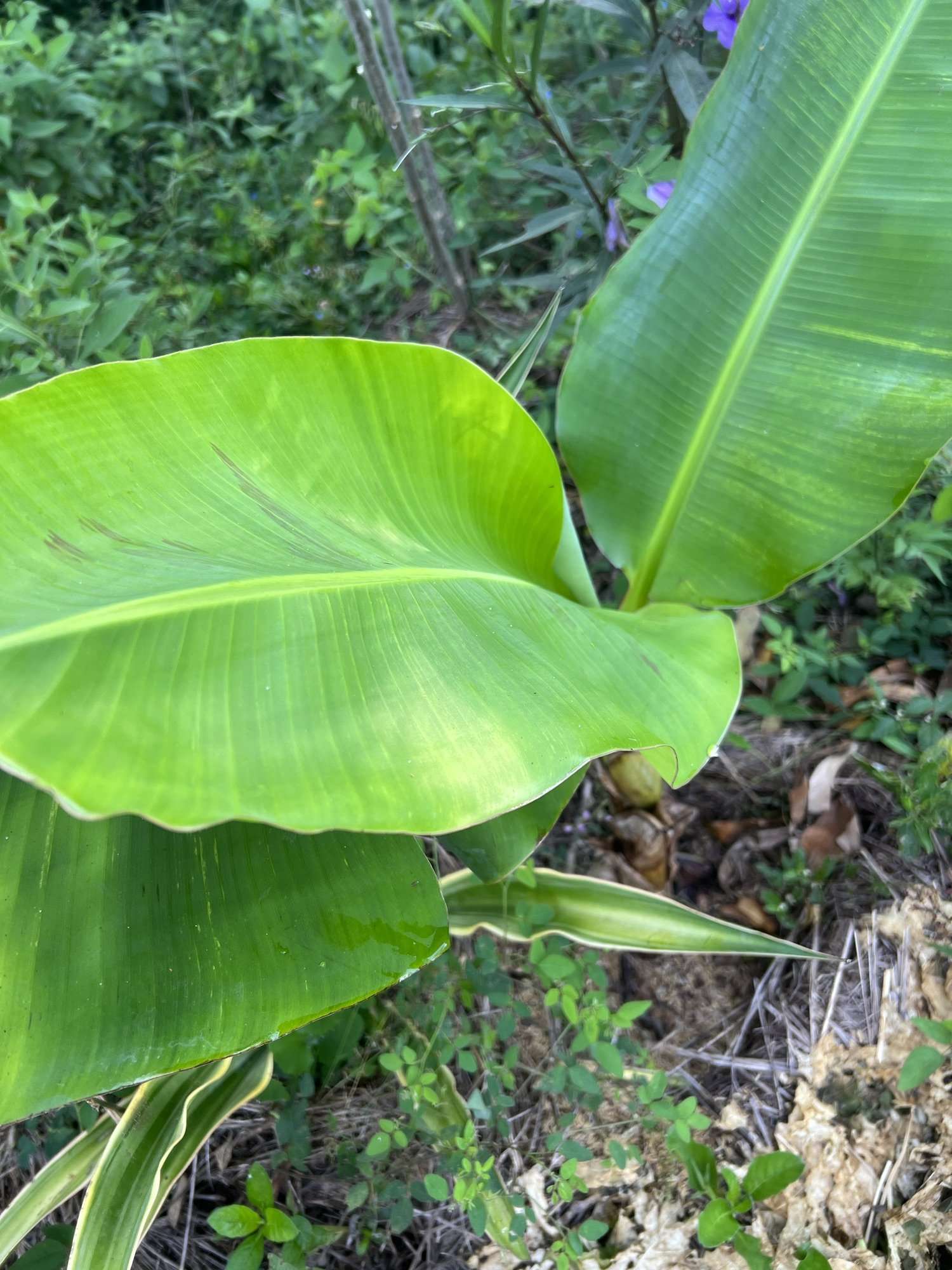
Mysteries of the universe

Many of us are fascinated by the conventional mysteries of the universe.

How old is it? Was there an actual “beginning”? Does it have an end? Will it end in heat death or does it pulse? What’s behind the observations we label “black matter” and “black energy”? Is there other life in the universe? Is it intelligent? Has it visited us? What happened to Mary Celeste? Does bigfoot exist? Will we have controlled fusion within the next ten years?

These are entertaining and – for most of us – relatively unthreatening topics.

THE MYSTERY WITHIN WHAT WE THINK WE UNDERSTAND AND KNOW

And yet, the mysteries of the universe go far beyond this.

Anything we collectively think we know are stories with limited and temporary validity.

And anything I personally think I know are stories with limited and temporary validity.

These are stories with a practical function only. They help us orient and navigate in the world. They cannot reflect any complete, final, or absolute truth. Reality is always more than and different from our stories about it.

There is a fundamental mystery even in what’s most familiar to us and what we think we know and understand.

And taking that in is, in some cases, difficult. We may struggle quite a bit before we open to the ultimate mystery within what we think we know and understand.

What are our most cherished stories about ourselves, others, and the world? They may include basic assumptions about the world and ourselves. For instance, the world is knowable. I am a being and object in the world. They may also include politics and ethics. People should be decent and fair. People shouldn’t destroy nature. Greed is bad. And they may include our ideas about our own life and other people. I am a victim. Something terrible happened to me. I am good. She is a bad person. He shouldn’t lie. Or even metaphysics. God is love. God is a being. God is all of existence.

THE MYSTERY OF WHAT WE ARE

There is also the mystery of our own nature, and the nature of reality.

What am I more fundamentally, in my own first-person experience? How is it to allow this human self to reorganize within that noticing? How is it to live from it, here and now?

Is what I find also the nature of existence in general?

ENTERTAINING VS CHALLENGING MYSTERIES

Lisa may enjoy the entertaining and relatively unchallenging mysteries of the universe.

But does she enjoy the ones that challenge her most cherished assumptions about herself, others, life, and the world?

How do we relate to those more fundamental mysteries?

Embracing diversity

I am listening to the audio version of Tove Jansson: Arbeide og Elske (Tove Jansson: Work and love), about the Finnish artist and author, including of the Moomin stories. 

One thing that strikes me is that she and others in her political and artistic circle seem to not only have strong views on art, society, and politics (which is healthy) but think that these views are exclusively right and other views are inherently wrong. 

I have always been puzzled by this. For me, there is beauty and necessity in the diversity of views, orientations, and preferences. That’s how the richness of our society and culture is created, it’s how we go outside of our own limited conditioning and learn to view things from other perspectives.

Collectively, it’s how we – as a society and species – can become more resilient and adaptable. Some of us may have insights and solutions that are just what we need in responding to new situations. And we cannot easily predict what this will be in advance.

For me, there is something of value in just about any view and orientation. Each reflects the experiences and background of some of us humans. They all fit into a bigger whole. I can learn something about humanity, the world, and myself from each of these views. And all of it reflects and mirrors something in me, and I can use it as a pointer to find it and get to know it in myself.

When it comes to art, there is obviously art I don’t quite resonate with or understand. And I am very happy if it resonates with someone else. Also, who knows, perhaps it will resonate with me in the future? It likely will if I take the time to explore it.

Why do some of us have a more inclusive orientation, while others take a more exclusive view? 

I can find both orientations in myself, as I assume we all can. In some areas, I am effortlessly more inclusive and value diversity (for instance, food), and in other areas, I may go into unexamined and fearful patterns and take a more judgmental and exclusive view.

If we take a mirror approach and use the diversity in the world to find our own inner diversity, then we tend to find a deeper appreciation of the diversity of the world. We know how to make use of it to get to know ourselves better and consciously embrace more of our own wholeness and diversity. The richness of the world becomes a way for me to find my own richness.

If we take an evolutionary perspective, we see that this diversity – in orientations, views, and preferences – is vital for our survival. Each view has something of value and together creates a richer collective repertoire for us to draw from. Faced with new collective challenges, some subgroups may have just what we need to adapt, survive, and thrive.

If we use our own views, orientations, and preferences to create an exclusive identity for ourselves, we’ll tend to feel we have to defend it, including through putting down and diminishing other views, orientations, and preferences. It becomes a small orientation. This too has its place. At the very least, it serves as a mirror for ourselves so we can find where and when we do the same. (Which we inevitably do or, at least, did.)

Tove Jansson and her friends lived in the last century. Perhaps this more inclusive view is more widespread and common today, at least among the more liberal segments of society. Perhaps

Note: I wrote this on my phone in the wilderness so it’s more flow-of-consciousness and less edited than it normally would be.

Read More

Is my true nature the true nature of all of existence?

Is my true nature the true nature of all of existence? This is a side to awakening that is interesting although it doesn’t have great practical importance for us at an individual level. I thought I would briefly revisit the topic here.

My true nature

Our true nature is capacity for the world, that which all our experiences happen within and as. The content of experience is the normal one – this human self, thoughts, emotions, sensations, the wider world, and so on. The awakeness here is the ordinary awakeness all conscious living beings have. The only thing that changes is that our true nature – this awake capacity – notices itself as all of it.

Since the world to us happens within and as what we are, it seems that the world has the same true nature as ourselves. It has to appear that way to us.

If I am honest, I cannot say that I know for certain that my true nature is the true nature of all of existence.

What are some of the features of our true nature? My true nature is capacity for the world. It’s awake. And it is – if it separates itself a bit from itself – conscious of itself. Those are three aspects that stand out.

The true nature of existence as a whole?

So what about existence as a whole? What can I say about it?

It seems that the true nature of humans is the same as mine, based on their reports. And I have to assume that the true nature of all beings is the same. It’s difficult to imagine it’s otherwise.

Beyond that, it seems that existence as a whole is capacity for itself. It has to be no-thing that’s filled with itself, otherwise, it wouldn’t exist.

Is it awake? Parts must be. In this universe, any conscious being is awake in this sense, whether their true nature notices itself or not. There may also be non-embodied beings that are awake. And yet, other parts may not be awake, like rocks. (When I say awake in this context, I just mean the ordinary awakenes of all conscious beings.)

Is the true nature of all of existence conscious of itself? No, that doesn’t seem to be the case. It is, locally, through some beings, perhaps through some non-embodied beings, and perhaps in a divine realm, but that may be about it.

Does it matter?

Does it matter whether my true nature is the true nature of all of existence?

Not really. It matters in the sense that it’s good to be honest about what we can say something about and what we are guessing or imagining. It also matters for physics and cosmology and our general worldview, although most mainstream physics and cosmology don’t (yet) address these questions. But in a practical sense for us as individuals living our lives in the world, it doesn’t matter so much.

Is all of existence consciousness?

This is a related question. Since my world happens within and as consciousness, it appears to me that all of existence is consciousness. But is it really? It’s a thorny question and I am not sure if I can say much about it, and it also depends on our definition.

We can say that the universe is the body of the divine, or the divine taking a physical form.

And we can, depending on our definition, say it’s consciousness that appears to us as matter and energy. But it’s not necessarily as a whole awake consciousness in the way consciousness is locally awake in and as living beings.

Summary

So locally, existence notices its true nature here and some other places. To me, the true nature of all of existence seems to be the same as my true nature since it happens within and as what I am. It seems that the true nature of all beings is the same as my own true nature. All of existence must be capacity for itself. It’s awake locally through beings in whatever form they take. And the true nature of existence is conscious of itself locally through and as some beings.

Energy healing, identity, and science

I discovered healing abilities in my mid-teens, used it occasionally with people close to me, and mainly kept it to myself. More recently, through Vortex Healing, I have done this type of healing more openly.

And although I know it works, and sometimes works well, it does rub up against some desired identities I have. I want to be seen as someone rooted in science, and I have often gone out of the way to explain what I am doing and interested in – meditation, inquiry, heart-centered practices, therapeutic tremoring etc. – in ways that are grounded, logcial, and fits with current science.

Energy healing, often done at a distance, cannot so easily be explained so it makes sense from a current mainstream view. To explain it, we have to bring in non-local connections, and perhaps all as essentially consciousness, or the divine.

Although this moderate identity crisis is a bit uncomfortable, I also know it’s good for me. It helps me see some identities I am still identified with and wish to hold onto. It helps me see where I limit myself, and where I hold onto unexamined beliefs.

Another side to this is that our mainstream worldview, and the content of our science, changes over time. In fifty or a hundred years, perhaps energy healing at a distance fits in with the current worldview and science. I wouldn’t be surprised, although I have no idea about the timeline. These shifts tend to happen when people cannot any longer deny the validity of what doesn’t fit the existing worldview, and that typically requires the accumulation of solid research over time.

Werner Heisenberg: Only a few know, how much one must know to know how little one knows

Only a few know, how much one must know to know how little one knows.

– Werner Heisenberg (1901 – 1976)

In one sense, we don’t need to know much to know how little we know.

We just need to know that our thoughts are questions about the world, educated guesses at most. They are practical tools to help us orient and navigate in the world. Their role is not to give us any final or absolute answers to anything.

And yet, to know that, we often need to wade through a great deal of worldly knowledge. We need to know a lot about different things and see that what we know is a tiny drop in the ocean of all there is to know, and also that what we think we know often isn’t as certain or valid as we thought. Even our most basic assumptions are up for question.

At a social level, this is especially clear when we learn about the history of thought, science, and worldviews, and we see how different it is across cultures and how much all of it changes over time. What we take as a given today – about specifics and our worldview as a whole – will be seen as obsolete by future generations.

There is a shortcut to realizing how litte we know, and that is to examine our thoughts more directly. We can see how our mental “field” creates an overlay of images on the world and makes up what we think we know about ourselves, others, and the world. It’s all created in our own mind. None of it is “out there” inherent in anything. It’s all just questions about the world. None of it contains any final or absolute truth.

If we rely on knowing things to feel safe or loved or good about ourselves, then this can seem distressing. But, in reality, this realization and noticing is immensely freeing.

We get to see thoughts more as they are, and we get to see their role and function and what they can do – which is to provide some provisional and practical orientation and guidance, and what they cannot do – which is to provide any truths or final answers.

That goes for what we collective think we know and understand about the world. It applies to our personal lives and what we think we know about others, situations, and ourselves. And it applies to our most basic assumptions about existence.

My larger body

Some statements are often seen as poetic or romantic, but in this case, it’s a literal reality.

My larger body is nature and society. My larger body is this planet. My larger body is this solar system and universe.

My existence as a human being depends 100% on this larger body for its existence and survival. The only boundaries between this human self and the larger whole is imagined, and invested with reality only by our minds.

This is very real from a ordinary material and scientific point of view.

And going beyond that, as what I am – what all experience happens within and as – it’s all what I am.

It may seem a romantic or hippyish notion, but it has very real consequences for how we live our lives.

If I see myself as a human being mostly separate from the larger whole, I’ll act accordingly. I’ll act as if the health and well being the larger social and ecological systems matters little for my own health and well being. I’ll tend to act from a short term and narrow perspective. I’ll tend to act in a way that’s – intentionally or not – harmful for the larger whole. And we create our societies, social systems, and worlviews to reflect this. We’ll use economic models that assume that the health and well being of the larger whole doesn’t really matter. We’ll create transportation systems, production systems, food systems, water systems, energy systems, and more that reflect this world view. And we’ll reap the consequences individually and collective. That’s what we see today with a growing awareness of the consequences of toxins in our air, land, and water, diminishing ecosystems, and climate change.

If I see the larger social and ecological systems as my larger body, my view and actions will be different. I’ll act from a longer term and larger perspective. I’ll seek solutions that benefits myself as well as the whole. And we’ll collective use worldviews and systems that reflect this reality and this desire to support life at all levels.

If I see the solar systema and universe as my larger body, I’ll tend to experience a deep and profound sense of belonging and meaning. As Carl Sagan said, we are the local eyes, ears, thoughts, and feelings of the universe. We are the universe bringing itself into conscious awareness.

Of course, this has to be a lived reality for us. It may become a living reality through natural adult maturation and development. It may happen if we live in a society or group where this is a mainstream view. And it can happen through education and experiences such as the Practices to Reconnect by Joanna Macy.

I am aware that I am using the word “reality” here and it’s not really that. It’s a perception. An experience. A worldview. But “reality” works as a shorthand even if it’s not that precise.

Read More
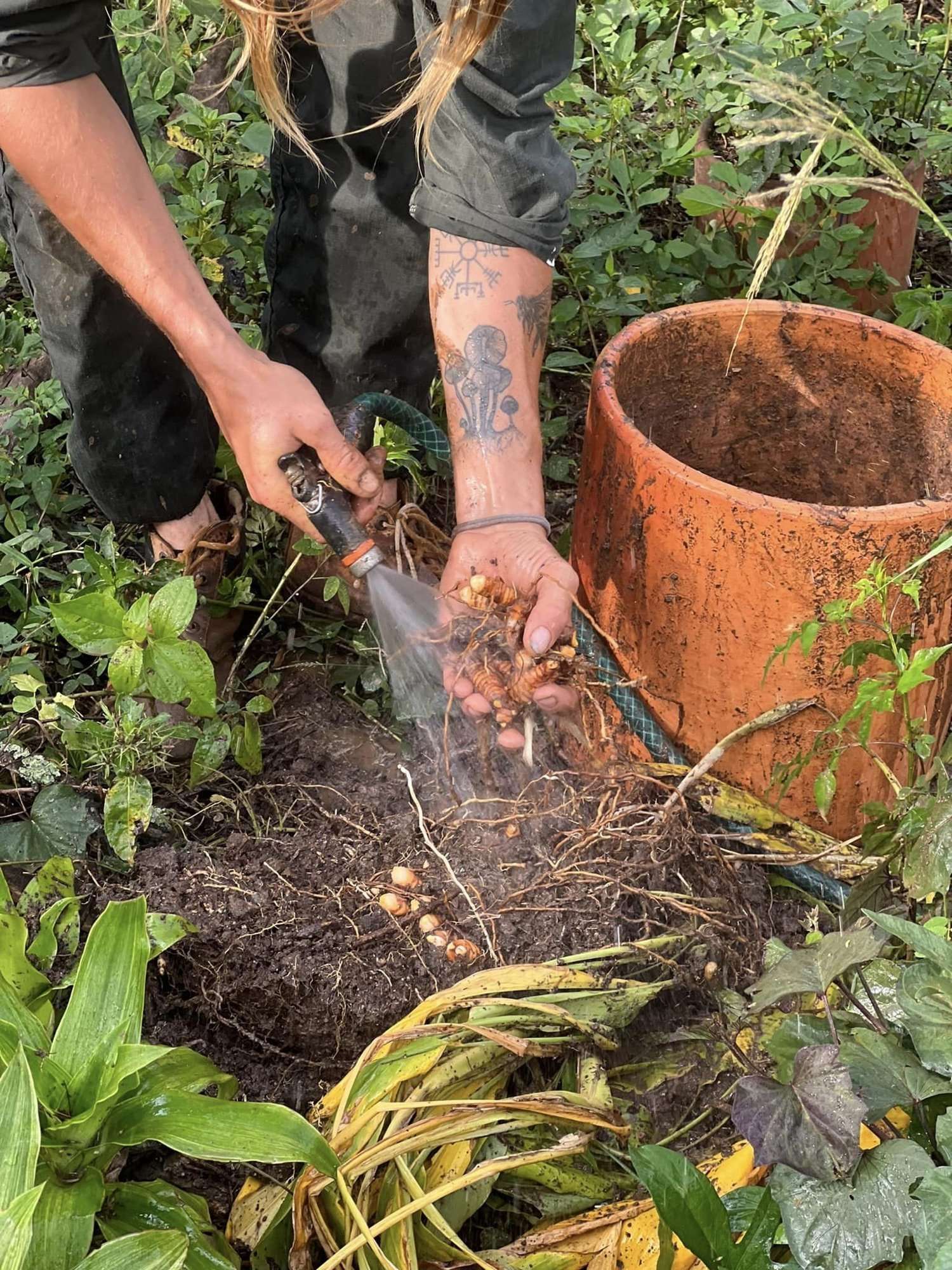
Healing, Awakening & Sustainability = aligning with reality

Healing, awakening, & sustainability. As shines through what I wrote above, healing, awakening and sustainability are all about aligning with reality. That’s why the three – for me – are inseperable. The seeds of dis-ease, an unawakened experience, and a society out of tune with the larger living world, are all the same. And the basic remedy is the same as well – align with life and reality.

For healing, we can align through inquiry, TRE, Breema, yoga, meditation and more. For awakening, we can align through inquiry, meditation, prayer, and more (whatever helps us ripen). For sustainability, we can align with life through philosophical and economic frameworks that takes ecological realities into account (which none of the current mainstream ones do), and a generally worldview that does the same.
This is from a previous post where I wrote mostly about healing and awakening, and added sustainability as an afterthought. So I thought I would write a briefer post here about the three as equals.
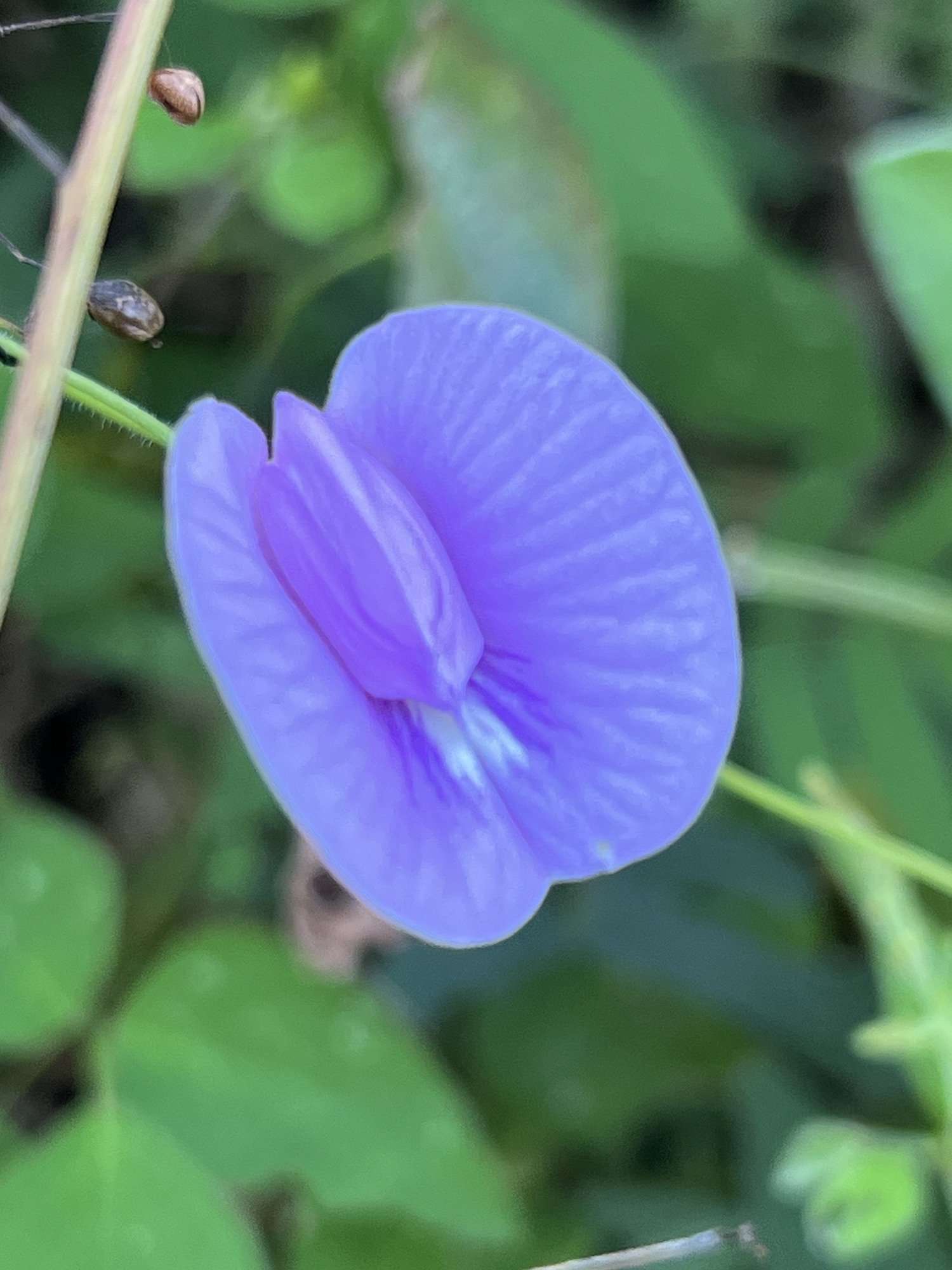
Healing, awakening, and sustainablity all have to do with aligning with reality.

Healing is here healing of the mind, and we do so by questioning stressful and debilitating thoughts and finding what’s more true for us. When we look closely, my experience and the experience of others, is that we find something that’s genuinely more true for us than the initial thought that’s also very healing. (The Work.) Or we may find that thoughts that seemed real and substantial because they had a charge (associated with sensations) now have less or no charge. They are recognized as a thought, and comes with less or no stress. (Living Inquiries.)

Awakening similarly comes from seeing what’s more real than our initial experience and assumptions. Consciousness takes itself as (a) a being (b) that’s separate from everything else, and that comes from a deeply ingrained thought helds as true. When consciousness starts to align more with reality, it recognizes itself as all there is, and the local being as happening within and as itself. The being doesn’t go away, and doesn’t really need to change. The only change is a shift of what consciousness takes itself to be. And just as with healing and maturing, this is an ongoing process.

Sustainability has to do with aligning our worldviews and all our philosophies, frameworks, and systems with ecological realities. To the extent our views and how we organize ourselves – individually and collectively – is aligned with life, we have a sustainable life and society. Right now, we are quite far from this.

Our current mainstream worldviews and frameworks (for economy, industry, transportation, energy, waste etc.) are set up as if our wider ecological systems didn’t exist. This means they are inevitably unsustainable. Even our current mainstream attempts of sustainability are done within this mental and physical framework and are not anywhere close to being really sustainable.

We do have a wide range of good replacements of these views and systems, and real-life examples of how we can organize ourselves collectively and live our lives. We just need to chose to implement them. And that will come. It has to come, at least if we come to our senses and wish for our civilization to continue.

It may seem that our only choice is between real sustainability or collapse of civilization as we know it. But there is also a(n unsatisfactory) middle ground where we have a partial collapse, a loss of a good number of people, and an attempt to build up again from there.

Reality is kind & ruthless. In each of these three areas, reality waits for us and shows us when we are off. It’s kind in that sense. And also ruthless if we don’t get it.

Why not all three? Why do some chose to focus on only one or two of these, when they so obviously are intertwined? I don’t know. It may have to do with personal inclination and interest, or perhaps just wanting to specialize.

Symbiotic. For me, there is a symbiotic relationship between healing, awakening, and sustainability. The seed problems and solutions are the same in each of these areas. There is a great deal of room to explore how patterns in one area is transferable to another, offering new insights and ways of working with it. I assume we’ll see much more of this in the future.

My worldview

A friend of mine is interviewing me within a couple of weeks to determine my level of maturity or adult development…! It’s part of his certification using the work of Robert Keegan.

It made me reflect a bit on what my worldview is. In some ways, it hasn’t changed much since the dust had settled from the initial opening in my mid-teens. And in other ways, more in the details, it must have changed – or matured – some. Here are some essays I wrote which reflect my teens/early twenties view on – or rather experience of – the world.

Here are some highlights of how I experience/view the world these days.

Lila. Life is existence expressing, exploring, and experiencing itself in always new ways. Or we could call it God, Brahman, Buddha Mind, Big Mind, Spirit, Allah, or whatever word you prefer for the divine, or life, or existence. It’s all the play of the divine.

I experienced it this way very clearly in the initial opening, and many years later learned it’s called Lila in sanscrit. There is nothing new under the sun, at least not when it comes to our perception or understanding of basic reality.

Integral view. When it comes to maps, I have been drawn to Ken Wilber’s integral maps and framework for understanding the world. It makes a lot of sense of me, and did even back in my teens and early twenties. I typically don’t refer to it explicitly, but it’s there informing how I mentally map things.

View and perspectives. These are ways to mentally understand and map the world. In the best case, they help us navigate and function in the world. And the drawback is that it’s easy for us to take them as some absolute and final truth, and that tends to create stress and distress.

A thought is the same as a view or perspective, and there is some truth to just about all of them – if we look for it. The type of validity or truth may vary, and it’s helpful to learn to sort these as best and honestly as we can.

Physical matter. Matter is – to us – an experience. It’s sensory input with an overlay of thought telling us what it is. As anything else, it’s “unfindable” in any final or absolute sense. We can say it’s an experience in awareness which is awareness itself, and awareness too is really “unfindable”.

And yet, ideas of matter and awareness can be very helpful in helping us orient and function in the world. If they are recognized as ideas and held lightly, they are even more helpful.

Awareness. Any content of experience is happening within and as awareness, or awakeness, or consciousness, or Spirit. It’s what we are expressing, exploring, and experiencing itself. It’s real in that it’s a real experience. At the same time, it may not be as real or substantial as it initially appears.

Physical senses. The diversity of lifeforms – perhaps including life other places in the universe – allows life to express, explore, and experience itself in a rich and always changing and evolving way.

The different Earth species is Earth and life expressing, exploring, and experiencing itself in a rich and changing way, through different physical senses and different perceptions.

Earth. Earth is a living and evolving system. Everything “on” Earth is part of the living Earth and this living system, including humans – and our consciousness, culture, society, technology, hopes and dreams, and everything else that’s part of human experience.

We are a part of Earth, we are the Earth’s local eyes, ears, senses, and awareness (to paraphrase Carl Sagan). Our experience is, in a literal sense, the local experience of Earth. And the local experience of the universe, and life, and Existence, and Spirit.

Read More